Blogs
At Brown Packaging, we provide insightful content about the packaging industry to keep our clients, followers, and partners informed with the latest trends and accurate information. Our goal is to equip you with up-to-date knowledge that helps you stay ahead in the ever-evolving world of packaging.

Holiday returns cost retailers billions each year, with packaging failures being a major driver. Damaged goods, oversized boxes, and poor protection lead to dissatisfied customers and costly reverse logistics. For packaging buyers, engineering better holiday packaging is one of the most effective ways to reduce returns and protect profit margins. Why Returns Spike During the Holidays High order volumes: More packages mean more opportunities for failure. Rushed fulfillment: Mistakes in packing increase product damage. Fragile products: Gifts like electronics and glassware need extra care. Customer expectations: Shoppers expect pristine deliveries for gifting. Packaging Strategies to Reduce Returns Right-size design: Prevents product shifting and dimensional weight charges. Protective inserts: Foam, molded pulp, or corrugated dividers secure fragile items. Durability upgrades: Double-wall corrugated for heavy or bulk SKUs. Moisture resistance: Coatings or liners protect against winter weather. Clear labeling: “This Side Up” and handling icons reduce rough handling. The Role of Testing in Return Reduction Packaging validation ensures boxes survive real-world conditions: Compression testing for stacked trailers. Drop testing for rushed warehouse handling. Vibration testing for long-haul shipping. Testing reduces the risk of repeat failures that erode consumer trust. Balancing Cost and Protection Not all SKUs need the same level of packaging reinforcement. Buyers should prioritize: High-value and fragile products. SKUs with past return issues. Items that ship long distances or through multiple carriers. Holiday Packaging Solutions with Brown Packaging Brown Packaging helps brands reduce holiday returns through smarter packaging design and testing. From right-sizing to reinforced corrugated and protective inserts, our solutions protect products and profitability. Contact us to strengthen your holiday packaging program. References International Safe Transit Association (ISTA). (2022). Test Procedures for Packaged Products in Transit.UPS. (2023). Peak Season Returns and Reverse Logistics Report. Retrieved from https://www.ups.comSoroka, W. (2009). Fundamentals of Packaging Technology (4th ed.). Institute of Packaging Professionals. (714)300-0650 request@brownpackaging.com Most Recent Posts: Categories: Corrugated Ecommerce ESD Design Display Flexible Packaging Foam Folding Carton Packaging Plastic Packaging Pouch Printing Protection Retail Rigid Box Thermoform Sustainability Subscribe To Our Newsletter Ecommerce Packaging By submitting your information, you agree to our terms and conditions and privacy policy. Facebook Twitter LinkedIn Pinterest Relevant Posts

Unboxing has become a core part of the e-commerce experience, especially during the holidays. Seasonal packaging creates anticipation, reinforces branding, and turns customer deliveries into memorable moments. For packaging buyers, custom boxes offer the opportunity to elevate holiday campaigns while maintaining durability and efficiency in high-volume shipping. Why Holiday Unboxing Matters Customer experience: Shoppers view packaging as part of the gift. Social sharing: Festive unboxing encourages online engagement. Brand reinforcement: Seasonal graphics differentiate products in crowded markets. Repeat business: Memorable packaging builds loyalty beyond the holidays. Design Considerations for Custom Boxes Holiday boxes must balance branding with protective strength. Substrate selection: Corrugated mailers and folding cartons with seasonal graphics. Printing options: Digital and flexographic printing for custom runs. Right-sizing: Boxes tailored to SKU dimensions for better protection. Inserts: Custom dividers or trays secure products while enhancing presentation. Balancing Branding and Efficiency Customization should not come at the expense of supply chain performance. Buyers should consider: Production lead times: Seasonal runs require early planning. Freight optimization: Compact designs reduce shipping costs. Sustainability: Choose recyclable substrates and eco-friendly inks. Examples of Holiday Custom Packaging Subscription boxes: Festive graphics with recyclable inserts. Premium gifts: Rigid boxes with seasonal foil accents. E-commerce mailers: Printed corrugated with holiday messaging inside and out. Holiday Packaging Solutions with Brown Packaging Brown Packaging designs custom boxes that make holiday unboxing unforgettable. From seasonal graphics to structural inserts, our solutions balance branding with performance. Contact us to create packaging that delivers both joy and protection. References Soroka, W. (2009). Fundamentals of Packaging Technology (4th ed.). Institute of Packaging Professionals.Sustainable Packaging Coalition. (2022). Design for Recyclability Guidelines. Retrieved from https://sustainablepackaging.orgShopify. (2023). Holiday Packaging Trends and Consumer Expectations. Retrieved from https://www.shopify.com (714)300-0650 request@brownpackaging.com Most Recent Posts: Categories: Corrugated Ecommerce ESD Design Display Flexible Packaging Foam Folding Carton Packaging Plastic Packaging Pouch Printing Protection Retail Rigid Box Thermoform Sustainability Subscribe To Our Newsletter By submitting your information, you agree to our terms and conditions and privacy policy. Ecommerce Facebook Twitter LinkedIn Pinterest Relevant Posts

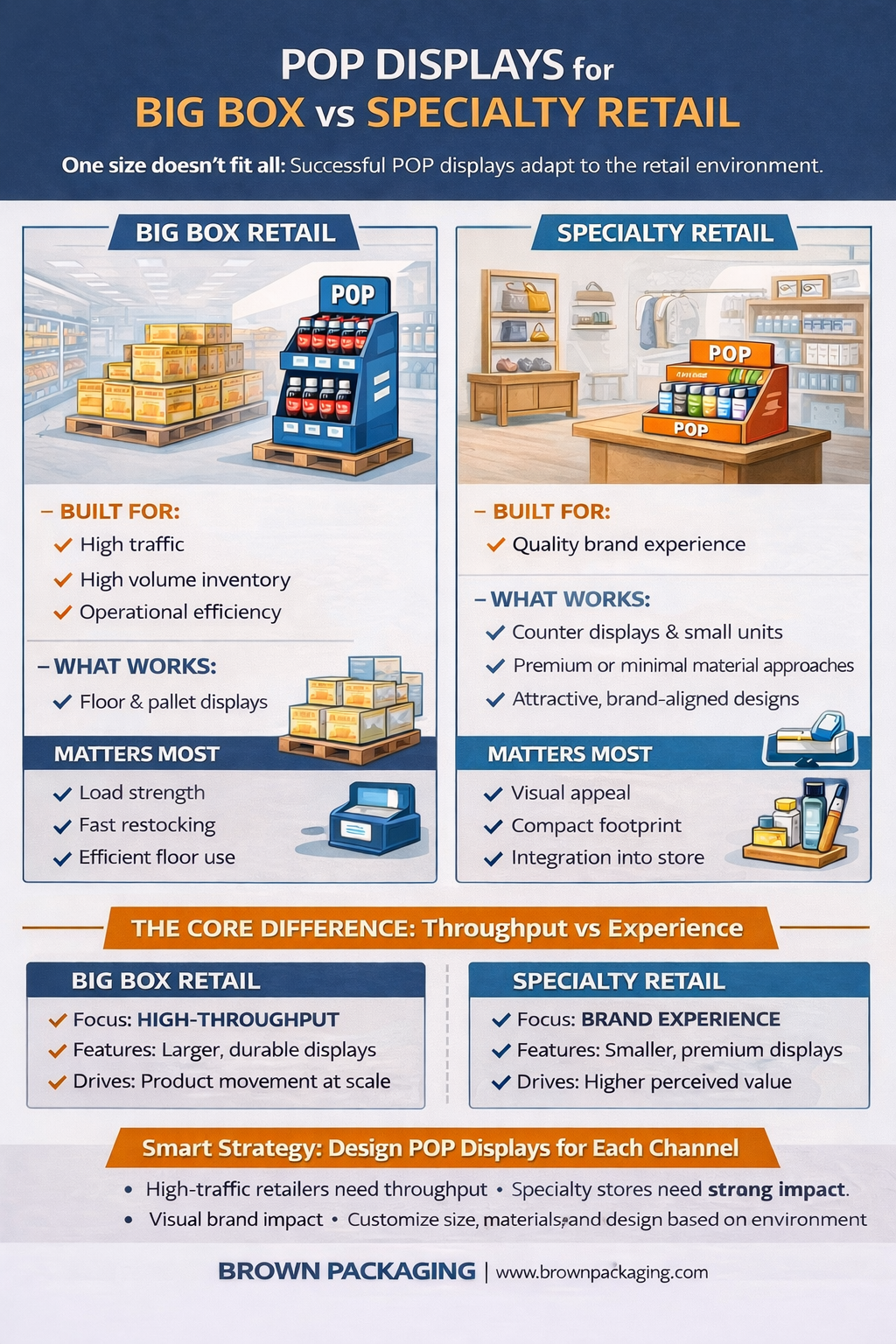
Club stores such as Costco, Sam’s Club, and BJ’s Wholesale represent unique opportunities for brands. These high-traffic environments demand large-format point-of-purchase (POP) displays that deliver maximum visual impact while meeting strict retailer specifications. A successful club store display must balance branding, strength, and compliance to protect margins and attract attention in busy aisles. Unique Challenges of Club Store Displays Unlike standard retail, club stores have wider aisles, bulk packaging, and larger average purchase volumes. POP displays must adapt to: High visibility demands: Displays must stand out from a distance. Heavy product loads: Larger packs and bulk SKUs require stronger structures. Extended campaigns: Displays often stay on floors for weeks or months. Strict compliance standards: Club stores enforce precise guidelines for footprint, height, and pallet integration. Structural Design Requirements Club store POP displays often sit directly on pallets, making strength and stability critical. Engineering considerations include: Pallet fit: Displays must align with 40×48 pallets for handling and stacking. Load capacity: Designs must withstand heavy unit loads without sagging. Durability: Reinforced edges and coatings resist wear over extended campaigns. Ease of setup: Displays should arrive pre-packed or require minimal assembly. Graphics for Club Store Impact Graphics in club stores need to be bold and easily legible from a distance. Subtlety is lost in large-format retail environments. Oversized branding: Large logos and product imagery capture attention. Simple messaging: Short, benefit-driven text is more effective than detail-heavy designs. 360-degree visibility: Graphics should appear on all sides for maximum exposure. Best Practices for Club Store POP Displays Design for pallet integration and warehouse handling. Use double- or triple-wall corrugated for strength when needed. Apply protective coatings to extend floor life. Coordinate with graphics teams to simplify high-visibility messaging. Club Store Display Solutions with Brown Packaging Brown Packaging engineers POP displays designed to meet club store demands. From pallet-ready bulk displays to reinforced seasonal promotions, we balance branding with compliance to ensure success in high-traffic environments. Contact us to discuss club store display solutions. References Shop! Association. (2021). Best Practices for In-Store Marketing and POP Displays. Retrieved from https://www.shopassociation.orgSoroka, W. (2009). Fundamentals of Packaging Technology (4th ed.). Institute of Packaging Professionals.Costco Wholesale. (2023). Merchandising Guidelines for Vendors. (714)300-0650 request@brownpackaging.com Most Recent Posts: Categories: Corrugated Ecommerce ESD Design Display Flexible Packaging Foam Folding Carton Packaging Plastic Packaging Pouch Printing Protection Retail Rigid Box Thermoform Sustainability Subscribe To Our Newsletter By submitting your information, you agree to our terms and conditions and privacy policy. POP Display Facebook Twitter LinkedIn Pinterest Relevant Posts

Point-of-purchase (POP) displays play a dual role in retail environments: they must capture attention with graphics while supporting products with reliable structure. If one side is overemphasized, the other suffers—eye-catching graphics on a weak structure can lead to product collapse, while overbuilt displays with poor graphics fail to drive sales. Successful POP design requires careful coordination between visual branding and engineering strength. The Role of Graphics in POP Displays Graphics carry the brand message and attract consumer attention in crowded retail aisles. Effective use of color, typography, and imagery transforms a standard corrugated display into a compelling marketing tool. Reinforces brand identity. Highlights product features or promotions. Differentiates products from competitors on the same shelf. However, graphics must be placed with consideration of die lines, folds, and assembly points. A design that looks strong in concept may lose effectiveness if critical elements are cut or hidden during production. Structural Integrity and Functionality The best POP display design balances aesthetics with durability. Structural engineering ensures the display holds weight, withstands handling, and complies with retailer requirements. Load-bearing capacity: Displays must hold multiple units without sagging. Assembly efficiency: Designs should be easy to set up in stores. Retail compliance: Dimensions must fit within chain-specific guidelines. Ignoring structure risks costly failures on the retail floor, from leaning displays to complete collapse. Achieving Balance Between Graphics and Structure Collaborative design: Graphic and structural designers should work together from concept through prototype. Testing in real-world conditions: Simulate load, handling, and lighting before production. Material selection: Choose board grades and coatings that allow high-quality print while maintaining rigidity. Print-to-structure alignment: Ensure graphics align with folds, cutouts, and SKU placement. Industry Examples Club stores: High-traffic environments demand bold graphics paired with strong pallet displays. Seasonal promotions: Graphics drive excitement, but structural resilience ensures displays last through extended campaigns. Cross-merchandising displays: Must hold different SKUs securely without compromising print impact. POP Display Solutions with Brown Packaging At Brown Packaging, we engineer POP displays that balance structural integrity with brand-forward graphics. From retail-ready pallet displays to seasonal floor stands, our team ensures your design attracts attention without sacrificing performance. Contact us to start planning your next POP display. References Soroka, W. (2009). Fundamentals of Packaging Technology (4th ed.). Institute of Packaging Professionals.Shop! Association. (2021). Best Practices for In-Store Marketing and POP Displays. Retrieved from https://www.shopassociation.orgASTM International. (2022). ASTM D642: Standard Test Method for Determining Compressive Resistance of Shipping Containers. (714)300-0650 request@brownpackaging.com Most Recent Posts: Categories: Corrugated Ecommerce ESD Design Display Flexible Packaging Foam Folding Carton Packaging Plastic Packaging Pouch Printing Protection Retail Rigid Box Thermoform Sustainability Subscribe To Our Newsletter By submitting your information, you agree to our terms and conditions and privacy policy. POP Display Facebook Twitter LinkedIn Pinterest Relevant Posts

Point-of-purchase (POP) displays must catch a shopper’s eye while also moving efficiently through the supply chain. Striking the right balance between visual impact and logistics ensures displays drive sales without creating costly inefficiencies. A design that leans too far toward graphics may ship poorly, while one built only for logistics risks blending into the background. The Role of Visual Impact Graphics and structure are central to a display’s retail performance. Visual impact drives traffic and communicates the brand message at a glance. Bold colors and large product imagery attract attention. Clean layouts improve readability in busy aisles. Seasonal themes and promotions build urgency. Without strong branding, even the most efficient display may fail to engage shoppers. Logistics Demands in POP Displays Retailers expect displays that not only sell but also ship and set up efficiently. Logistics considerations include: Cube efficiency: Displays should maximize pallet and trailer space. Durability: Strength to withstand transit and handling. Ease of assembly: Retail staff need quick setup without extra labor. Compliance: Dimensions must meet retailer guidelines for footprint and safety. Strategies to Balance Both Sides Collaborative design: Structural and graphics teams work together from the start. Prototype testing: Confirm visual alignment and shipping durability before production. Material selection: Choose corrugated grades that allow high-quality print and strength. Right-size graphics: Design branding that adapts to fold lines and pallet constraints. Examples of Balanced POP Designs Club store pallet displays: Large branding surfaces combined with pallet-ready engineering. Seasonal promotions: Bold graphics with lightweight, compact shipping formats. Cross-merchandising units: Multi-SKU designs that showcase brands while stacking efficiently. POP Display Solutions with Brown Packaging Brown Packaging creates POP displays that deliver both retail impact and supply chain efficiency. Our designs maximize brand presence while meeting freight, compliance, and setup demands. Contact us to explore display options that balance impact with logistics. References Shop! Association. (2021). Best Practices for In-Store Marketing and POP Displays. Retrieved from https://www.shopassociation.orgSoroka, W. (2009). Fundamentals of Packaging Technology (4th ed.). Institute of Packaging Professionals.ASTM International. (2022). ASTM D685: Standard Practice for Conditioning Paper and Paper Products for Testing. (714)300-0650 request@brownpackaging.com Most Recent Posts: Categories: Corrugated Ecommerce ESD Design Display Flexible Packaging Foam Folding Carton Packaging Plastic Packaging Pouch Printing Protection Retail Rigid Box Thermoform Sustainability Subscribe To Our Newsletter By submitting your information, you agree to our terms and conditions and privacy policy. POP Display Facebook Twitter LinkedIn Pinterest Relevant Posts

High-speed automated packaging lines can run hundreds of cartons per minute, but only if the carton’s design and material are optimized for smooth feeding, folding, and sealing. Small structural or material missteps can lead to jams, misfeeds, and costly downtime. This guide covers the critical design, tolerance, and substrate considerations for folding cartons intended for high-speed automation. Dimensional Accuracy Automated lines demand tight dimensional control in die cutting. Die Cut Precision: Carton blanks must be within ±0.015 inches for consistent feeding and folding (Soroka, 2014). Blank Squareness: Even minor skew can cause issues with glue flap alignment or panel folding. Caliper Consistency: Variations in board thickness can change fold behavior and sealing pressure. Scoring and Creasing Profiles High-speed folding relies on scores that create predictable, repeatable folds. Score Depth and Bead Width: Too shallow causes spring-back; too deep risks cracking. Bead/Channel Ratio: Must match board caliper and fiber composition for clean folding at speed. Grain Direction: Scores parallel to grain can crack if bead pressure isn’t optimized. Glue Flap Design Flap dimensions and positioning are critical for automated glue application. Flap Width: Minimum 10–12 mm recommended for cold glue; narrower flaps risk bond failure. Glue-Free Zones: Essential near scores to prevent squeeze-out during folding. Coating Considerations: Gloss varnish or film lamination in glue areas requires corona treatment or glue type adjustment for proper adhesion. Material Selection Not all boards perform equally on automated lines. SBS: Smooth feeding, excellent fold consistency, best for high-graphic retail cartons. CUK: Added stiffness and moisture resistance for cold chain or beverage applications. FBB/Recycled: Economical, but may need adjusted scoring to reduce cracking at speed. Folding Sequence Compatibility Structural design must align with the machine’s folding sequence. Tuck End Cartons: Ensure flap lengths are balanced to avoid collision in the folding belts. Auto-Bottom Designs: Verify glue flap and lock panels don’t bind during machine erection. Full Seal End: Flap lengths and bevel angles must accommodate sealing jaws without interference. Surface Coatings and Friction Carton surfaces influence how blanks travel through feeders and conveyors. High Gloss Coatings: Can cause feeding slippage; mitigated with anti-slip varnish zones. Poly Coatings: Increase stiffness but may alter fold memory—test for score cracking before production. Matte Varnish: Generally more forgiving in high-speed feeders. Machine Trials and Prototyping Before committing to a production run: Run on the Target Machine: Testing on actual equipment verifies compatibility. Check Across Speed Range: A carton may run well at 100 cpm but fail at 300 cpm. Inspect Post-Run Samples: Look for misaligned folds, glue squeeze-out, or score fractures. References Soroka, W. (2014). Fundamentals of packaging technology (5th ed.). Institute of Packaging Professionals. ISBN: 978-1-930268-37-2 Twede, D., & Goddard, R. (2021). Cartons, crates and corrugated board: Handbook of paper and wood packaging technology (2nd ed.). DEStech Publications. ISBN: 978-1-60595-120-5 (714)300-0650 request@brownpackaging.com Most Recent Posts: Categories: Corrugated Ecommerce ESD Design Display Flexible Packaging Foam Folding Carton Packaging Plastic Packaging Pouch Printing Protection Retail Rigid Box Thermoform Sustainability Subscribe To Our Newsletter By submitting your information, you agree to our terms and conditions and privacy policy. Custom Folding Cartons Facebook Twitter LinkedIn Pinterest Relevant Posts

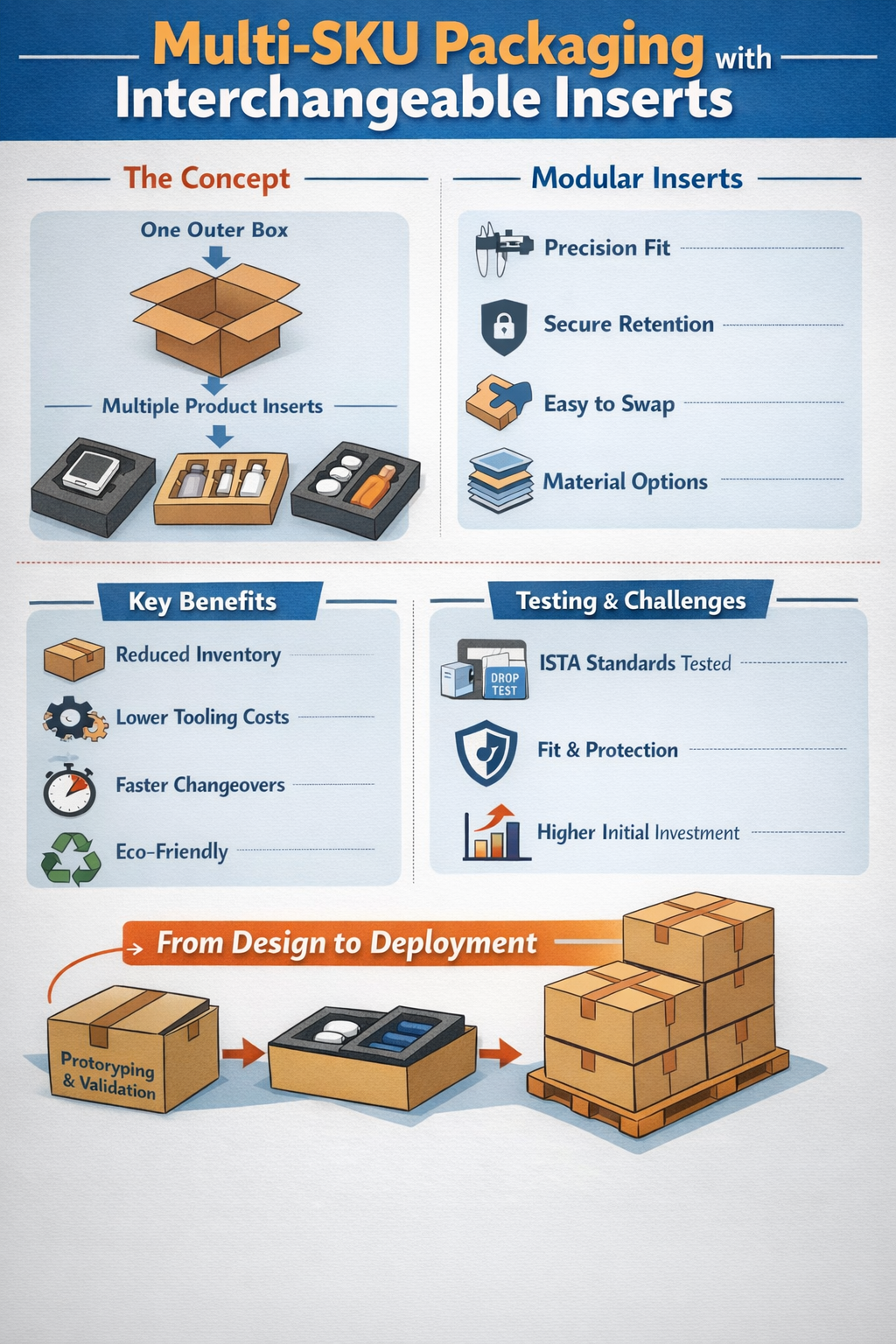
Foam-in-corrugated hybrid inserts combine the cushioning properties of foam with the structural rigidity of corrugated board, creating a packaging solution that is both protective and adaptable. This design approach is particularly useful in industries where precision fit and shock absorption are critical, such as electronics, medical devices, and high-value industrial components. Why Combine Foam and Corrugated? Corrugated offers structural stability, vertical stacking strength, and a printable surface for branding or instructions. Foam provides vibration dampening, energy absorption during impact, and surface protection against scratches or abrasions. When integrated, these materials address a broader range of performance requirements than either could alone. Material Selection The choice of foam type—such as polyethylene (PE), polyurethane (PU), or expanded polystyrene (EPS)—should be driven by product fragility, weight, and storage conditions. PE foam, for example, excels in repeated compression recovery, making it suitable for reusable inserts. Corrugated board grades (e.g., single-wall B-flute vs. double-wall BC-flute) must be matched to anticipated stacking loads and compression requirements. Bonding Methods and Compatibility Adhesive selection is critical. Water-based adhesives can warp corrugated under high humidity, while hot-melt options may degrade certain foam chemistries. Mechanical retention methods, such as die-cut lock tabs or slotted cavities, can reduce adhesive usage and improve recyclability. Engineering Fit and Tolerance Control Foam compression should be engineered to 10–30% deflection under typical product weight to balance retention and ease of removal. Corrugated cutouts must account for foam expansion and any dimensional variation due to manufacturing tolerances. Overly tight fits can cause stress concentrations, while loose fits reduce protection efficiency. Shock and Vibration Performance ASTM D1596 testing can determine the foam’s cushioning curve, ensuring the hybrid insert meets drop-test performance requirements. Corrugated structure should be verified under ASTM D642 compression testing to confirm stacking safety in transit and storage. Sustainability Considerations Designing with minimal adhesive, using water-based inks for print, and specifying recyclable PE foams can increase end-of-life recyclability. An emerging approach is designing separable components so the foam and corrugated can be easily disassembled for proper recycling streams. References American Society for Testing and Materials. (2019). ASTM D1596-14: Standard Test Method for Dynamic Shock Cushioning Characteristics of Packaging Material. https://doi.org/10.1520/D1596-14American Society for Testing and Materials. (2015). ASTM D642-15: Standard Test Method for Determining Compressive Resistance of Shipping Containers. https://doi.org/10.1520/D0642-15Soroka, W. (2016). Fundamentals of Packaging Technology (5th ed.). Institute of Packaging Professionals.Kistler, S. F., & Schweizer, P. M. (Eds.). (2013). Liquid Film Coating: Scientific Principles and Their Technological Implications. Springer. https://doi.org/10.1007/978-94-011-4942-0 (714)300-0650 request@brownpackaging.com Most Recent Posts: Categories: Corrugated Ecommerce ESD Design Display Flexible Packaging Foam Folding Carton Packaging Plastic Packaging Pouch Printing Protection Retail Rigid Box Thermoform Sustainability Subscribe To Our Newsletter By submitting your information, you agree to our terms and conditions and privacy policy. Custom Packaging Facebook Twitter LinkedIn Pinterest Relevant Posts

Board caliper—the thickness of paperboard—directly influences carton strength, folding behavior, print quality, and cost. Selecting the right caliper is a balancing act between performance requirements and budget. This guide explains how caliper affects carton engineering and when it makes sense to go thicker—or thinner. Defining Board Caliper Board caliper is measured in thousandths of an inch (points) or millimeters. Common folding carton calipers range from 0.012″–0.024″ (12–24 pt). Thicker boards offer greater rigidity and stacking strength, while thinner boards reduce weight and material cost. Structural Performance Compression Strength: Higher caliper increases edge crush resistance and stacking load capacity. Panel Rigidity: Reduces bowing and warping, important for large-panel cartons. Impact Resistance: Added thickness absorbs more shock during handling. Trade-Off: Excess caliper can over-spec the package, adding unnecessary cost and complicating folding on small-radius scores. Folding and Creasing Caliper affects how the board behaves at fold lines: Tighter Radii: Thicker boards need deeper scores to avoid spring-back. Score Cracking Risk: Increases with caliper if scoring isn’t adjusted for bead/channel ratio. Grain Direction Sensitivity: More critical in thicker boards—incorrect grain can cause severe cracking. Print Quality and Surface Smoothness Ink Holdout: Heavier calipers often provide better ink laydown, but fiber quality matters more than thickness alone. Show-Through Prevention: Thicker boards reduce show-through from dark products or graphics on the reverse side. Cost Implications Material Cost: Increases proportionally with caliper. Shipping Weight: Higher caliper increases per-unit mass, affecting freight cost. Storage Volume: Larger stacks and more pallet space required. Optimization Tip: Use the thinnest caliper that meets performance requirements—extra thickness adds cost with no functional benefit. Application Examples High-Strength Needs: 20–24 pt CUK for beverage carriers or frozen food requiring moisture resistance and stacking strength. Premium Branding: 18–20 pt SBS for cosmetics or electronics, balancing rigidity with a smooth print surface. Cost-Driven Retail: 14–16 pt recycled FBB for dry food or lightweight multipacks. Testing Before Scaling Prototyping: Test multiple calipers for rigidity, folding performance, and visual appeal. Distribution Simulation: Run compression, vibration, and humidity testing to confirm performance. Machine Compatibility: Thicker boards may require slower speeds or equipment adjustments. References Soroka, W. (2014). Fundamentals of packaging technology (5th ed.). Institute of Packaging Professionals. ISBN: 978-1-930268-37-2 Twede, D., & Goddard, R. (2021). Cartons, crates and corrugated board: Handbook of paper and wood packaging technology (2nd ed.). DEStech Publications. ISBN: 978-1-60595-120-5 (714)300-0650 request@brownpackaging.com Most Recent Posts: Categories: Corrugated Ecommerce ESD Design Display Flexible Packaging Foam Folding Carton Packaging Plastic Packaging Pouch Printing Protection Retail Rigid Box Thermoform Sustainability Subscribe To Our Newsletter By submitting your information, you agree to our terms and conditions and privacy policy. Custom Folding Cartons Facebook Twitter LinkedIn Pinterest Relevant Posts
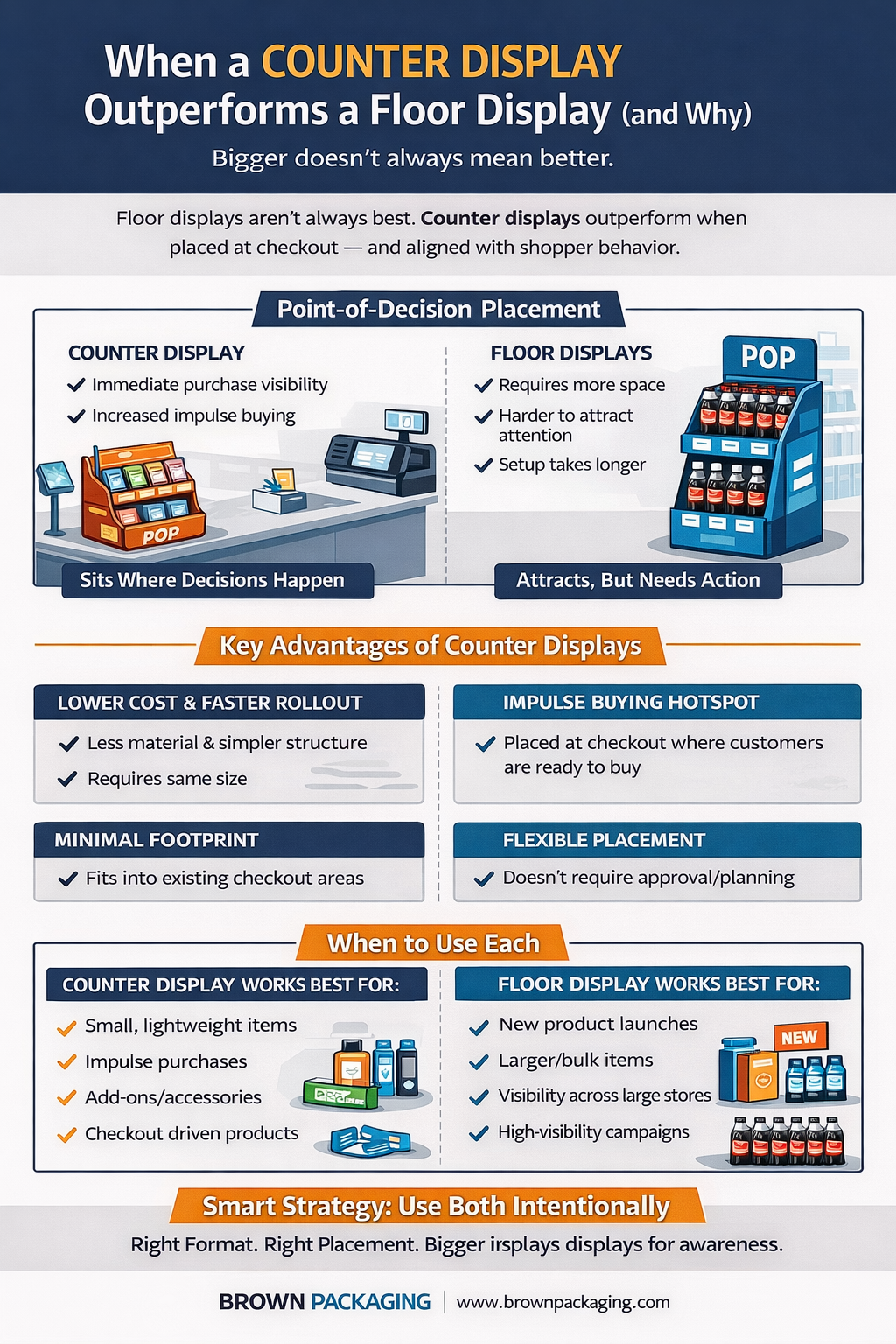
Point-of-purchase (POP) displays come in two primary formats: reusable and disposable. Each option offers advantages depending on campaign goals, budget, and retail environment. Choosing the right format requires balancing cost, durability, sustainability, and brand objectives. What Are Disposable POP Displays? Disposable POP displays are typically made from corrugated board and are designed for short-term use. After a campaign ends, they are recycled or discarded. Best for: Seasonal promotions, product launches, and short campaigns. Advantages: Lower upfront cost, lightweight, fast to ship and assemble. Limitations: Less durable, limited lifespan, not suited for extended use. What Are Reusable POP Displays? Reusable displays are built with stronger materials such as reinforced corrugated, plastic, or metal components. They can be restocked and redeployed across multiple campaigns. Best for: Long-term promotions, club stores, and high-value products. Advantages: Greater durability, long-term cost savings, premium brand presentation. Limitations: Higher upfront cost, heavier to ship, more complex to assemble. Factors to Consider When Choosing Campaign duration: Short-term promotions benefit from disposable displays. Budget priorities: Lower upfront cost vs. long-term savings. Brand positioning: Premium brands may prefer reusable for consistent presence. Sustainability goals: Reusable displays reduce waste, while recyclable disposable displays minimize footprint. Examples of Applications Disposable: Back-to-school displays, holiday promotions, limited editions. Reusable: Beverage pallet displays, electronics showcases, club store programs. POP Display Solutions with Brown Packaging Brown Packaging designs both reusable and disposable POP displays, tailored to campaign goals and supply chain needs. Whether you need cost-effective corrugated for seasonal promotions or reinforced structures for long-term use, our solutions balance impact and efficiency. Contact us to explore your options. References Shop! Association. (2021). Best Practices for In-Store Marketing and POP Displays. Retrieved from https://www.shopassociation.orgSoroka, W. (2009). Fundamentals of Packaging Technology (4th ed.). Institute of Packaging Professionals.ASTM International. (2022). ASTM D685: Standard Practice for Conditioning Paper and Paper Products for Testing. (714)300-0650 request@brownpackaging.com Most Recent Posts: Categories: Corrugated Ecommerce ESD Design Display Flexible Packaging Foam Folding Carton Packaging Plastic Packaging Pouch Printing Protection Retail Rigid Box Thermoform Sustainability Subscribe To Our Newsletter By submitting your information, you agree to our terms and conditions and privacy policy. POP Display Facebook Twitter LinkedIn Pinterest Relevant Posts

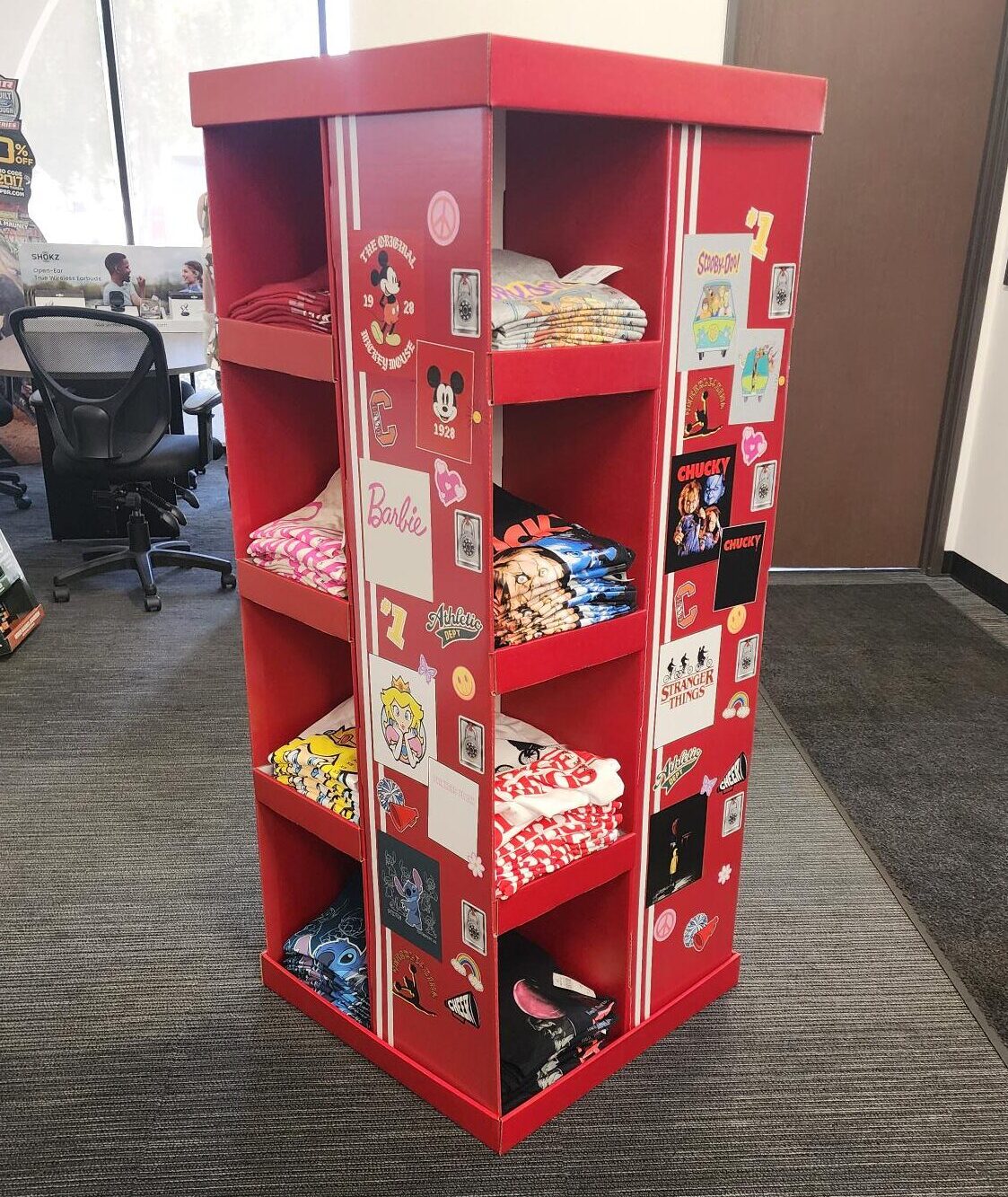
Cross-merchandising is one of the most effective ways to increase basket size in retail. By pairing complementary products in a single point-of-purchase (POP) display, brands can encourage impulse buys and highlight product synergies. Well-designed cross-merchandising displays must balance structural integrity with creative graphics to hold multiple SKUs securely while capturing shopper attention. Why Cross-Merchandising Works Shoppers often overlook product pairings when items are placed in separate aisles. POP displays solve this by bringing products together in a single, convenient location. Encourages impulse purchases. Educates consumers on product compatibility. Strengthens brand visibility and retailer relationships. Increases revenue per shopper visit. Structural Considerations for Multi-SKU Displays Cross-merchandising displays require careful engineering to hold different shapes and weights. Compartmentalized trays: Keep SKUs organized and accessible. Reinforced shelving: Prevent sagging under uneven product loads. Flexible layouts: Allow for multiple packaging sizes. Retail compliance: Dimensions must fit chain-specific guidelines. Graphics That Highlight Product Pairings Graphics play a key role in cross-merchandising by showing shoppers why products belong together. Use bold imagery to connect items visually. Highlight bundle savings or promotional pricing. Position brand messaging where both products share visibility. Ensure graphics remain clear even when product stock is low. Examples of Cross-Merchandising POP Displays Snacks and beverages: Pairing chips with soda or beer. Health and beauty: Combining shampoo with conditioner or styling products. Electronics: Packaging batteries alongside small devices. Household goods: Cleaning products displayed with tools or accessories. POP Display Solutions with Brown Packaging Brown Packaging designs cross-merchandising POP displays that integrate structural strength with branding impact. Our solutions make it easy to showcase complementary products while meeting retailer standards. Contact us to explore custom display designs for your retail strategy. References Shop! Association. (2021). Best Practices for In-Store Marketing and POP Displays. Retrieved from https://www.shopassociation.orgSoroka, W. (2009). Fundamentals of Packaging Technology (4th ed.). Institute of Packaging Professionals.ASTM International. (2022). ASTM D685: Standard Practice for Conditioning Paper and Paper Products for Testing. (714)300-0650 request@brownpackaging.com Most Recent Posts: Categories: Corrugated Ecommerce ESD Design Display Flexible Packaging Foam Folding Carton Packaging Plastic Packaging Pouch Printing Protection Retail Rigid Box Thermoform Sustainability Subscribe To Our Newsletter By submitting your information, you agree to our terms and conditions and privacy policy. POP Displays Facebook Twitter LinkedIn Pinterest Relevant Posts

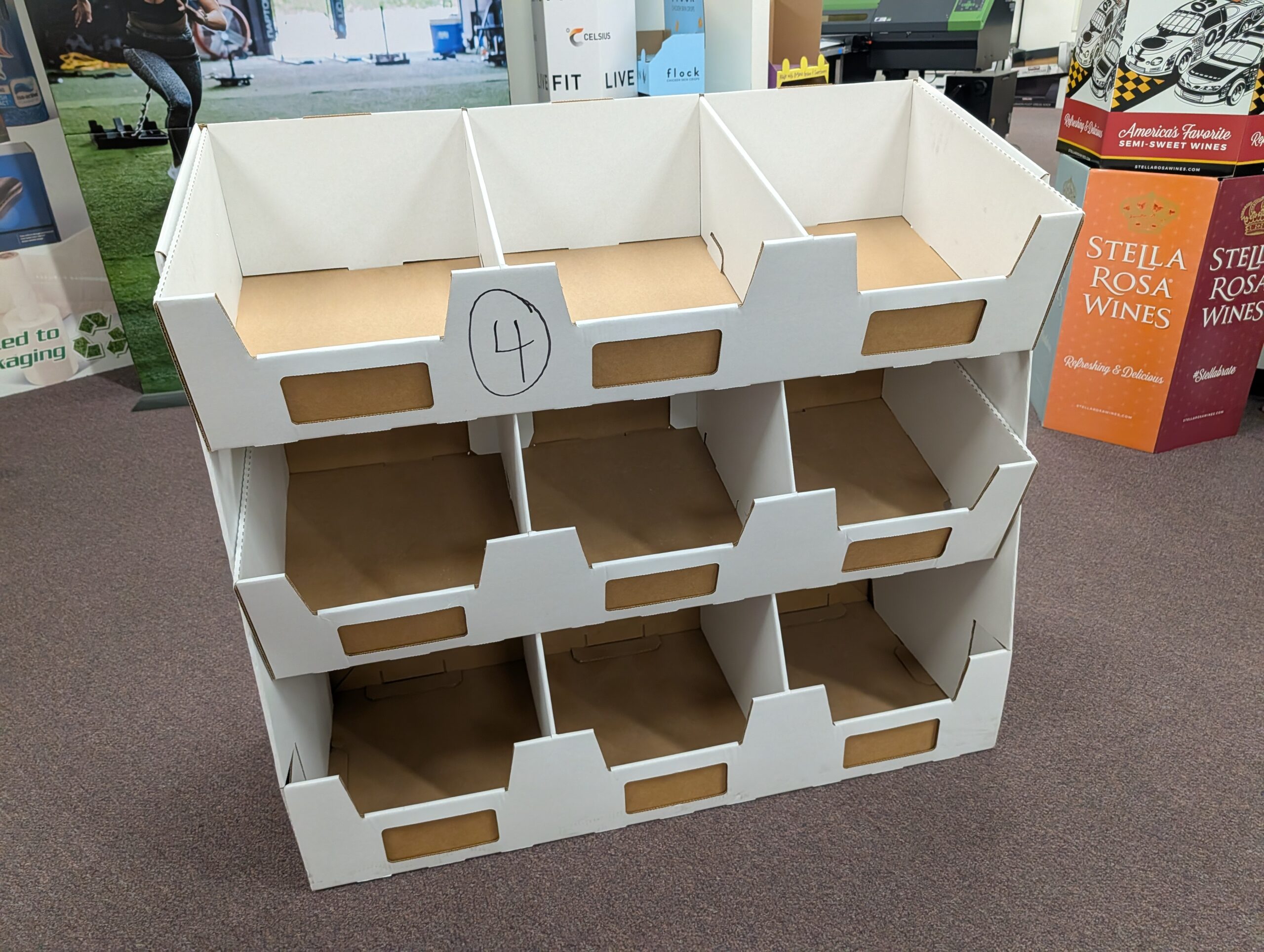
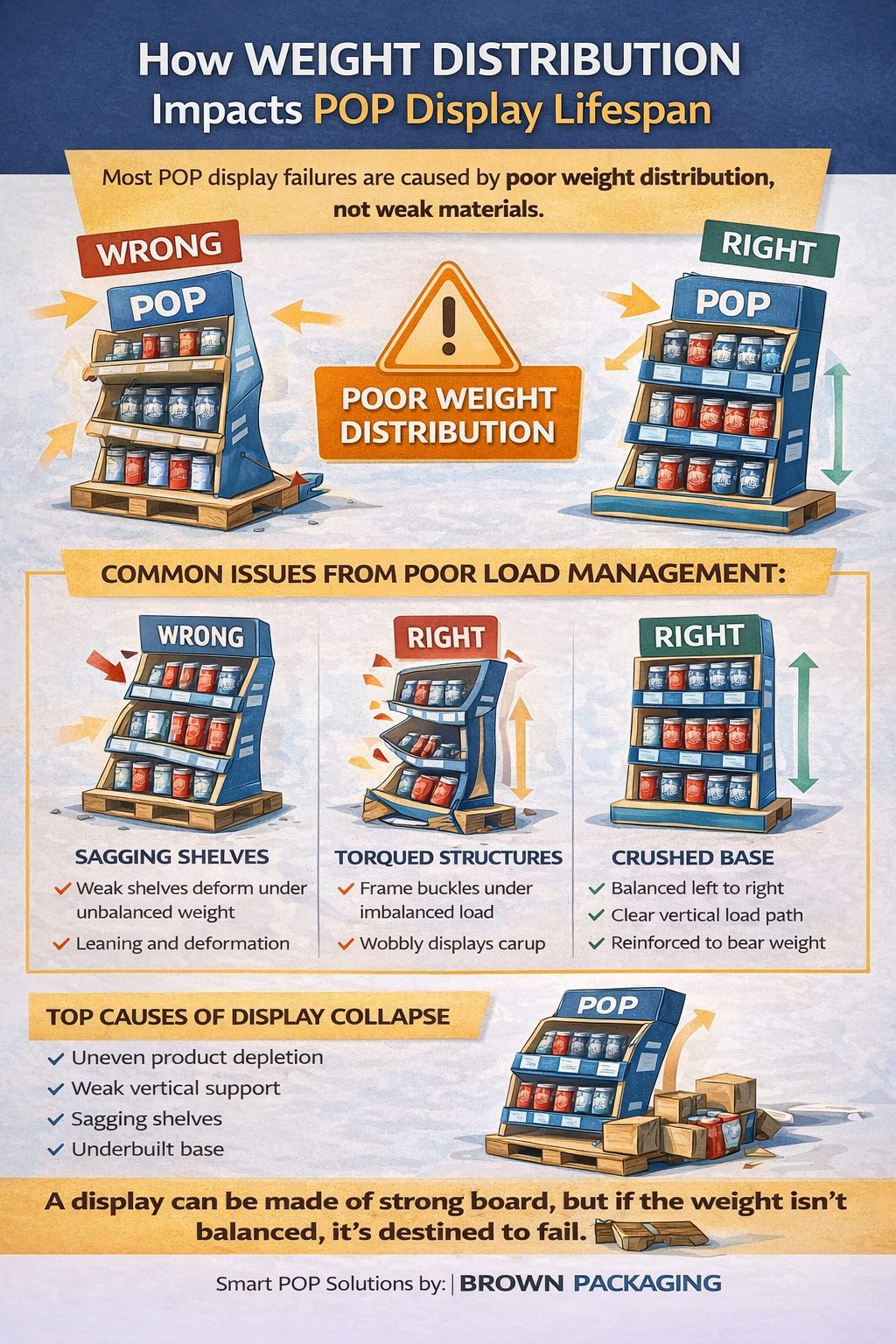
POP displays must balance eye-catching branding with structural integrity. Inadequate load-bearing design can result in product sagging, leaning, or complete collapse, which not only risks product loss but also damages retailer confidence. By applying engineering principles, testing protocols, and correct material selection, brands can maximize display stability without unnecessary cost. Understanding Load-Bearing Capacity Static Load vs. Dynamic Load: Static load refers to the total weight a display can hold without movement. Dynamic load accounts for forces during handling, stocking, and customer interaction. Failure Modes: Panel buckling, shelf deflection, joint separation, and base collapse are the most common failure points. Material Selection Corrugated Board Strength: Flute profile (B, C, E, or BC) impacts stiffness and stacking strength. Higher ECT boards increase vertical load capacity but also affect cost and weight. Coatings and Laminates: Water-resistant coatings prevent fiber weakening in humid environments. Laminates can increase rigidity but may impact recyclability. Structural Reinforcements Double-Wall Shelving: For heavier products such as beverages or canned goods. Internal Braces: Die-cut supports hidden behind the graphic panels for increased stability. Base Skids: Distributes load more evenly to prevent floor contact wear and pallet jack damage. Design and Geometry Weight Distribution: Heavier SKUs should be placed at lower tiers to reduce tipping risk. Joint Engineering: Lock tabs, glue flaps, and interlocking slots improve structural stability. Shear Resistance: Cross-bracing and panel alignment reduce the risk of diagonal collapse. Testing Protocols ASTM D642: Measures compression strength to determine safe stacking loads. ISTA 3A & 6-Series: Simulates real-world handling, vibration, and impact. Shelf Deflection Tests: Measures how much a shelf bends under load over time. Best Practices Always design for at least 25% higher load capacity than the expected maximum product weight. Validate prototypes under realistic load and environmental conditions before production. Balance cost-to-performance ratio — over-engineering increases cost without visible retail benefit. References ASTM International. (2015). ASTM D642-15: Standard test method for determining compressive resistance of shipping containers. ASTM International. https://www.astm.org/d0642-15.htmlInternational Safe Transit Association. (2018). ISTA 3A general simulation performance test for packaged-products for parcel delivery system shipment. ISTA. https://ista.org/International Safe Transit Association. (2018). ISTA 6-Series transit tests. ISTA. https://ista.org/ (714)300-0650 request@brownpackaging.com Most Recent Posts: Categories: Corrugated Ecommerce ESD Design Display Flexible Packaging Foam Folding Carton Packaging Plastic Packaging Pouch Printing Protection Retail Rigid Box Thermoform Sustainability Subscribe To Our Newsletter By submitting your information, you agree to our terms and conditions and privacy policy. POP Display Facebook Twitter LinkedIn Pinterest Relevant Posts

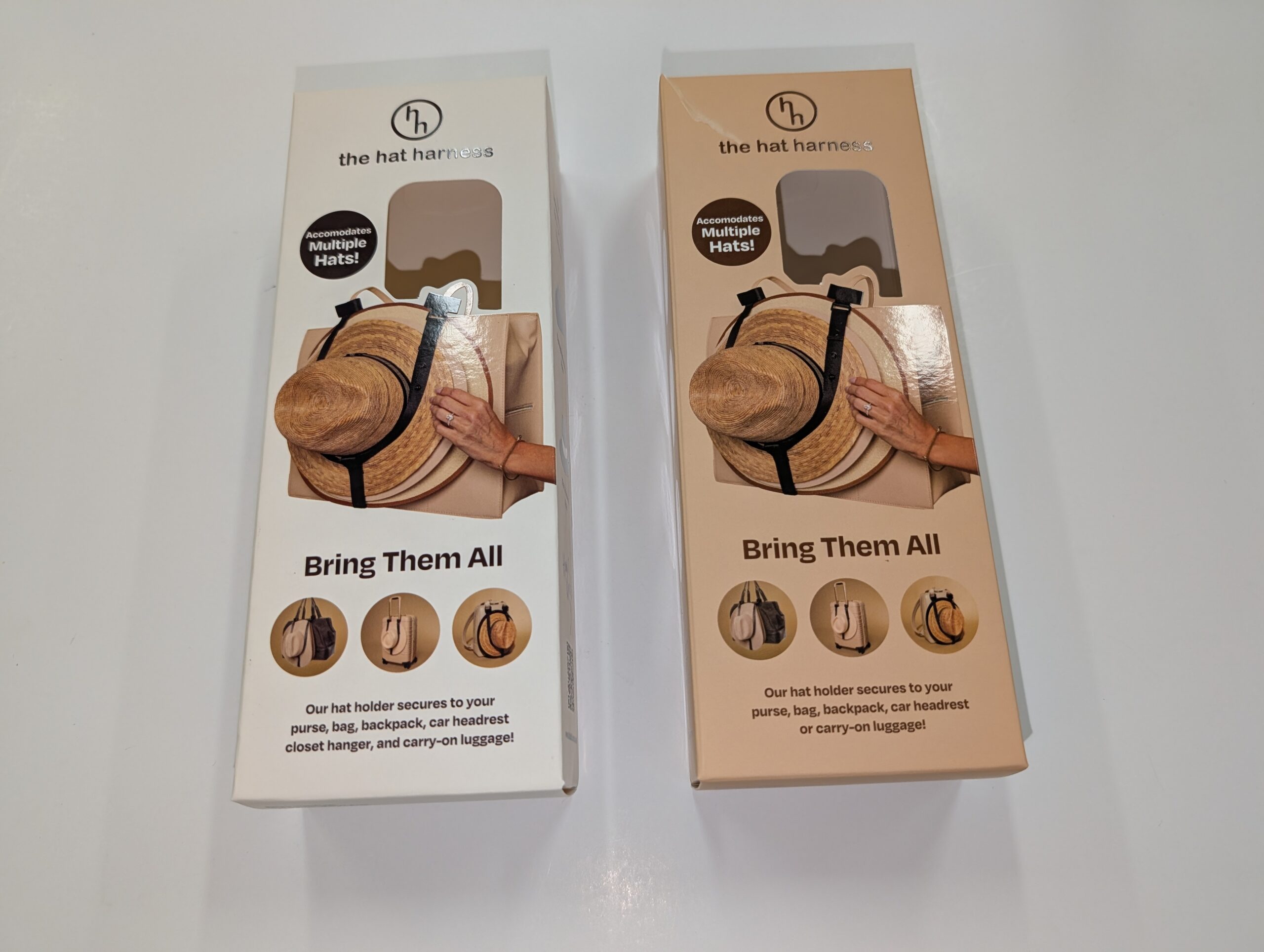
Folding carton style selection directly impacts packaging line efficiency, end-user experience, and the overall cost-to-deliver. Each design offers unique advantages in terms of assembly speed, structural performance, and retail presentation. This guide breaks down common formats—Straight Tuck End (STE), Reverse Tuck End (RTE), Auto-Bottom, Full Seal End (FSE), plus specialty options—and when each is best suited to your product. Straight Tuck End (STE) Both tucks close on the same panel, producing a smooth front face ideal for uninterrupted graphics. Strengths: Clean front panel for high-impact branding. Efficient layout in certain die-cutting patterns. Smooth folding action for automated lines. Drawbacks: Not optimal for heavy contents. Lower tamper resistance compared to sealed formats. Common Uses: Lightweight retail products where appearance is critical. Reverse Tuck End (RTE) Top and bottom tucks close in opposite directions, improving material yield in specific blank layouts. Strengths: Ergonomic for hand-packing operations. Potential material savings over STE. Quick to assemble without gluing. Drawbacks: Break in front panel graphics due to tuck slit. Common Uses: Pharmaceuticals, small personal care, and dry goods. Auto-Bottom (Crash Lock Bottom) Base panels are pre-glued to lock automatically upon erection, cutting down manual assembly time. Strengths: High load capacity without switching to corrugated. Consistent bottom strength in every unit. Time savings in labor-intensive packing lines. Drawbacks: Higher manufacturing cost from extra gluing. Slightly bulkier in storage than flat-tuck styles. Common Uses: Heavier retail goods, food jars, premium candles. Full Seal End (FSE) Both ends are fully sealed with adhesive after filling, creating a strong, tamper-evident structure. Strengths: Maximum security during transport. High resistance to crushing and stacking pressure. Compatible with high-speed sealing equipment. Drawbacks: No reseal capability for consumers. Less flexible for manual, small-batch operations. Common Uses: Frozen foods, medical kits, beverage multipacks. Specialty and Hybrid Designs Sleeve Cartons – Brand-focused wraps around trays or multipacks. Gable Top – Common in refrigerated liquids; requires specialized forming equipment. 5-Panel Hanger – Integrated hang-tab for pegged retail displays. Custom Geometries – Hexagonal or other non-standard shapes for unique shelf presence. Decision Points When determining the best carton style, evaluate: Filling Method – Automated vs. manual. Product Handling – Fragility, stacking pressure, and in-transit vibration. Consumer Access – Single-use vs. resealable. Branding Priorities – Continuous front panel vs. cost efficiency. Speed-to-Market Goals – How quickly tooling and production can be brought online. References Soroka, W. (2014). Fundamentals of packaging technology (5th ed.). Institute of Packaging Professionals. ISBN: 978-1-930268-37-2 Twede, D., & Goddard, R. (2021). Cartons, crates and corrugated board: Handbook of paper and wood packaging technology (2nd ed.). DEStech Publications. ISBN: 978-1-60595-120-5 (714)300-0650 request@brownpackaging.com Most Recent Posts: Categories: Corrugated Ecommerce ESD Design Display Flexible Packaging Foam Folding Carton Packaging Plastic Packaging Pouch Printing Protection Retail Rigid Box Thermoform Sustainability Subscribe To Our Newsletter By submitting your information, you agree to our terms and conditions and privacy policy. Custom Folding Cartons Facebook Twitter LinkedIn Pinterest Relevant Posts

Choosing a folding carton isn’t just about the graphics or the style—it’s about how the structural design and substrate work in tandem. The right combination can optimize line efficiency, protect products during transit, and reinforce brand perception, while the wrong pairing can lead to excess costs, damaged goods, or production slowdowns. This guide explains how style and material decisions influence one another and how to align them for maximum performance. Load-Bearing and Product Weight Heavier products place greater stress on both the style and the board grade. High-Strength Pairing: Auto-bottom or Full Seal End designs with coated unbleached kraft (CUK) for beverage carriers, glass jars, or frozen food. Lightweight Retail: Straight Tuck End (STE) with SBS for cosmetics or nutraceuticals, where presentation outweighs structural load. Key Interaction: Style choice can compensate for lighter materials—an auto-bottom with medium caliper SBS can still handle moderate weight without upgrading to heavier board. Straight Tuck End (STE) Reverse Tuck End (RTE) Environmental Resistance Packaging exposed to moisture, grease, or temperature swings needs both the right style and the right coating. Cold Chain Products: FSE with poly-coated CUK to prevent panel warping in refrigerated or frozen conditions. Dry Shelf Products: STE or RTE with uncoated SBS for vibrant graphics without added cost. Key Interaction: The wrong pairing—like SBS without coating in high-humidity environments—can fail even if the style is structurally sound. Assembly Speed and Automation Line efficiency depends on how easily the style works with the chosen substrate. High-Speed Automation: FSE or STE in SBS or FBB for consistent feeding and folding with minimal score cracking. Manual Operations: RTE or auto-bottom in softer recycled FBB for easy hand folding. Key Interaction: Certain recycled boards may require adjusted creasing profiles to fold cleanly at high speeds—designers must factor this into style selection. Branding and Shelf Presence Material surface quality and structural layout work together to shape consumer perception. Premium Branding: STE in SBS for uninterrupted front panels and high-gloss finishes. Natural/Artisan Look: Sleeve or RTE in natural kraft CUK for an eco-conscious aesthetic. Key Interaction: Choosing a style with large uninterrupted panels means surface smoothness matters more, favoring higher-grade boards. Cost Optimization The most cost-effective designs balance board grade, caliper, and style complexity. Cost-Down Opportunities: Switch from STE to RTE when material yield is higher in layout, or move from SBS to recycled FBB when strength is over-specified. When to Spend More: Upgrade to auto-bottom when labor costs outweigh the savings of a simpler tuck style. Key Interaction: Sometimes a stronger style allows for a lighter material, and sometimes a higher-grade board allows for a simpler style—knowing which trade-off delivers more savings is critical. Decision Framework Define Product Constraints – Weight, fragility, shelf life, and environmental conditions. Set Line Requirements – Manual vs. automated, speed targets, changeover flexibility. Match Style to Strength – Select a structural format that supports handling and branding needs. Match Material to Style – Ensure board grade, caliper, and coatings enhance the style’s performance. Validate with Prototypes – Test under real-world shipping and retail conditions before committing to production. References Soroka, W. (2014). Fundamentals of packaging technology (5th ed.). Institute of Packaging Professionals. ISBN: 978-1-930268-37-2 Twede, D., & Goddard, R. (2021). Cartons, crates and corrugated board: Handbook of paper and wood packaging technology (2nd ed.). DEStech Publications. ISBN: 978-1-60595-120-5 (714)300-0650 request@brownpackaging.com Most Recent Posts: Categories: Corrugated Ecommerce ESD Design Display Flexible Packaging Foam Folding Carton Packaging Plastic Packaging Pouch Printing Protection Retail Rigid Box Thermoform Sustainability Subscribe To Our Newsletter By submitting your information, you agree to our terms and conditions and privacy policy. Custom Folding Cartons Facebook Twitter LinkedIn Pinterest Relevant Posts

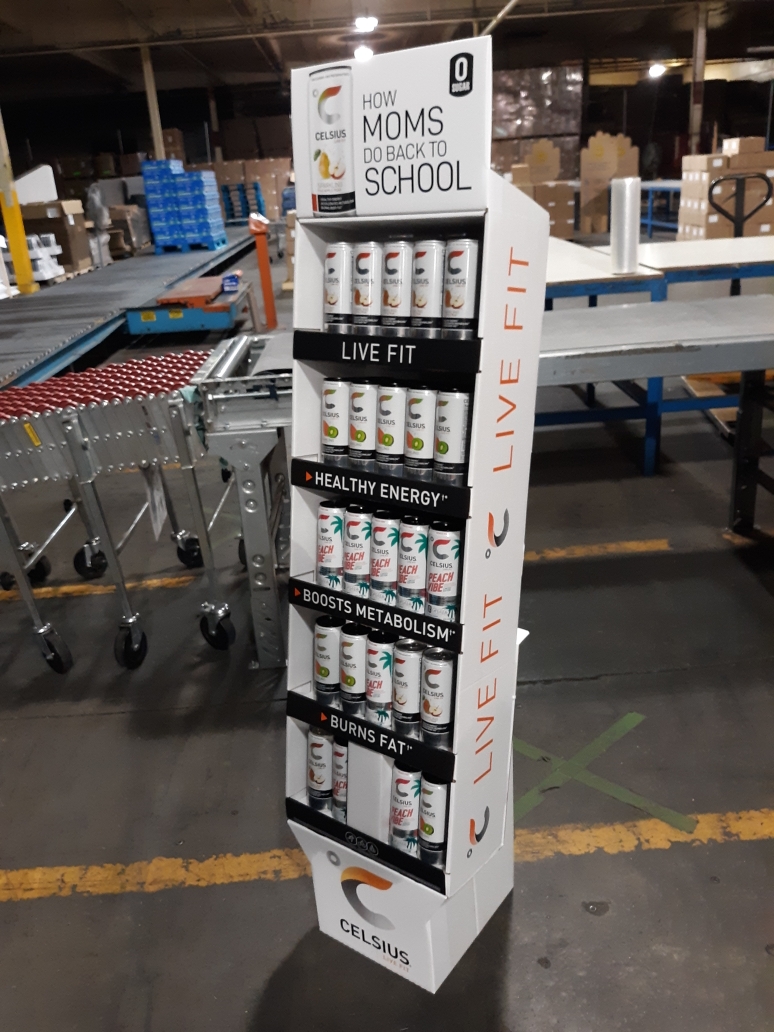
Seasonal promotions are among the most powerful opportunities for brands to capture attention in retail environments. From holidays to back-to-school campaigns, point-of-purchase (POP) displays serve as the centerpiece of these promotions. To succeed, seasonal displays must deliver bold branding, withstand short-term but intensive use, and remain cost-efficient for rapid deployment. The Role of POP Displays in Seasonal Campaigns Seasonal promotions rely on speed, visibility, and excitement. POP displays amplify these campaigns by: Highlighting limited-time offers. Creating urgency that drives impulse purchases. Reinforcing brand presence during peak shopping periods. Allowing retailers to reconfigure store layouts quickly. Design Considerations for Seasonal POP Displays Unlike long-term club store displays, seasonal displays must balance structural strength with temporary use. Lightweight but durable materials: Enough to last weeks, not months. Fast assembly: Retail staff must set up displays quickly. Compact shipping: Flat-pack designs keep logistics efficient. Creative graphics: Bold, festive, and aligned with seasonal themes. Balancing Cost and Performance Because seasonal promotions are short-lived, packaging buyers must avoid overspending on unnecessary strength. Best practices include: Using single-wall corrugated with protective coatings when appropriate. Right-sizing displays to fit promotion duration and product volume. Selecting cost-efficient printing methods that deliver strong visual impact. Examples of Seasonal POP Applications Holiday promotions: Gift packs, limited-edition items, and themed displays. Back-to-school campaigns: Stationery, snacks, and student-focused promotions. Summer promotions: Beverage displays and outdoor lifestyle products. Valentine’s Day or Easter: Small-scale seasonal displays with high turnover. POP Display Solutions with Brown Packaging Brown Packaging designs POP displays tailored for seasonal promotions. From festive graphics to cost-efficient structural designs, we create displays that attract shoppers and maximize return during short-term campaigns. Contact us to learn more about seasonal POP solutions. References Shop! Association. (2021). Best Practices for In-Store Marketing and POP Displays. Retrieved from https://www.shopassociation.orgSoroka, W. (2009). Fundamentals of Packaging Technology (4th ed.). Institute of Packaging Professionals.ASTM International. (2023). ASTM D5445: Standard Practice for Pictorial Markings for Handling of Goods. (714)300-0650 request@brownpackaging.com Most Recent Posts: Categories: Corrugated Ecommerce ESD Design Display Flexible Packaging Foam Folding Carton Packaging Plastic Packaging Pouch Printing Protection Retail Rigid Box Thermoform Sustainability Subscribe To Our Newsletter By submitting your information, you agree to our terms and conditions and privacy policy. POP Display Facebook Twitter LinkedIn Pinterest Relevant Posts

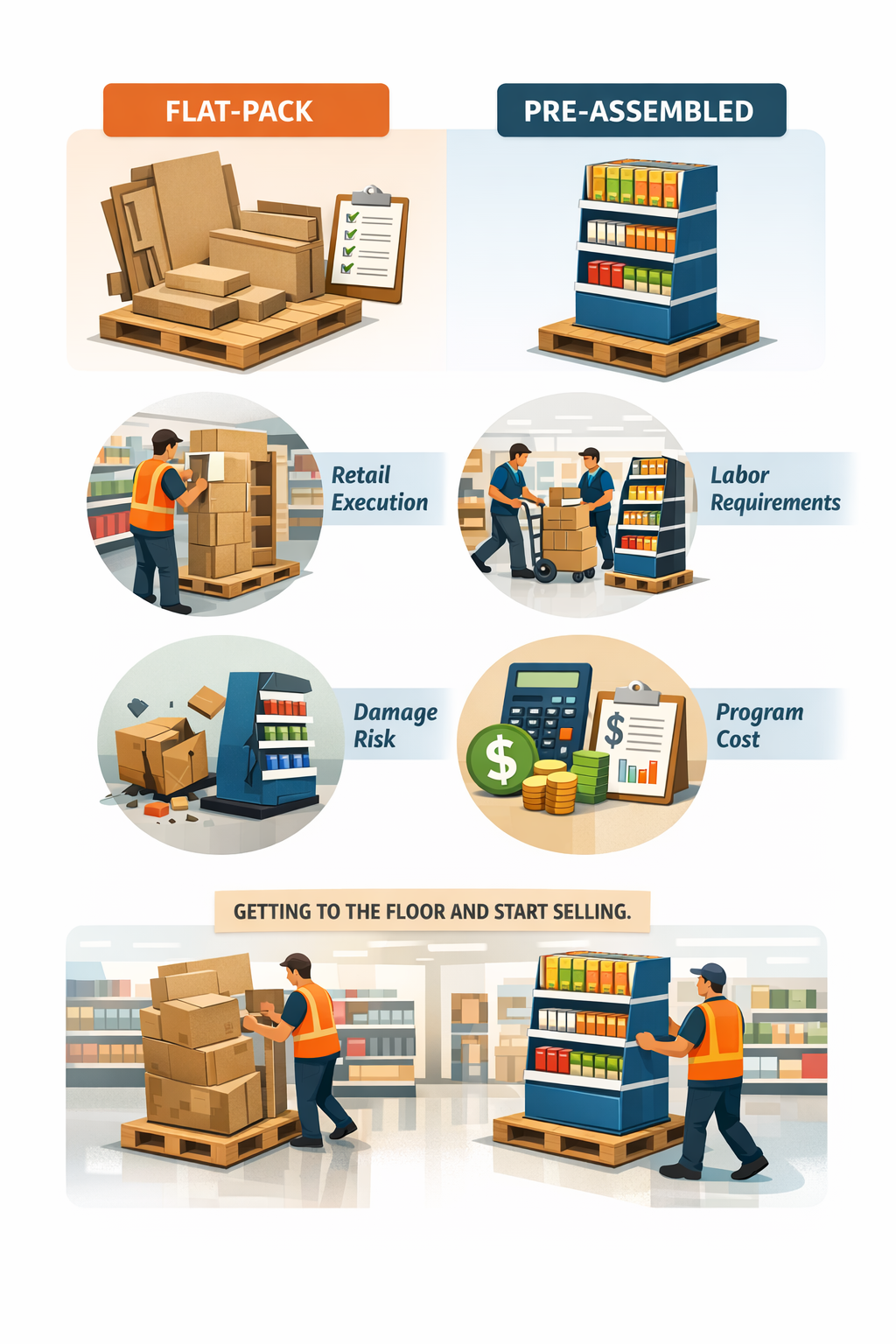
Freight is one of the largest cost drivers in retail packaging programs. Point-of-purchase (POP) displays that look impressive on the floor may be inefficient to ship, leading to wasted space, higher freight charges, and reduced margins. By designing POP displays with logistics in mind, brands can reduce transportation costs without sacrificing retail impact. Why Freight Costs Matter in POP Programs Shipping inefficiency adds up quickly across high-volume campaigns. Displays that do not cube out effectively—or require excessive protective packaging—cost more to move and handle. In some cases, freight expenses outweigh the cost of the displays themselves. Designing POP Displays for Shipping Efficiency Flat-pack design: Displays that ship knocked down reduce cubic volume. Right-size engineering: Minimize excess corrugated or void space. Lightweight materials: Reduce overall shipping weight. Stacking strength: Displays must withstand compression during pallet transport. Balancing Shipping and Retail Needs Designers must ensure that cost savings on freight do not compromise in-store performance. Best practices include: Testing displays for stability after flat-pack assembly. Using reinforced corrugated grades where stacking is required. Designing displays that integrate seamlessly with pallets. Coordinating with logistics teams early in the design process. Examples of Freight-Efficient POP Displays Club store pallet displays: Engineered for direct-to-floor placement. Seasonal promotions: Lightweight designs shipped compactly in bulk. Floor stands: Collapsible displays that expand on-site without excess packaging. POP Display Solutions with Brown Packaging Brown Packaging designs POP displays that balance retail impact with freight efficiency. Our solutions reduce logistics costs while ensuring displays perform as intended in-store. Contact us to explore freight-efficient POP display options. References Shop! Association. (2021). Best Practices for In-Store Marketing and POP Displays. Retrieved from https://www.shopassociation.orgSoroka, W. (2009). Fundamentals of Packaging Technology (4th ed.). Institute of Packaging Professionals.ASTM International. (2023). ASTM D4169: Standard Practice for Performance Testing of Shipping Containers and Systems. (714)300-0650 request@brownpackaging.com Most Recent Posts: Categories: Corrugated Ecommerce ESD Design Display Flexible Packaging Foam Folding Carton Packaging Plastic Packaging Pouch Printing Protection Retail Rigid Box Thermoform Sustainability Subscribe To Our Newsletter By submitting your information, you agree to our terms and conditions and privacy policy. POP Display Facebook Twitter LinkedIn Pinterest Relevant Posts

Incorporating recycled fiber into corrugated board is essential for sustainability goals, but it directly affects the mechanical properties of packaging. Understanding how fiber composition influences durability allows packaging engineers to strike the right balance between performance and environmental impact. Fiber Strength and Recycling Cycles Virgin Fiber: Longer, more intact cellulose fibers that offer superior tensile and compression strength. Recycled Fiber: Shorter fibers due to repeated processing; reduced bonding potential and stiffness. Fiber Degradation: Each recycling cycle shortens fibers, leading to diminished ECT and burst resistance. Mechanical Trade-Offs High Recycled Content: Lower material cost and improved sustainability metrics, but reduced edge crush strength and puncture resistance. Mixed Fiber Blends: Commonly used to maintain performance while increasing recycled content. Moisture Sensitivity Recycled fibers tend to absorb and retain more moisture, accelerating loss of stacking strength in humid environments. Sizing agents and moisture-resistant coatings can partially offset this effect. Testing Protocols ASTM D685: Standard practice for conditioning paper and paper products before testing. TAPPI T410: Grammage testing to verify consistency in basis weight. Long-Term Compression Testing: To monitor creep and compression loss over storage periods. Application Guidelines Use higher recycled content in light-duty e-commerce boxes where high stacking strength isn’t required. Retain virgin outer liners for high-performance applications like industrial goods or long-distance freight. References ASTM International. (2014). ASTM D685-14: Standard practice for conditioning paper and paper products for testing. ASTM International. https://www.astm.org/d0685-14.htmlTechnical Association of the Pulp and Paper Industry. (2013). TAPPI T410 om-13: Grammage of paper and paperboard. TAPPI. https://www.tappi.org/content/store/shared/T410.htmlFibre Box Association. (2023). Corrugated recycling and performance considerations. Fibre Box Association. https://www.fibrebox.org (714)300-0650 request@brownpackaging.com Most Recent Posts: Categories: Subscribe To Our Newsletter By submitting your information, you agree to our terms and conditions and privacy policy. Sustainable Packaging Facebook Twitter LinkedIn Pinterest Relevant Posts

Score cracking—visible fiber breakage along a fold—can ruin a carton’s appearance, weaken its structure, and cause failures on automated lines. Understanding the causes and engineering solutions is critical for producing folding cartons that maintain both strength and visual quality. What Causes Score Cracking Score cracking occurs when fibers along the fold line break instead of bending cleanly. Low Moisture Content: Dry board becomes brittle and less pliable (ASTM D685-22). Improper Score Depth: Shallow scores increase folding resistance; deep scores can cut fibers. Incorrect Grain Direction: Folding parallel to the grain increases cracking risk. Surface Coating Rigidity: Gloss varnish, films, and metallic layers reduce fiber flexibility. Material Selection SBS (Solid Bleached Sulfate): Generally folds cleanly but can crack with heavy coatings or low EMC. CUK (Coated Unbleached Kraft): Higher tear resistance; better for humid conditions. FBB (Folding Boxboard): Softer surface layers reduce cracking risk in coated applications. Tip: Match fiber composition and surface finish to the intended folding radius and production environment. Moisture and Conditioning Pre-Production Conditioning: Allow board to reach equilibrium moisture content (TAPPI T402). Humidity Control: Maintain 40–60% RH in converting and packing areas. Target EMC: Typically 5–8% for most paperboard grades. Coating and Lamination Adjustments Scoring After Coating: Where possible, score post-coating to reduce fiber breakage. Film Selection: Thinner, more flexible films reduce cracking risk. Relief Scoring: Adding micro-perfs in the coating layer only can relieve stress without affecting the substrate. Testing and Quality Control Bend Tests: Assess crack formation on sample folds before full production. High-Speed Trials: Score cracking can be magnified at higher folding speeds. Visual Standards: Establish acceptable limits for cosmetic cracking based on brand requirements. References ASTM International. (2022). ASTM D685-22: Standard practice for conditioning paper and paper products for testing. ASTM International. https://doi.org/10.1520/D0685-22Soroka, W. (2014). Fundamentals of packaging technology (5th ed.). Institute of Packaging Professionals. ISBN: 978-1-930268-37-2TAPPI. (2019). T 402: Standard conditioning and testing atmospheres for paper, board, pulp handsheets, and related products. TAPPI Press.Twede, D., & Goddard, R. (2021). Cartons, crates and corrugated board: Handbook of paper and wood packaging technology (2nd ed.). DEStech Publications. ISBN: 978-1-60595-120-5 (714)300-0650 request@brownpackaging.com Most Recent Posts: Categories: Corrugated Ecommerce ESD Design Display Flexible Packaging Foam Folding Carton Packaging Plastic Packaging Pouch Printing Protection Retail Rigid Box Thermoform Sustainability Subscribe To Our Newsletter By submitting your information, you agree to our terms and conditions and privacy policy. Custom Folding Cartons Facebook Twitter LinkedIn Pinterest Relevant Posts

E-commerce packaging for pet products must endure far more stress than traditional retail packaging. Shipments face repeated drops, vibration, compression, and environmental fluctuations. Structural design, material selection, and protective features must work together to ensure the product arrives in perfect condition. Key Hazards in E-Commerce Distribution Drop Impact: Packages may be dropped from heights of up to 1.2 m (4 ft) during sortation or delivery. Vibration: Continuous shaking in transit can cause product settling or material fatigue. Compression: Stacking in transit or warehouses can deform or crush underfilled packages. Moisture and Temperature Extremes: Exposure to rain, snow, and heat during delivery. Structural Design Considerations Reinforced Corrugated Shippers: Double-wall or heavy-duty C-flute for bulk pet food and accessories. Internal Bracing or Partitioning: Keeps products from shifting during transit. Right-Sizing: Minimizes void space to reduce product movement and dimensional weight charges. Material Selection Moisture-Resistant Coatings: For corrugated and paperboard used in outer shipping containers. Puncture-Resistant Films: Prevent tearing from sharp pet accessories like toys or grooming tools. Impact-Absorbing Cushioning: Paper-based or foam inserts to protect fragile items such as glass supplement jars. Protective Features Tamper-Evident Seals: Maintain consumer trust and ensure product integrity. Overwraps or Polybags: Provide secondary protection against moisture and dirt. Label Durability: Smudge- and water-resistant labels for scannability. Performance Testing for E-Commerce Drop Testing: ISTA 3A or ASTM D5276 to simulate parcel handling. Vibration Testing: ASTM D999 to evaluate performance under prolonged vibration. Compression Testing: ASTM D642 to determine stacking strength. Environmental Conditioning: ASTM D4332 to simulate humidity and temperature changes. E-Commerce Packaging Guidelines Amazon ISTA 6 Standards: Requires packaging to pass drop and vibration tests without damage. Right-Weighting: Balancing durability with material reduction to lower shipping costs. Consumer Experience: Easy-open designs and branding that reinforce product quality. References ASTM International. (2015). ASTM D5276-15: Standard test method for drop test of loaded containers by free fall. ASTM International. https://doi.org/10.1520/D5276-15ASTM International. (2015). ASTM D642-15: Standard test method for determining compressive resistance of shipping containers. ASTM International. https://doi.org/10.1520/D0642-15International Safe Transit Association. (2022). ISTA test procedures. https://ista.org (714)300-0650 request@brownpackaging.com Most Recent Posts: Categories: Corrugated Ecommerce ESD Design Display Flexible Packaging Foam Folding Carton Packaging Plastic Packaging Pouch Printing Protection Retail Rigid Box Thermoform Sustainability Subscribe To Our Newsletter By submitting your information, you agree to our terms and conditions and privacy policy. Custom Packaging Facebook Twitter LinkedIn Pinterest Relevant Posts

Corrugated boxes lose a significant portion of their original compression strength during prolonged storage, especially under load. Understanding the mechanics of compression creep and the environmental factors at play allows packaging engineers to design boxes that maintain structural integrity throughout their intended shelf life. Why Compression Strength Declines Material Creep: Fibers gradually deform under constant load, reducing box stiffness. Humidity Impact: Elevated RH accelerates creep, with potential strength losses of 40–60% in humid conditions. Stacking Configuration: Poor pallet patterns or uneven weight distribution compound stress points. Testing and Standards ASTM D4577: Measures compressive creep over time in shipping containers. ASTM D642: Evaluates initial compression strength, serving as a baseline before long-term storage. Design Strategies to Reduce Loss Select Higher ECT Boards: Provides a stronger starting point, delaying the drop below critical load thresholds. Moisture Control: Use desiccants, ventilation, or moisture-barrier coatings in high-humidity warehouses. Pallet Pattern Optimization: Uniform stacking prevents concentrated stress on corner posts. Application Considerations Long-term storage in non-climate-controlled facilities should factor in 30–50% compression loss for safety margins. Double-wall or reinforced designs are advised for seasonal inventory stored for extended periods. References ASTM International. (2015). ASTM D4577-15: Standard test method for compressive creep of shipping containers. ASTM International. https://www.astm.org/d4577-15.htmlASTM International. (2015). ASTM D642-15: Standard test method for determining compressive resistance of shipping containers. ASTM International. https://www.astm.org/d0642-15.html (714)300-0650 request@brownpackaging.com Most Recent Posts: Subscribe To Our Newsletter By submitting your information, you agree to our terms and conditions and privacy policy. Custom Corrugated Boxes Facebook Twitter LinkedIn Pinterest Relevant Posts

E-commerce exposes folding cartons to more handling points, longer transit times, and harsher mechanical stresses than traditional retail distribution. Designing for these conditions requires careful material selection, structural reinforcement, and testing to ensure the product arrives intact and presentable. Understanding E-Commerce Transit Hazards Small-parcel shipping subjects cartons to conditions outside typical retail supply chains: Multiple Sorting Touchpoints: Each transfer increases the risk of edge crush and panel denting. High Vibration: Long delivery routes and conveyor systems cause sustained shaking. Compression Loads: Cartons may be stacked under heavier mixed-weight items in transport. Environmental Variability: Temperature and humidity swings in delivery trucks and sorting centers. (ASTM D4169 simulates these hazards for performance testing.) Material Selection CUK (Coated Unbleached Kraft): Higher tear and puncture resistance, ideal for heavier or rigid products. High-Caliper SBS: Provides a smooth print surface while increasing crush resistance. Poly-Coated or Moisture-Barrier Boards: Essential for humid climates or cold-chain shipments. Tip: Avoid over-specifying — choose the lightest grade that meets drop, compression, and vibration requirements. Structural Reinforcements Full Seal End (FSE): Seals both ends for maximum tamper resistance and panel rigidity. Auto Bottom: Improves stacking strength while enabling faster manual packing. Reinforced Glue Flaps: Wider flaps or added tear-resistant tape in high-stress zones. Double-Panel Sides: Layering board at impact-prone edges to reduce corner crushing. Coatings and Finishes Scuff-Resistant Varnish: Maintains appearance after multiple handling points. Water-Resistant Coatings: Prevent fiber swelling from rain or condensation. Matte Finishes: Reduce visible wear compared to high gloss in transit. Testing and Validation Drop Tests: Simulate handling from waist height at multiple orientations. Vibration Testing: Identify structural weaknesses under sustained shaking (ASTM D4728). Compression Tests: Ensure cartons can withstand stacking in mixed-weight loads (TAPPI T804). Environmental Conditioning: Test under humidity and temperature extremes before market launch. Cost–Performance Balance Over-engineering increases per-unit cost and shipping weight. The most durable e-commerce cartons balance material and style to meet ISTA or ASTM testing requirements without exceeding budget targets. References ASTM International. (2016). ASTM D4169-16: Standard practice for performance testing of shipping containers and systems. ASTM International. https://doi.org/10.1520/D4169-16ASTM International. (2016). ASTM D4728-06(2016): Random vibration testing of shipping containers. ASTM International. https://doi.org/10.1520/D4728-06R16TAPPI. (2017). T 804: Compression test of fiberboard shipping containers. TAPPI Press.Soroka, W. (2014). Fundamentals of packaging technology (5th ed.). Institute of Packaging Professionals. ISBN: 978-1-930268-37-2Twede, D., & Goddard, R. (2021). Cartons, crates and corrugated board: Handbook of paper and wood packaging technology (2nd ed.). DEStech Publications. ISBN: 978-1-60595-120-5 (714)300-0650 request@brownpackaging.com Most Recent Posts: Categories: Corrugated Ecommerce ESD Design Display Flexible Packaging Foam Folding Carton Packaging Plastic Packaging Pouch Printing Protection Retail Rigid Box Thermoform Sustainability Subscribe To Our Newsletter By submitting your information, you agree to our terms and conditions and privacy policy. Folding Cartons Facebook Twitter LinkedIn Pinterest Relevant Posts

The Edge Crush Test (ECT) is a critical performance metric for corrugated boxes, directly correlating to stacking strength and load-bearing capacity. In the high-stress world of e-commerce shipping, where packages face frequent handling, multi-stop routes, and varying climates, optimizing ECT values without over-engineering is essential for cost efficiency and product protection. Why ECT Matters in E-Commerce Stacking Strength: Determines how well boxes can withstand vertical loads in warehouse racking or trailer stacking. Material Efficiency: Allows engineers to achieve performance targets with lighter weight liners or mediums, reducing costs. Regulatory Alignment: Certain carriers and industry sectors specify minimum ECT ratings for compliance. Balancing ECT and Basis Weight ECT vs. Mullen Burst: ECT measures column strength; Mullen measures resistance to puncture/tearing. E-commerce often favors ECT for stacked pallet loads. Lightweighting Strategies: Use high-performance recycled fiber blends to maintain stiffness. Incorporate higher-grade outer liners for localized reinforcement. Design Variables That Influence ECT Flute Profile: B- and C-flutes offer different stiffness profiles. B-flute generally yields higher ECT for the same board weight. Adhesive Quality: Uniform glue lines prevent micro-buckling under compression. Moisture Resistance: High humidity can reduce ECT by up to 50%; moisture-resistant coatings help maintain performance. Testing and Standards ASTM D642: Measures box compression strength. TAPPI T839: Determines edgewise compressive strength of corrugated fiberboard using the clamp method. ISTA Series: Full-scale distribution simulation, including drop, vibration, and compression under varying conditions. Optimization in Practice Case Example: Switching from 44 ECT double-wall to 32 ECT single-wall with enhanced flute medium reduced material cost by 14% without increasing damage claims in a 90-day trial. Prototyping: Lab ECT data should be validated through route-specific field testing before large-scale rollout. ReferencesASTM International. (2015). ASTM D642-15: Standard test method for determining compressive resistance of shipping containers. ASTM International. https://www.astm.org/d0642-15.htmlTechnical Association of the Pulp and Paper Industry. (2018). TAPPI T839 om-18: Edgewise compressive strength of corrugated fiberboard using the clamp method. TAPPI. https://www.tappi.org/content/store/shared/T839.htmlInternational Safe Transit Association. (2018). ISTA 6-Series transit tests. ISTA. https://ista.org/ (714)300-0650 request@brownpackaging.com Most Recent Posts: Categories: Corrugated Ecommerce ESD Design Display Flexible Packaging Foam Folding Carton Packaging Plastic Packaging Pouch Printing Protection Retail Rigid Box Thermoform Sustainability Subscribe To Our Newsletter By submitting your information, you agree to our terms and conditions and privacy policy. Custom Corrugated Boxes Facebook Twitter LinkedIn Pinterest Relevant Posts