
Home » When Digital Printing Becomes Scalable At Industrial Volume
When Digital Printing Becomes Scalable At Industrial Volume
Digital printing is often positioned as a short-run solution for emerging brands. But advances in press technology, workflow automation, and material compatibility have expanded its role well beyond limited production. The real question in 2026 is not whether digital can scale — it’s when it becomes strategically scalable.
Scalability is not defined by run length alone.
The Misconception: Digital Equals Small Volume
Many industrial buyers still associate digital printing with:
- Test runs
- Seasonal programs
- Startup brands
- Limited SKUs
While those applications remain valid, modern digital platforms now support higher throughput, improved color consistency, and broader substrate compatibility across corrugated and flexible packaging.
The limiting factor is no longer press capability — it is economic alignment.
What Actually Determines Scalability
Digital printing becomes scalable when the operational benefits outweigh the perceived unit cost premium.
Key variables include:
- SKU density
- Version frequency
- Forecast volatility
- Artwork revision cycles
- Inventory carrying cost
In multi-SKU industrial programs, digital can remain competitive at higher annual volumes because it avoids plate replication across variations.
Throughput and Workflow Evolution
Modern digital systems now support:
- Automated file handling
- Integrated color management
- Shorter makeready cycles
- Faster job changeovers
For programs with frequent SKU rotation, the reduction in changeover time and setup disruption can materially impact total program efficiency.
Scalability must be evaluated at the program level — not per single run.
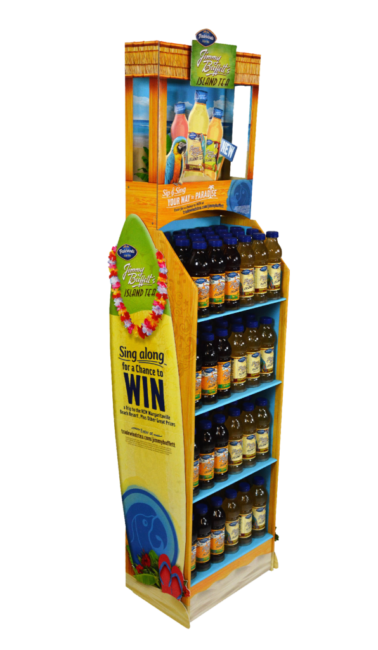
Industrial Corrugated and Display Programs
In corrugated and display environments, digital printing is increasingly used for:
- Regional distribution variants
- Multi-location retail rollouts
- Short-cycle promotional programs
- Private label adaptations
When industrial buyers manage multiple facilities or customer-specific graphics, digital flexibility supports distributed production strategies without plate redeployment.
The Hybrid Scaling Model
The most effective industrial programs rarely rely on a single print method.
A segmented approach may include:
- Digital printing for variable, evolving, or regional SKUs
- Flexographic or lithographic printing for stable, high-volume core products
This structure allows digital to scale strategically without replacing traditional efficiencies where appropriate.
Scalability is achieved through segmentation, not substitution.
When Digital Is Not Yet Scalable
Digital may remain less competitive when:
- Volume is concentrated in one stable SKU
- Artwork remains unchanged over extended cycles
- Forecast reliability is high
- Per-unit cost pressure outweighs flexibility needs
In these cases, traditional print methods maintain cost advantages.
The decision must reflect portfolio behavior — not assumptions about technology.
The Bottom Line
Digital printing has matured beyond short-run positioning. In multi-SKU, evolving industrial environments, it can scale effectively when evaluated through volatility, revision frequency, and inventory strategy.
Contact Brown Packaging to review your SKU concentration, production volume, and forecast stability to determine whether digital printing can scale within your packaging program — or whether a hybrid approach delivers stronger long-term performance.
Sources
- PRINTING United Alliance – Digital press throughput and production capability data
- Flexible Packaging Association (FPA) – Digital adoption trends across flexible and corrugated packaging
- PMMI – The Association for Packaging and Processing Technologies – Packaging automation and workflow research
- Smithers Market Reports – Global digital print growth in industrial packaging
- Deloitte Supply Chain Studies – Production flexibility and demand volatility research
Pallet efficiency is one of the most overlooked drivers of shipping cost. Most companies try to increase boxes per pallet—but do it in ways that compromise stability and increase damage.
Choosing between 32 ECT and 44 ECT is one of the most common decisions in corrugated packaging. It’s also one of the most misunderstood. Most companies either default to 32
Excess moisture in pet food packaging can cause mold growth, nutrient degradation, clumping, and product spoilage. Effective moisture control combines barrier material selection, packaging design, and controlled production environments to
Exporting products requires packaging that can endure extended transit times, multiple handling points, and strict international regulations. Full Overlap (FOL) boxes are a proven solution for export shipments because their
Home » When Digital Printing Becomes Scalable At Industrial Volume