Home » Designing Displays for Replenishment
Designing Displays for Replenishment
Most POP displays are designed for day-one appearance—not for what happens after the first few units sell.
That’s a problem.
Because in retail, performance is determined by what happens during replenishment, not initial setup.
If a display is hard to restock, it won’t stay full.
If it doesn’t stay full, it doesn’t sell.
Replenishment Is Where Displays Win or Fail
A display might look perfect at launch—but within days:
- Products sell unevenly
- Gaps start forming
- Organization breaks down
At that point, the only thing that matters is how easily store staff can restock it.
If replenishment is:
- Fast and intuitive → the display stays full and sells
- Slow or confusing → it becomes messy, empty, and ignored
The Reality of Store-Level Behavior
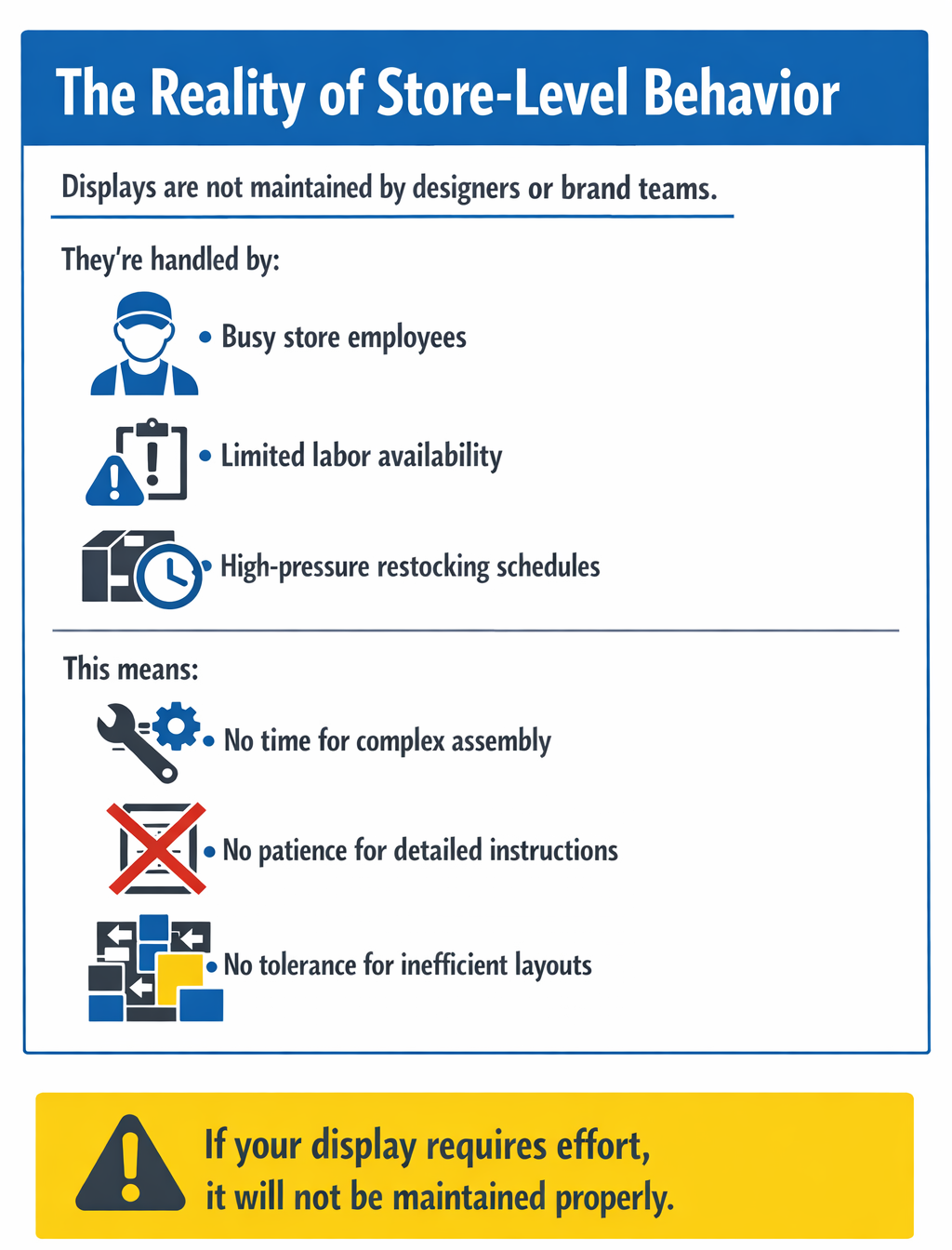
Displays are not maintained by designers or brand teams.
They’re handled by:
- Busy store employees
- Limited labor availability
- High-pressure restocking schedules
This means:
- No time for complex assembly
- No patience for detailed instructions
- No tolerance for inefficient layouts
If your display requires effort, it will not be maintained properly.
Common Replenishment Failures
Most underperforming displays share the same issues:
- Hard-to-reach product areas
- Tight or restrictive compartments
- No clear product organization
- Blocked access due to structure
These create friction.
And in retail, friction kills execution.
Top-Load vs Front-Load Design
How product is loaded matters more than most brands realize.
Top-Load Designs
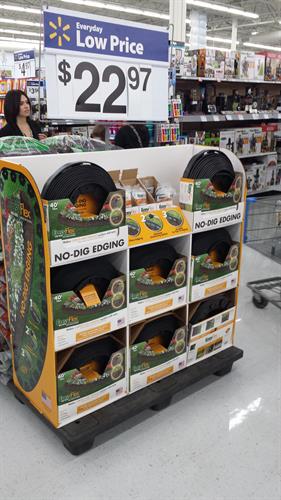
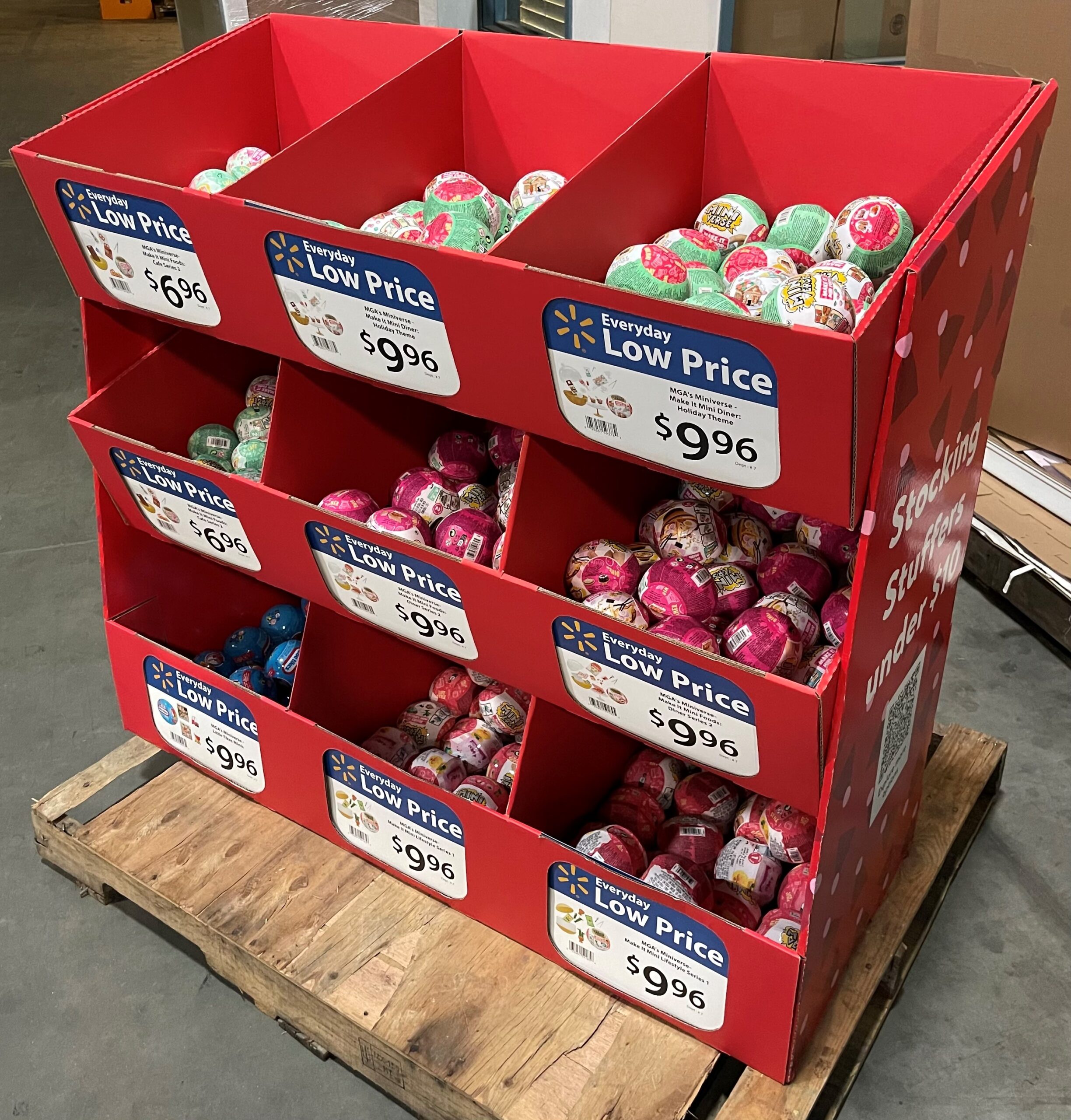
- Faster restocking
- Better for bulk replenishment
- Common in pallet displays
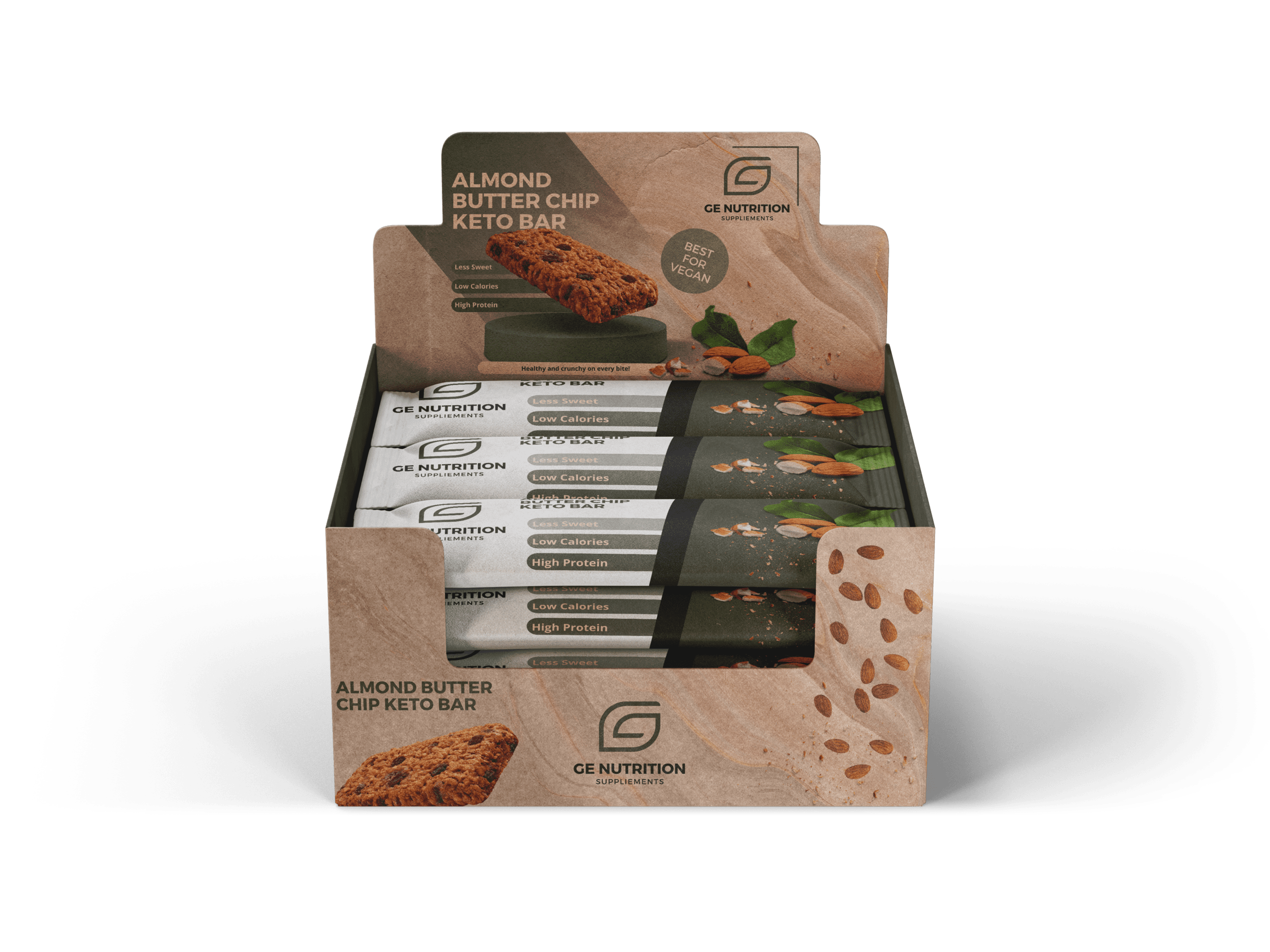
Front-Load Designs
- Better product visibility
- More controlled presentation
- Slower to restock if poorly designed
The key is aligning the loading method with:
- Product type
- Retail environment
Replenishment frequency
Organization Drives Efficiency
Displays need to guide behavior—not rely on it.
High-performing designs:
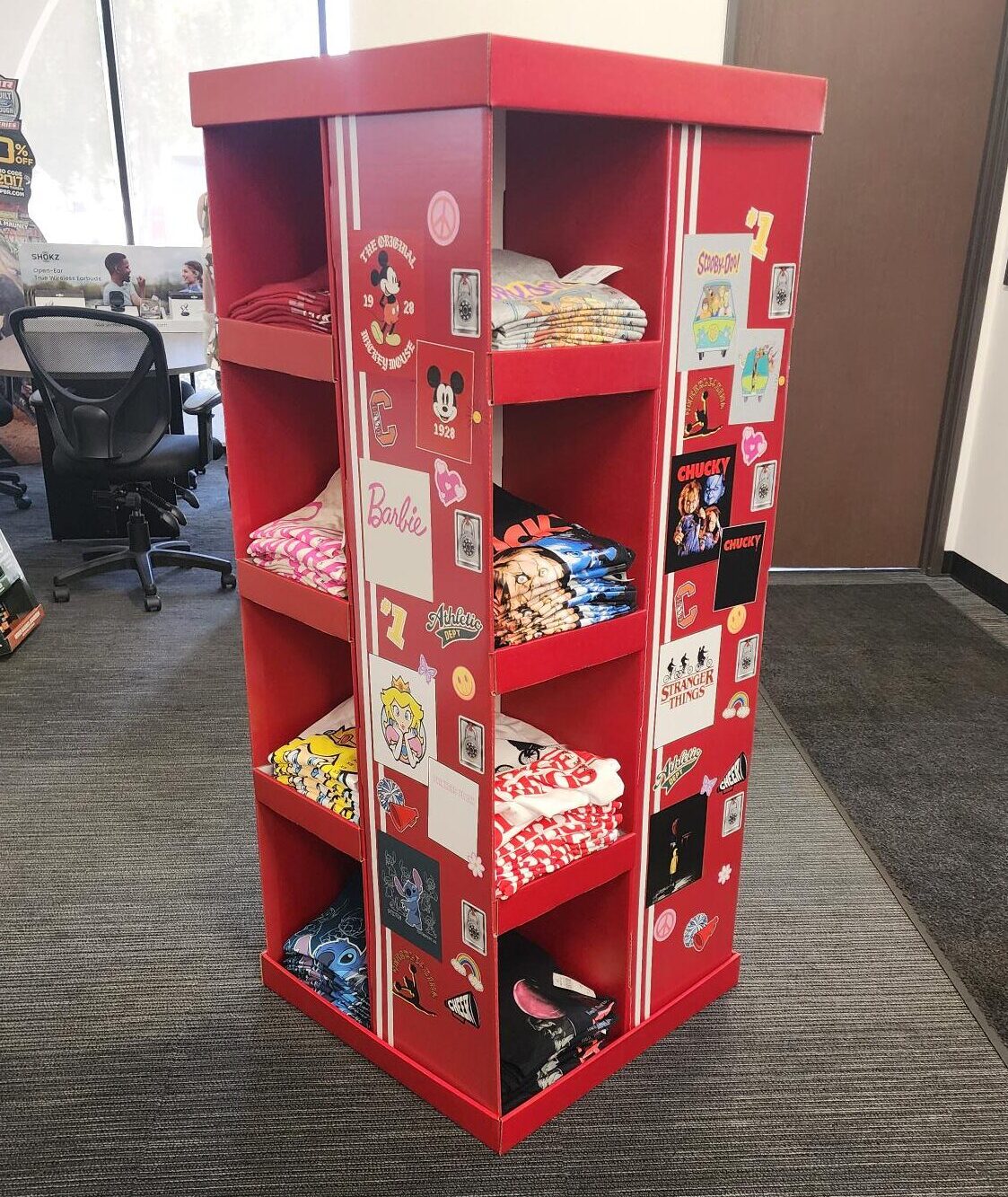
- Clearly separate SKUs
- Maintain product alignment as items sell
- Prevent mixing or collapse of layout
Without this:
- Products get disorganized
- Restocking becomes inconsistent
- Visual appeal declines quickly
Structural Design Impacts Replenishment Speed
Weak or complex structures slow everything down.
Problems include:
- Displays that shift during restocking
- Components that loosen over time
- Shelves that sag and block placement
This leads to:
- Longer restocking time
- Increased frustration
- Reduced compliance from store staff
A stable display is easier—and faster—to maintain.
Replenishment Frequency Changes Everything
Not all displays are restocked the same way.
- High-volume items → frequent replenishment
- Low-volume items → occasional restocking
Design must match this reality.
Frequent replenishment requires:
- Fast access
- Durable structure
- Simple organization
Otherwise, performance drops quickly.
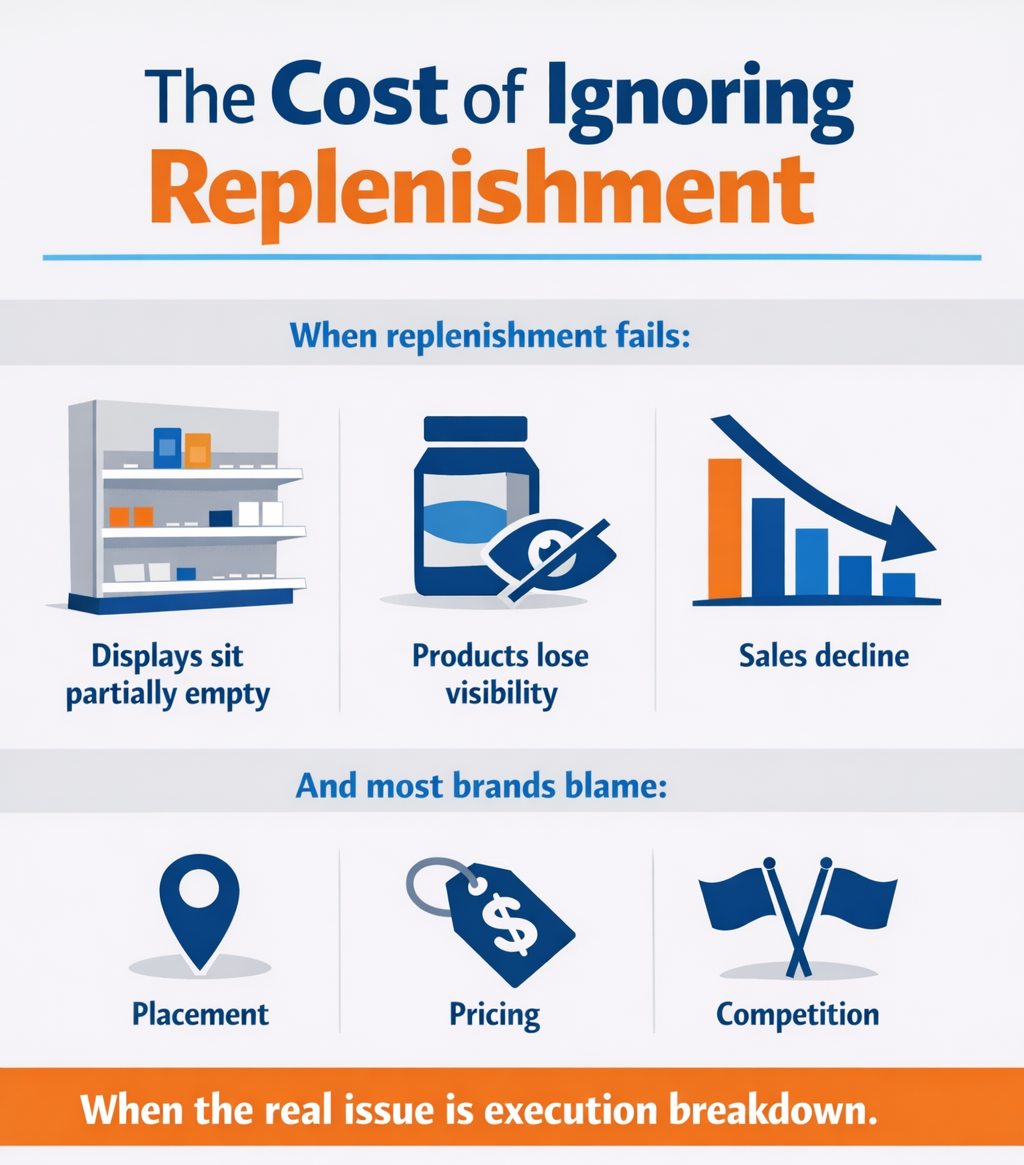
The Cost of Ignoring Replenishment
When replenishment fails:
- Displays sit partially empty
- Products lose visibility
- Sales decline
And most brands blame:
- Placement
- Pricing
- Competition
When the real issue is execution breakdown.
What High-Performing Displays Do Differently
They are designed for:
- Fast, intuitive restocking
- Clear product organization
- Minimal handling effort
- Consistent structure over time
They reduce friction—and friction is the enemy of retail execution.
Where Brands Get It Wrong
- Designing for appearance instead of usability
- Ignoring store-level labor constraints
- Overcomplicating product layouts
- Not testing replenishment speed
- Assuming perfect execution
These assumptions don’t hold up in real stores.
How Brown Packaging Designs for Replenishment Efficiency
At Brown Packaging, POP displays are engineered to perform throughout their lifecycle—not just at setup.
We focus on:
- Replenishment-friendly structures
- Clear SKU organization and access
- Durable designs that maintain integrity over time
- Reducing labor friction at store level
Because a display that can’t be restocked efficiently won’t stay full—and won’t sell.
References
Soroka, W. (2009). Fundamentals of Packaging Technology (4th ed.). IoPP.
Shop! Association. (2023). Retail Execution & In-Store Performance Study.
NielsenIQ. (2022). Retail Shelf and Display Effectiveness Report.
Deloitte. (2022). Retail Operations and Labor Efficiency Report.
ECR Retail Loss Group. (2022). Shelf Availability and Replenishment Study.
Most POP displays are designed for day-one appearance—not for what happens after the first few units sell. That’s a problem. Because in retail, performance is determined by what happens during
Most POP display decisions eventually come down to a tradeoff:make it look better or make it perform better. The mistake is thinking you have to choose. In reality, the best-performing
Many packaging purchasing decisions are made by comparing price per box. While this metric is easy to evaluate, it often fails to capture the real economics of packaging systems. Packaging
A POP display isn’t successful when it looks good leaving production—it’s successful when it arrives intact, gets placed correctly, and performs in-store. The problem is most displays are designed for
Home » Designing Displays for Replenishment