
Home » When to Transition from Digital to Flexographic Printing
When to Transition from Digital to Flexographic Printing
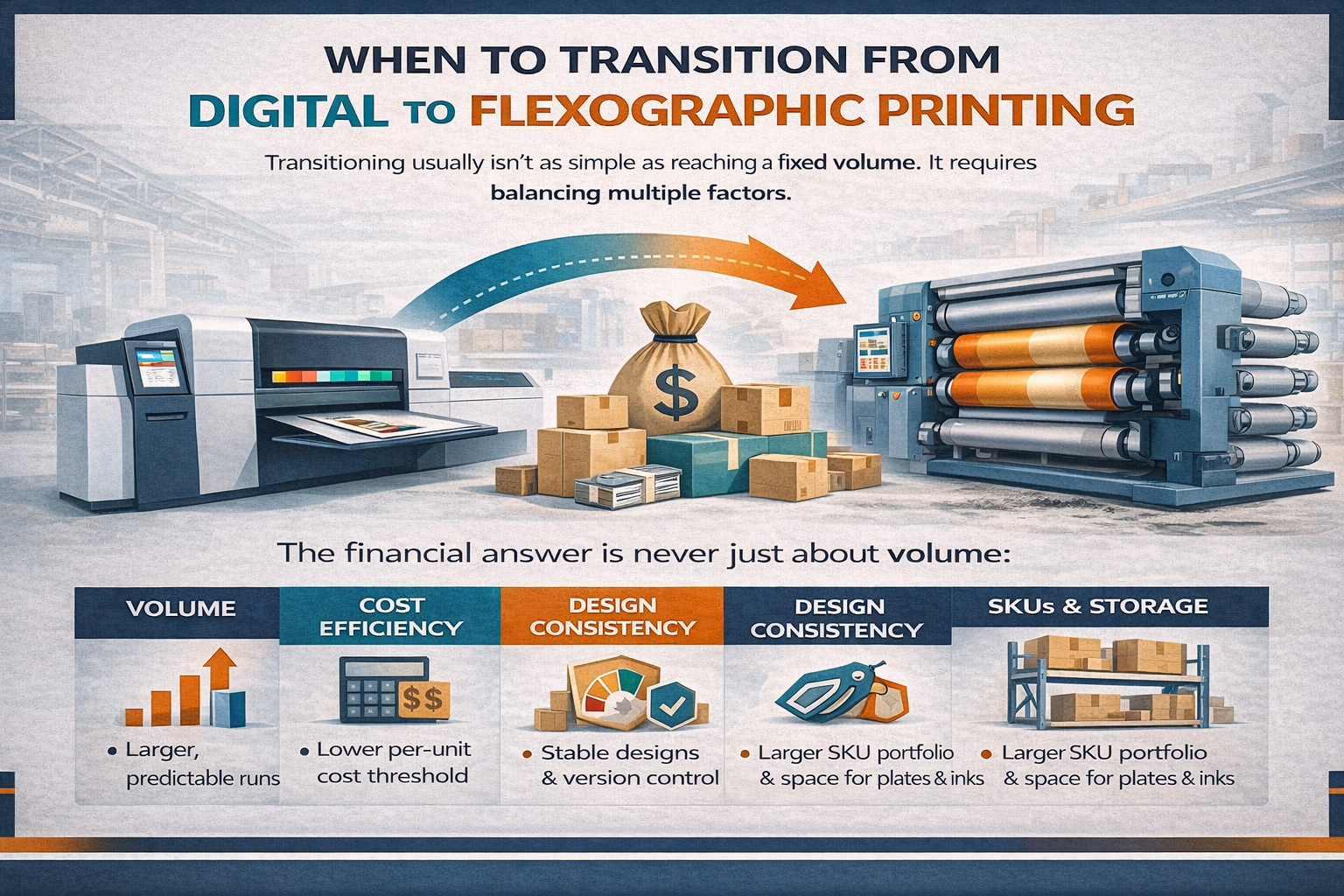
Digital printing is often the right starting point for growing brands and expanding SKU portfolios. But growth eventually raises a critical question: when does it make financial sense to transition to flexographic printing?
The answer is not based on volume alone.
The Traditional Assumption
Many buyers assume the shift should occur when:
- Annual volume increases
- Per-unit digital pricing appears higher
- Procurement pressures cost reduction
While scale matters, transitioning too early can increase financial risk and operational complexity.
The Four Indicators That a Transition May Make Sense
Volume Concentration
If one or two SKUs drive the majority of annual demand and forecast accuracy is strong, flexographic printing can create meaningful per-unit savings once plate costs are amortized.
Volume must be stable — not just high.
Artwork Stability
Flexographic printing performs best when graphics remain unchanged across extended production cycles. Frequent revisions, compliance updates, or seasonal redesigns reduce the financial benefit of plates.
If artwork volatility decreases, the case for flexo strengthens.
SKU Rationalization
When a portfolio tightens and SKU expansion slows, print efficiency improves. Fewer variations mean fewer plates and lower complexity.
If SKU growth continues, digital flexibility may remain more strategic.
Inventory Predictability
Flexographic efficiency depends on longer runs. That requires confidence in demand forecasting and inventory turnover.
If demand variability remains high, large print commitments may increase obsolescence risk.
When Not to Transition
Transitioning too early often leads to:
- Excess packaging inventory
- Plate reinvestment from mid-cycle artwork updates
- Higher write-off exposure
- Reduced agility for marketing and retail changes
If the business model still relies on frequent SKU expansion, regional variation, or promotional packaging, digital printing may continue to offer stronger total cost control despite higher unit pricing.
The Hybrid Reality
Many mature packaging programs do not fully “switch” methods. Instead, they segment:
- Flexographic printing for stable, high-volume core SKUs
- Digital printing for new launches, seasonal variants, and retailer-specific packaging
This protects margin while maintaining operational flexibility.
The smartest programs treat print methods as financial tools — not permanent commitments.
The Bottom Line
Transitioning from digital to flexographic printing should be based on volume stability, artwork consistency, SKU behavior, and forecast confidence — not pressure to reduce visible unit cost.
Contact Brown Packaging to evaluate your production data, SKU concentration, and forecast reliability to determine whether a transition, or a hybrid strategy, aligns with your financial and operational goals.
Sources
- PRINTING United Alliance – Comparative print production economics
- Flexible Packaging Association (FPA) – Digital and flexographic adoption trends
- PMMI – The Association for Packaging and Processing Technologies – Packaging operational efficiency research
- McKinsey & Company – Inventory and capital allocation studies
- Deloitte Supply Chain Reports – Forecast reliability and risk exposure analysis
Digital printing is often the right starting point for growing brands and expanding SKU portfolios. But growth eventually raises a critical question: when does it make financial sense to transition
Most POP display programs become inefficient over time—not because of poor design, but because of too many variations. Different sizes, different footprints, different structures. It feels flexible—but it creates: Higher
Packaging performance testing is designed to verify that packaging can withstand the stresses of distribution. Tests such as drop testing, compression testing, and vibration testing simulate transportation conditions and help
Most POP floor displays don’t fail immediately—they fail after they’ve been on the retail floor for a short period of time. Week one looks fine.By week two, problems start showing:
Home » When to Transition from Digital to Flexographic Printing