
Home » Flat Pack vs Pre Assembled Displays: What Retailers Prefer
Flat Pack vs Pre Assembled Displays: What Retailers Prefer
There’s no universal “better” option—but there is a better fit depending on your program.
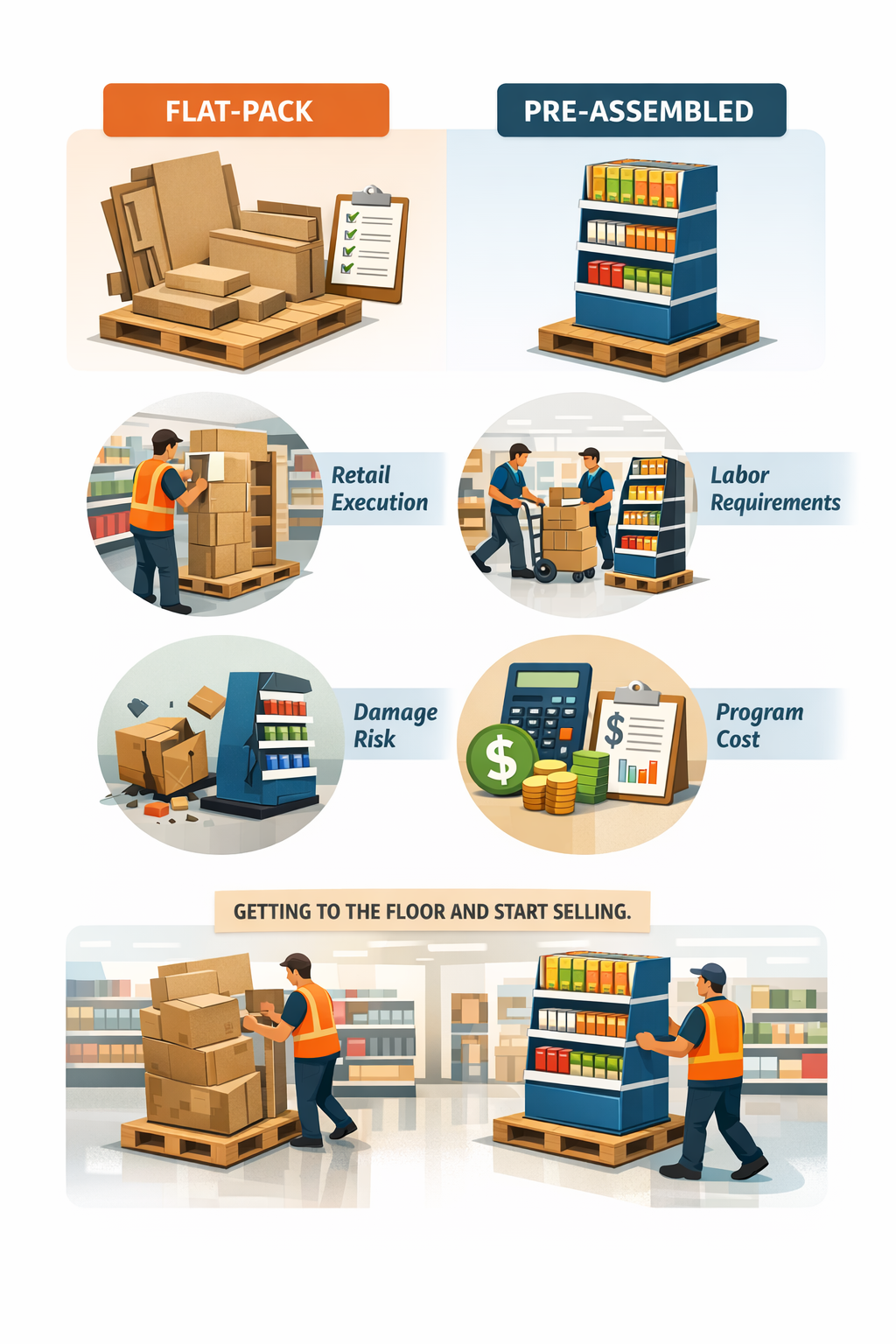
Brands often default to flat-pack to save on freight or pre-assembled for convenience, without fully understanding how each impacts:
- Retail execution
- Labor requirements
- Damage risk
- Overall program cost
Retailers don’t just care about how displays arrive—they care about how easily they get to the floor and start selling.
Flat-Pack Displays: Lower Freight, Higher Execution Risk
Flat-pack displays are shipped knocked down and assembled at the store or distribution level.
Where They Work Well
- High-volume rollouts
- Cost-sensitive programs
- Simple structural designs
- Retailers with available labor
Advantages
- Reduced freight costs (more units per pallet)
- Lower storage footprint
- Easier bulk shipping and handling
Where They Fail
- Complex assembly requirements
- Inconsistent setup across stores
- Increased labor burden at store level
Reality:
If assembly takes too long or isn’t intuitive, the display:
- Gets assembled incorrectly
- Or never gets assembled at all
Flat-pack saves money upfront—but can lose money in execution.
Pre-Assembled Displays: Higher Freight, Stronger Execution
Pre-assembled displays arrive ready to place on the floor with minimal setup.
Where They Work Well
- Retailers with limited labor availability
- Time-sensitive rollouts
- Complex or heavy display structures
- Club stores and high-volume environments
Advantages
- Faster placement on the floor
- Consistent setup across all locations
- Reduced store-level errors
- Better structural integrity out of the box
Where They Cost More
- Higher freight cost due to lower pallet density
- Increased storage space requirements
- Potentially higher production handling costs
But here’s the key:
They often perform better in-store because they eliminate execution risk.
What Retailers Actually Care About
Retailers prioritize:
- Speed of setup
- Minimal labor requirements
- Consistency across locations
- Structural reliability
They do not prioritize your freight savings.
If a display slows down store operations or creates extra work:
- It becomes a problem
- And problems get removed quickly
The Hidden Tradeoff: Freight vs Execution
Most decisions come down to this:
- Flat-pack → Lower freight, higher risk
- Pre-assembled → Higher freight, lower risk
What brands miss:
A display that never gets set up has a 100% failure rate—regardless of how cheap it was to ship.
Hybrid Approaches (Where Smart Programs Win)
You don’t always have to choose one or the other.
Hybrid solutions include:
- Partially assembled displays (critical structure pre-built)
- Quick-lock designs that reduce assembly time
- Modular components that simplify setup
These approaches balance:
- Freight efficiency
- Ease of assembly
- Structural consistency
This is where engineering makes the difference.
Matching the Format to the Retail Channel
Different environments require different approaches:
- Club stores → Pre-assembled (speed + durability)
- Big box retail → Often hybrid or simple flat-pack
- Specialty retail → Depends on complexity and volume
There is no one-size-fits-all solution.
Where Brands Get It Wrong
- Choosing based only on freight cost
- Underestimating store-level labor constraints
- Overcomplicating flat-pack designs
- Ignoring retailer preferences
- Not testing assembly time
These decisions don’t show up as problems until rollout—and by then, it’s too late.
How Brown Packaging Optimizes Display Format
At Brown Packaging, we help brands choose the right format based on real-world execution—not assumptions.
We evaluate:
- Retailer requirements and labor constraints
- Structural complexity and product weight
- Freight vs performance tradeoffs
- Assembly time and consistency
The goal is to deliver a display that doesn’t just ship efficiently—but gets placed, stays intact, and sells.
References:
Shop! Association. (2023). Retail Execution Study.
Freedonia Group. (2023). Retail Displays Market Analysis.
Deloitte. (2022). Retail Operations Efficiency Report.
McKinsey & Company. (2021). Supply Chain Optimization in Retail.
ISTA. (2023). Transport Packaging Testing Guidelines.
Packaging performance testing is designed to verify that packaging can withstand the stresses of distribution. Tests such as drop testing, compression testing, and vibration testing simulate transportation conditions and help
Most POP floor displays don’t fail immediately—they fail after they’ve been on the retail floor for a short period of time. Week one looks fine.By week two, problems start showing:
A lower unit price doesn’t mean lower cost. In POP display programs, the biggest losses rarely show up on the quote—they show up in damage rates, retail rejection, poor sell-through,
A visually impressive POP display doesn’t guarantee performance. In fact, many of the best-looking displays underperform because they’re designed for approval—not for real retail conditions. What works in a render,
Home » Flat Pack vs Pre Assembled Displays: What Retailers Prefer