

Home » How Folding Cartons Are Made
How Folding Cartons Are Made
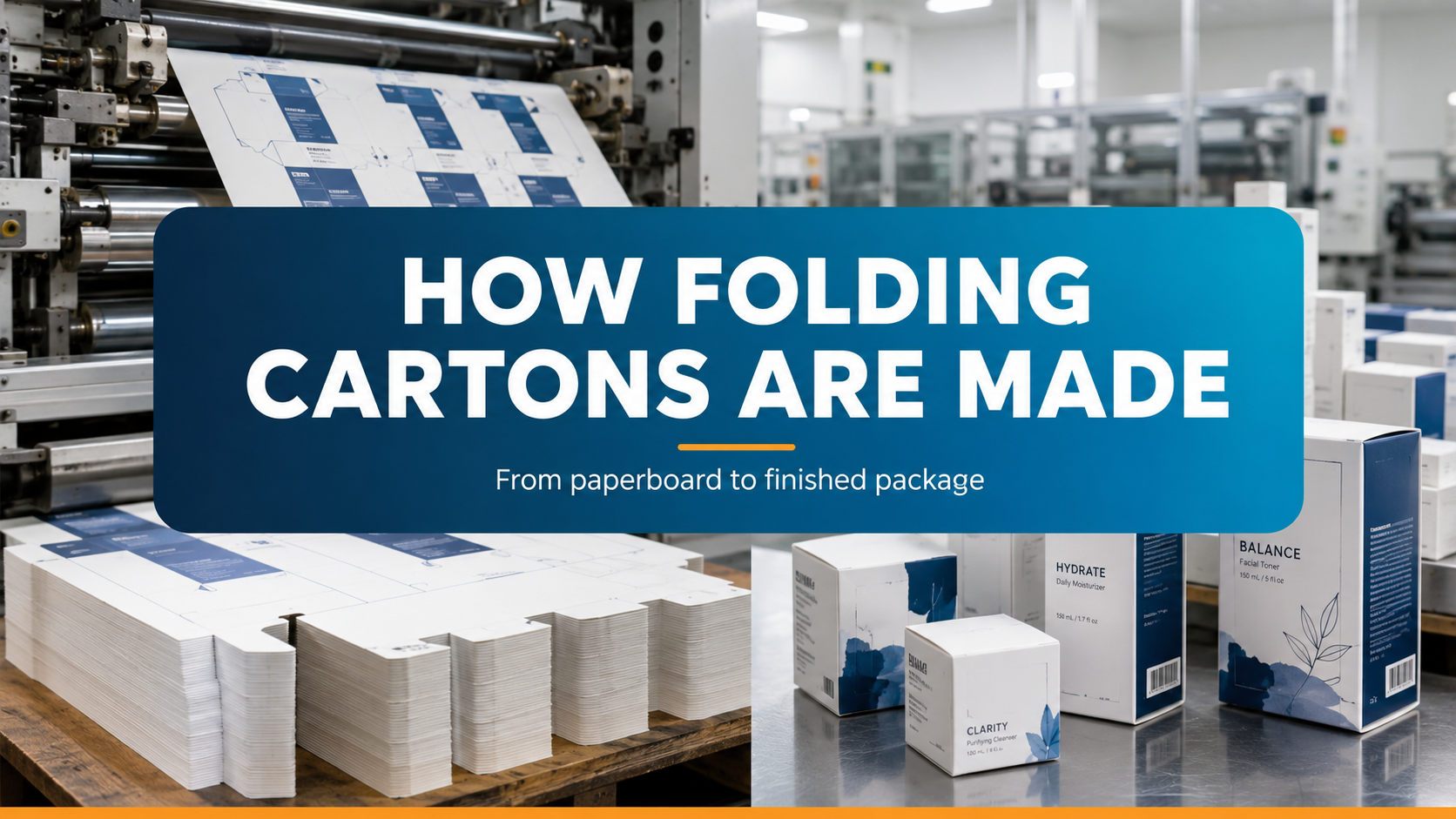
A folding carton may look simple once it reaches the shelf, but it goes through a controlled production process before it becomes a finished package. Every step — from paperboard selection to printing, die-cutting, scoring, folding, gluing, and inspection — affects cost, appearance, durability, and production efficiency.
For packaging buyers, understanding this process matters because small decisions early in the project can create major issues later. The wrong board grade can affect stiffness. A poor dieline can delay production. Weak scoring can affect how the carton folds. Overcomplicated finishes can increase lead time and cost.
The goal is not just to produce an attractive carton. The goal is to create a folding carton that can be printed cleanly, converted accurately, packed efficiently, and perform consistently in the market.
Paperboard Selection
The process starts with selecting the right paperboard.
Paperboard choice affects:
- Print quality
- Stiffness
- Folding performance
- Moisture resistance
- Shelf appearance
- Cost
- Compatibility with coatings or finishes
A carton used for cosmetics may need a bright, smooth surface for premium graphics. A frozen food carton may need better moisture resistance. A healthcare carton may prioritize clean print, consistency, and regulatory readability. A value-tier retail carton may prioritize cost efficiency.
This is why folding carton material should never be selected based on price alone. The board needs to match the product, print expectations, filling process, retail environment, and supply chain conditions.
Dieline and Structural Design
After the material direction is established, the carton structure is designed.
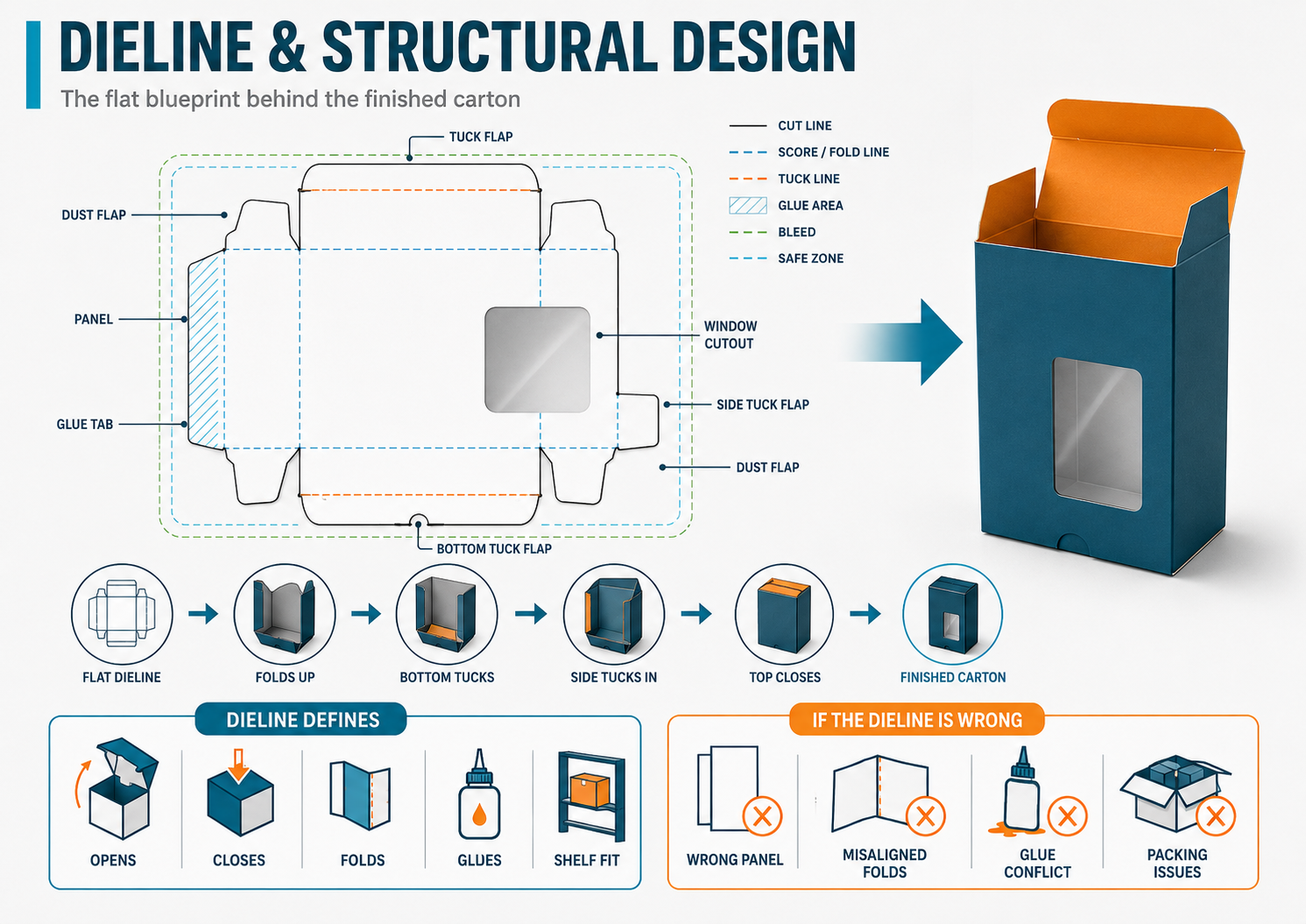
The dieline is the flat blueprint of the folding carton. It shows:
- Cut lines
- Fold lines
- Score lines
- Glue tabs
- Tuck flaps
- Dust flaps
- Panels
- Windows or cutouts
- Bleed and safe zones
This flat layout eventually becomes the finished three-dimensional carton.
The dieline controls how the carton opens, closes, folds, glues, and presents on shelf. A strong dieline helps reduce production delays because it gives the printer and converter a clear path from artwork to finished structure.
If the dieline is wrong, the entire project can be affected. Artwork may be placed on the wrong panel, folds may not align, glue areas may interfere with printing, or the carton may not run efficiently during packing.
Printing
Most folding cartons are printed while the paperboard is still flat.
This allows the full carton layout to receive graphics before it is cut, creased, folded, or glued. At this stage, brand colors, product information, regulatory copy, barcodes, images, and retail-facing graphics are applied to the sheet.
Printing decisions affect:
- Color consistency
- Shelf impact
- Brand presentation
- Readability
- Retail compliance
- Finish compatibility
- Production speed
For buyers, print quality is not only about looking good. It also affects how clearly the carton communicates product value, instructions, ingredients, claims, and required information.
A carton can have the right structure and still underperform if the print does not support the product’s category, retail environment, or customer expectations.
Coatings and Finishes
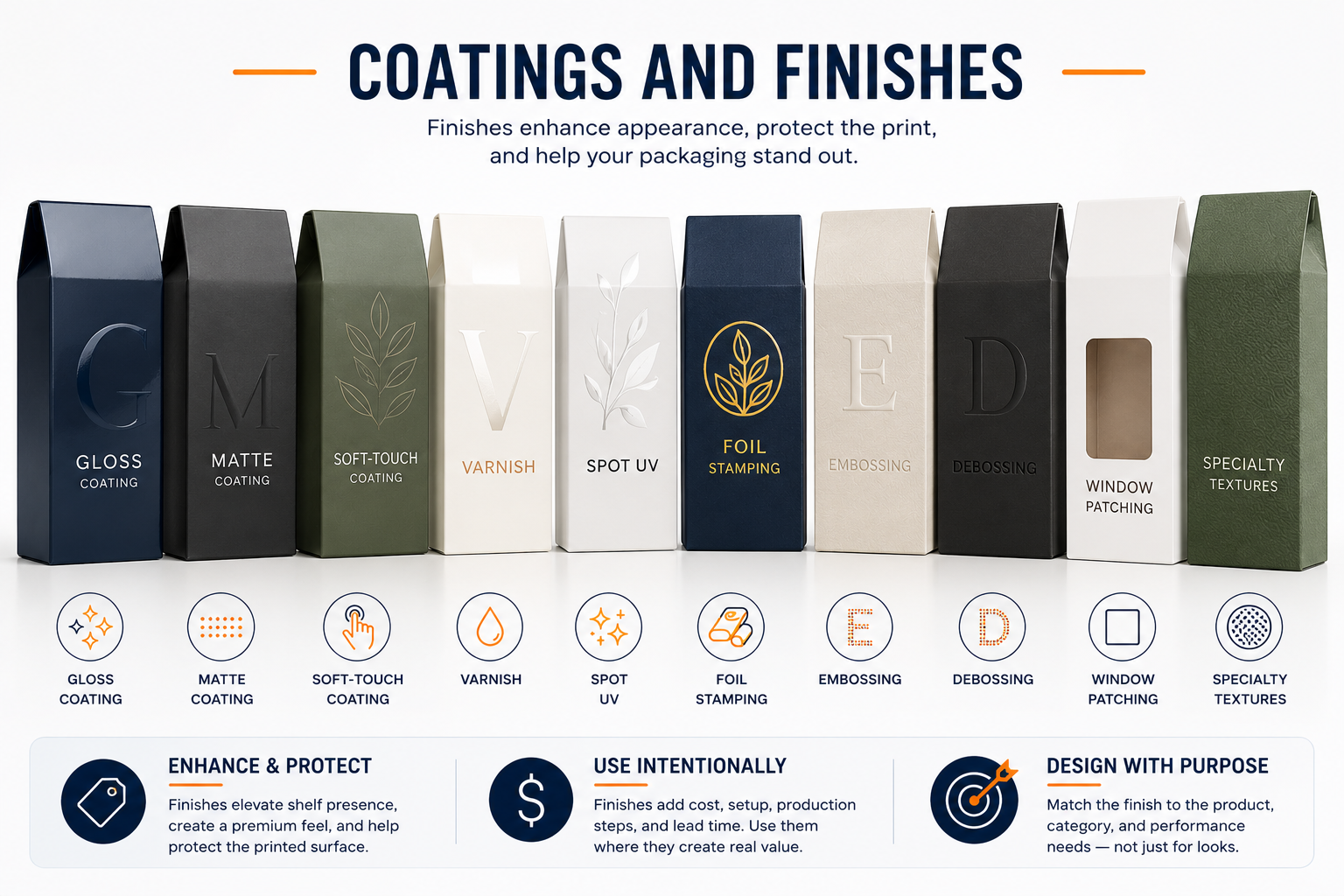
After printing, folding cartons may receive coatings or specialty finishes.
These can include:
- Gloss coating
- Matte coating
- Soft-touch coating
- Varnish
- Spot UV
- Foil stamping
- Embossing
- Debossing
- Window patching
- Specialty textures
Finishes can improve shelf presence, create a premium feel, protect the print surface, or help differentiate the product in a crowded category.
But finishes also add cost, setup requirements, production steps, and lead time. They should be used intentionally.
A premium cosmetic carton may justify foil or embossing. A high-volume food carton may not. A product that needs visibility may benefit from a window, but the window must be designed carefully so it does not weaken the carton or increase cost without improving the sale.
The Paperboard Packaging Council’s folding carton training includes production topics such as windowing, cold and hot foil, tooling, laminating, and automatic packaging, which reflects how many finishing and converting decisions can affect carton performance.
Die-Cutting
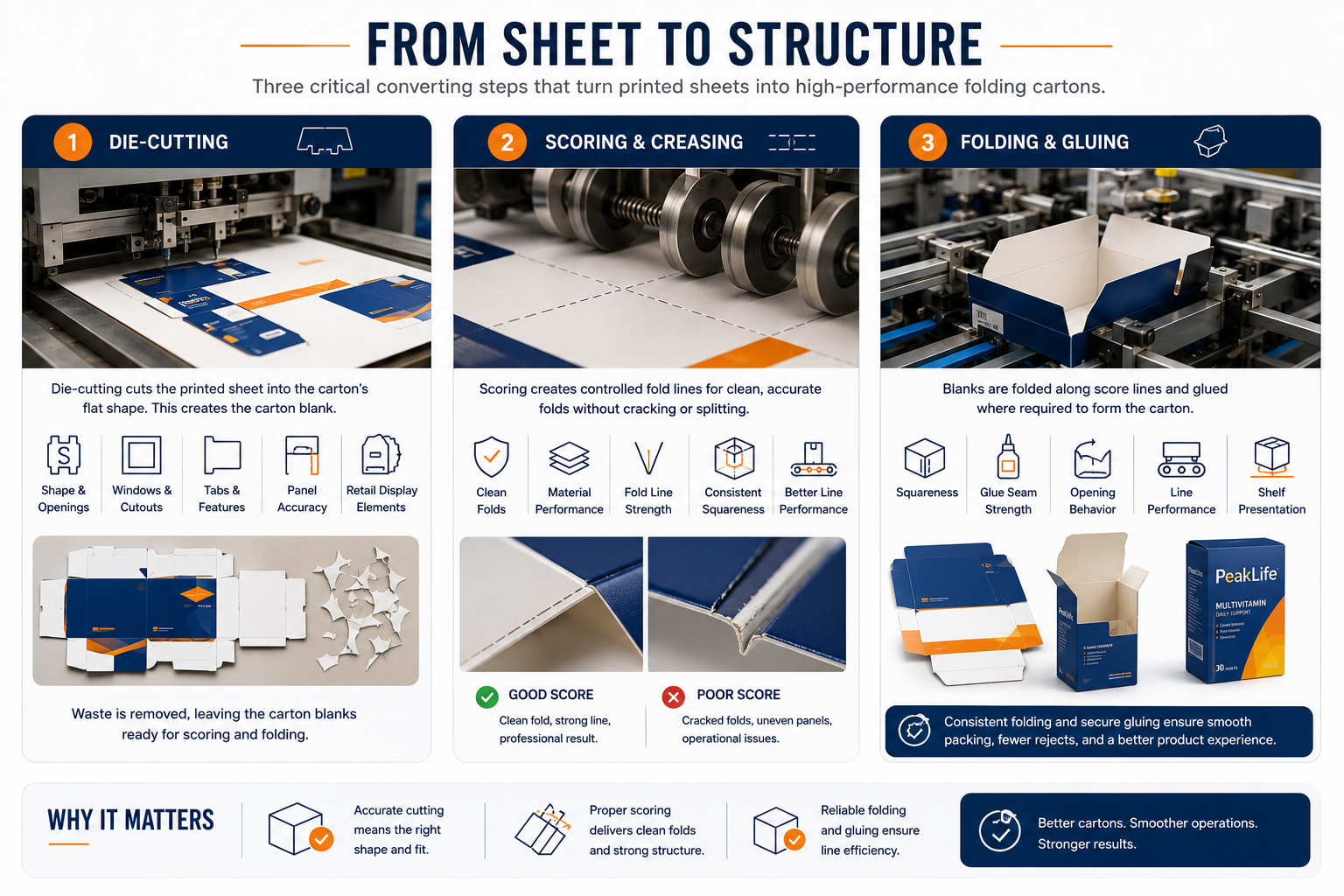
Die-cutting is the step that cuts the printed sheet into the carton’s flat shape.
This is where the printed sheet becomes a carton blank. The die cuts the outside shape, openings, windows, tabs, and structural features required for the final package.
Die-cutting affects:
- Carton shape
- Panel accuracy
- Window placement
- Tuck flap fit
- Glue tab alignment
- Retail display features
- Finished carton consistency
A carton with a simple shape may be straightforward to cut. A carton with windows, hang tabs, unusual curves, specialty openings, or complex locking features requires more precision.
After cutting, waste material is removed from around the carton blanks. The Paperboard Packaging Council describes blanking as the final stage of the cutting process, where waste is stripped and blanks are stacked before folding and gluing.
For buyers, this matters because die-cutting accuracy directly affects how the carton folds, closes, and appears after assembly.
Scoring and Creasing
Scoring creates controlled fold lines in the paperboard.
This step is critical because folding cartons need to fold cleanly without cracking, splitting, delaminating, or springing open. The score must be matched to the board grade, caliper, fiber direction, coating, and carton structure.
Poor scoring can lead to:
- Cracked folds
- Uneven panels
- Difficult opening
- Poor carton squareness
- Weak fold lines
- Gluing issues
- Problems on automated filling lines
Scoring is more technical than many buyers realize. Research published in TAPPI Journal discusses scoring and folding of paperboard as converting operations where material behavior affects delamination and folding performance.
For buyers, the important point is simple: a carton is only as good as its ability to fold correctly. Even strong graphics and premium board will not save a carton that folds poorly.
Folding and Gluing
Once the carton blanks are printed, cut, and scored, they move into folding and gluing.
This is where the flat carton blank is folded along the score lines and glued where required. Depending on the carton style, the finished cartons may be shipped flat and later opened for filling, or they may be formed closer to the packing process.
Folding and gluing affect:
- Carton squareness
- Glue seam strength
- Opening behavior
- Filling line performance
- Closure consistency
- Shelf presentation
- Final package quality
This step matters because cartons often need to run through manual, semi-automated, or automated packing processes.
If a carton is hard to open, does not square properly, or has inconsistent glue seams, it can slow down packing and create operational issues.
For automated filling lines, consistency is even more important. Cartons must open, fill, close, and move through equipment reliably. A small structural issue can lead to jams, rejects, downtime, or rework.
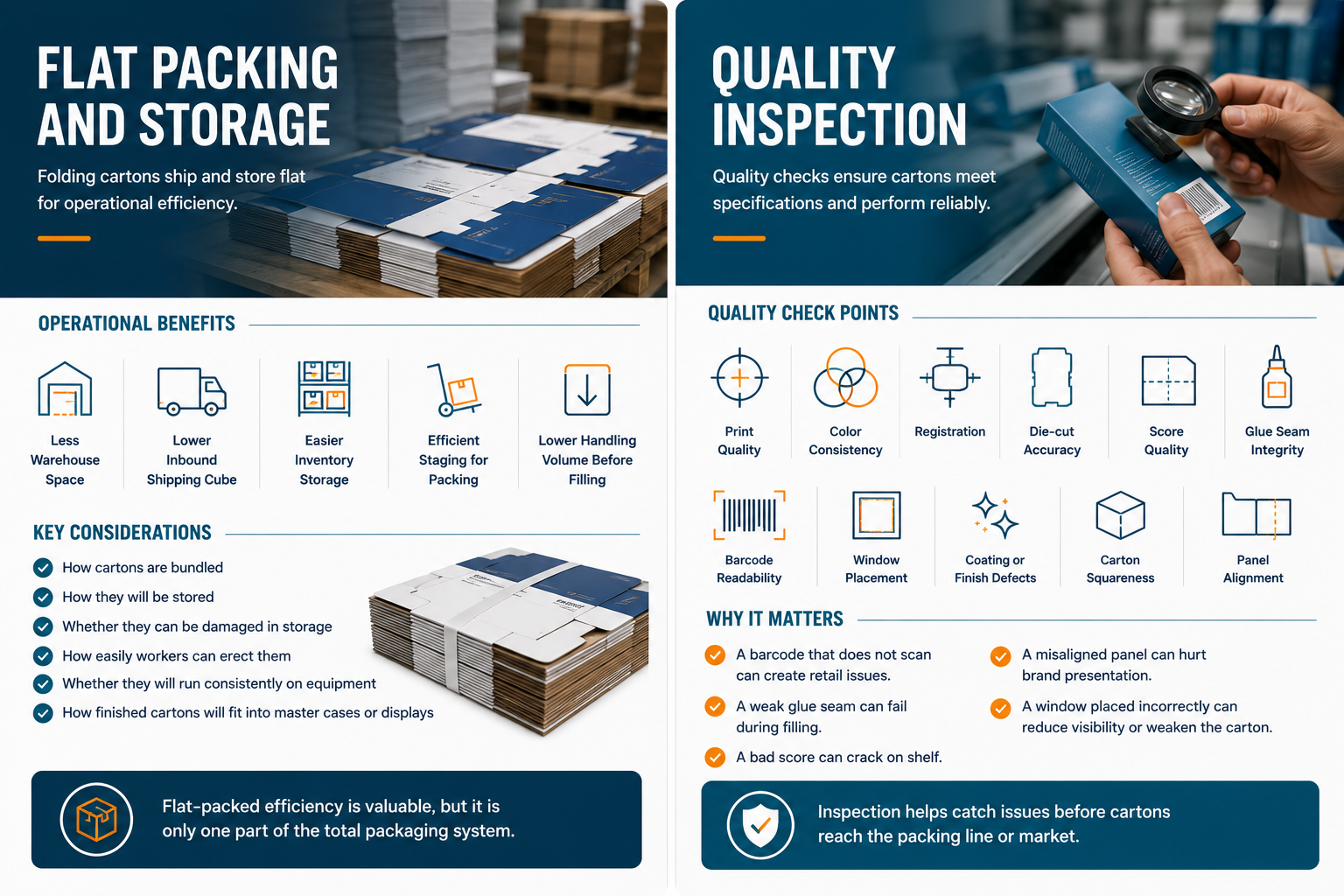
Flat Packing and Storage
One of the advantages of folding cartons is that they can usually be shipped and stored flat before use.
This creates operational benefits:
- Less warehouse space
- Lower inbound shipping cube
- Easier inventory storage
- Efficient staging for packing
- Lower handling volume before filling
However, flat storage only helps if the cartons are designed and packed correctly.
Buyers should still consider:
- How cartons are bundled
- How they will be stored
- Whether they can be damaged in storage
- How easily workers can erect them
- Whether they will run consistently on equipment
- How finished cartons will fit into master cases or displays
Flat-packed efficiency is valuable, but it is only one part of the total packaging system.
Quality Inspection
Before cartons are released, they should be checked for production quality.
Quality inspection may include:
- Print quality
- Color consistency
- Registration
- Die-cut accuracy
- Score quality
- Glue seam integrity
- Barcode readability
- Window placement
- Coating or finish defects
- Carton squareness
- Panel alignment
For buyers, quality issues can create more than visual problems.
A barcode that does not scan can create retail issues. A weak glue seam can fail during filling. A bad score can crack on shelf. A misaligned panel can hurt brand presentation. A window placed incorrectly can reduce visibility or weaken the carton.
Inspection helps catch these issues before cartons reach the packing line or market.
Why the Manufacturing Process Matters to Buyers
Understanding how folding cartons are made helps buyers make better decisions before production starts.
The manufacturing process affects:
- Lead time
- Unit cost
- Tooling
- Print quality
- Material performance
- Packing speed
- Shelf impact
- Quality consistency
- Reorder reliability
Most production problems are not caused by one isolated step. They usually happen when the carton design, material, artwork, finishing, and filling requirements are not aligned.
Common issues include:
Wrong Board for the Application
The carton may look right but lack stiffness, folding performance, or moisture resistance.
Poor Dieline Setup
Artwork, panels, folds, glue tabs, or windows may not align correctly.
Overcomplicated Finishes
Too many embellishments can increase cost, setup time, and production complexity.
Weak Scoring
Poor scores can cause cracking, folding issues, or inconsistent carton shape.
Carton Not Designed for Packing
A carton may look good in a rendering but slow down manual or automated filling.
No Full-System Review
The carton must work with the product, insert, master case, display, pallet, and supply chain.
This is why folding carton development should not be treated as a design-only process. It is a production and performance decision.
What Buyers Should Confirm Before Production
Before approving a folding carton, buyers should confirm:
Is the board grade right for the product?
The material should match weight, print needs, moisture exposure, and shelf expectations.
Is the dieline final and production-ready?
The structure should be approved before artwork and tooling move forward.
Are printing and finishing requirements clearly defined?
Colors, coatings, foil, embossing, windows, and specialty effects should be documented.
Will the carton run manually or automatically?
Packing method affects structure, opening force, closure type, and consistency.
Are scoring and folding requirements considered?
The carton must fold cleanly and hold shape after forming.
Will the carton be stored flat?
Storage, staging, and handling should be planned before production.
Does the finished carton need secondary packaging?
Master cases, retail displays, shippers, and palletization should be considered.
Are quality standards defined?
Buyers should know what matters most: color, barcode scanability, glue integrity, appearance, or structural performance.
These questions help prevent delays, rework, and packaging that looks good but performs poorly.
Final Takeaway
Folding cartons are made through a sequence of connected production steps: paperboard selection, dieline development, printing, finishing, die-cutting, scoring, folding, gluing, packing, and inspection.
Each step affects the final result.
A carton that looks simple on shelf may require careful coordination between material, structure, artwork, converting, and packing requirements.
For buyers, the goal is not just to approve a carton that looks good. The goal is to approve a carton that can be produced efficiently, packed consistently, and perform reliably in the market.
A folding carton is not just a printed box. It is a manufactured packaging system built from paperboard, structure, print, and process control.
Partner With Brown Packaging
Brown Packaging helps buyers develop folding cartons that are built around product requirements, production efficiency, and supply chain performance.
We can support structure selection, paperboard recommendations, dieline review, print method guidance, finishing decisions, and packaging specifications for retail, food, beverage, cosmetics, healthcare, household goods, promotional packaging, and specialty consumer products.
Whether your project requires a simple retail carton, premium printed packaging, windowed cartons, specialty finishes, or cartons designed for manual or automated packing, we can help align the design with the full production process.
Partner with Brown Packaging to build folding cartons that are ready for production, shelf impact, and real-world performance.
References
Paperboard Packaging Council. (2018, January 26). What to know about die-cutting. https://paperbox.org/what-to-know-about-die-cutting/
Paperboard Packaging Council. (n.d.). Folding Carton Essentials. https://ppcu.paperbox.org/products/folding-carton-boot-camp-online
Xia, Q., Boyce, M. C., & Parks, D. M. (2012). Delamination in the scoring and folding of paperboard. TAPPI Journal, 11(1), 54–61. https://www.researchgate.net/profile/Bandaru_Ramarao/publication/286761205_Delamination_in_the_scoring_and_folding_of_paperboard/
Sustainable packaging in 2027 will be less about broad claims and more about proof, performance, compliance, and cost control. Buyers will still care about recyclable materials, recycled content, and lower
Sustainable packaging in 2027 will be less about broad claims and more about proof, performance, compliance, and cost control. Buyers will still care about recyclable materials, recycled content, and lower
A folding carton may look simple once it reaches the shelf, but it goes through a controlled production process before it becomes a finished package. Every step — from paperboard
Folding carton production is becoming more automated because buyers are asking for faster timelines, tighter consistency, and more flexibility across more SKUs. Shorter product lifecycles, retail launch windows, labor pressure,
By submitting your information, you agree to our terms and conditions and privacy policy.

Home » How Folding Cartons Are Made


Reverse Tuck End (RTE) cartons are a popular packaging solution known for their unique design and versatility. In this blog, we will delve into the

When it comes to maximizing shelf space and capturing buyer attention, few pairings are more effective than folding cartons and POP displays. Whether it’s a
A folding carton may look simple once it reaches the shelf, but it goes through a controlled production process before it becomes a finished package.