

Home » How Automation Impacts Folding Carton Cost and Lead Times
How Automation Impacts Folding Carton Cost and Lead Times
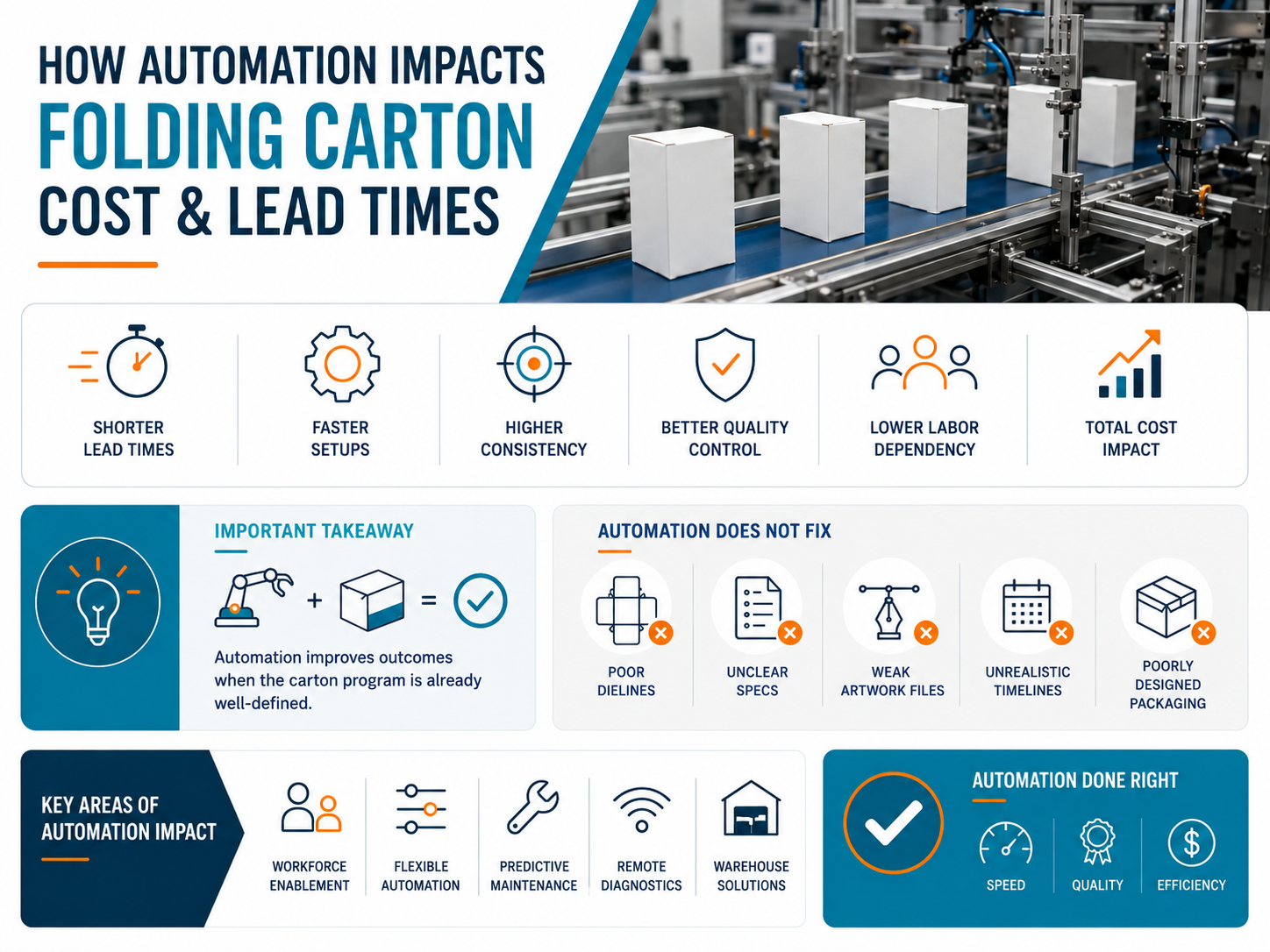
Folding carton production is becoming more automated because buyers are asking for faster timelines, tighter consistency, and more flexibility across more SKUs. Shorter product lifecycles, retail launch windows, labor pressure, and higher quality expectations all create more demand for controlled, repeatable production.
For packaging buyers, automation is not just a machinery topic. It affects lead times, setup efficiency, quality inspection, production consistency, and total program cost.
Industry reporting from PMMI points to automation as a major packaging and processing trend, especially as companies deal with labor constraints, ecommerce growth, facility limitations, and the need for more flexible operations. PMMI’s automation report highlights workforce enablement, flexible automation adoption, predictive maintenance, remote diagnostics, and warehouse solutions as key focus areas for packaging and processing operations.
For folding carton buyers, the important takeaway is simple: automation improves production outcomes when the carton program is already well-defined. It does not fix poor dielines, unclear specs, weak artwork files, unrealistic timelines, or packaging that was not designed around the product and filling process.
Why Automation Matters in Folding Carton Production
A folding carton project moves through multiple production stages before it becomes a finished package.
That may include:
- Artwork and prepress
- Material selection
- Printing
- Coating or finishing
- Die-cutting
- Stripping
- Folding
- Gluing
- Inspection
- Packing and shipment
Each step affects the next. If the dieline is wrong, prepress slows down. If the board grade is not matched to the structure, folding and gluing may become inconsistent. If inspection is not controlled, defects may be caught too late.
Automation helps reduce variation across these steps by improving repeatability, setup control, and quality monitoring.
The biggest value is not just speed. It is consistency.
For retail, food, healthcare, cosmetics, and consumer product cartons, consistency matters because the carton is not only protecting the product. It is also carrying branding, regulatory information, barcode data, and shelf presentation.
How Automation Affects Lead Times
Lead time is not determined only by how fast a machine runs.
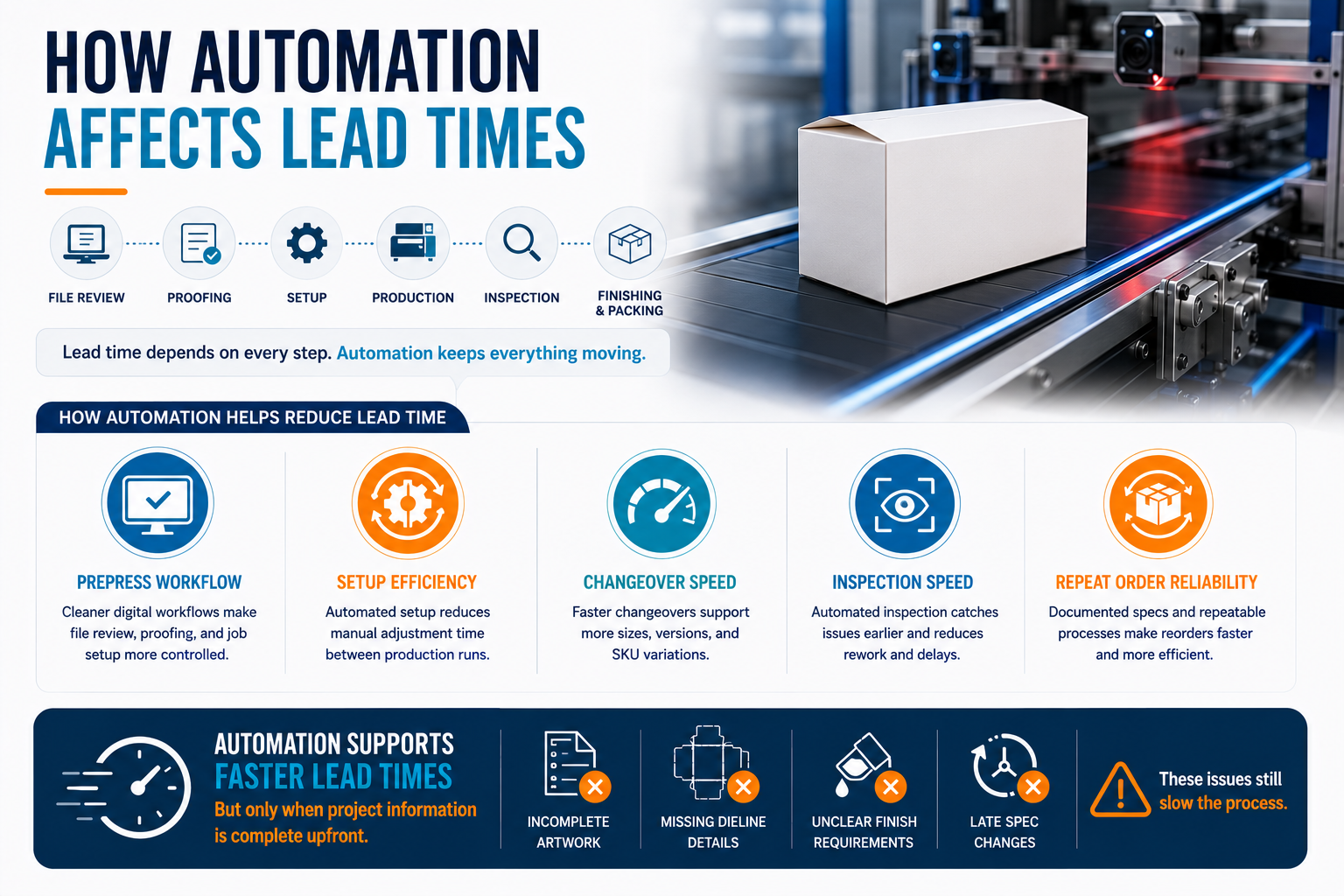
It is affected by how quickly the job moves through file review, proofing, setup, production, inspection, finishing, and packing.
Automation can help reduce lead time by improving:
Prepress Workflow
Cleaner digital workflows can make file review, proofing, and job setup more controlled.
Setup Efficiency
Automated setup reduces manual adjustment time between production runs.
Changeover Speed
This matters when buyers have multiple carton sizes, product versions, or SKU variations.
Inspection Speed
Automated inspection can help identify defects earlier instead of relying only on manual review.
Repeat Order Reliability
When specifications are documented and repeatable, reorders can move more efficiently.
PMMI’s warehouse automation report connects packaging automation demand to direct-to-consumer growth, labor gaps, warehouse constraints, and packaging flexibility. Those same pressures affect folding carton programs when buyers need faster launches, more versions, and fewer production delays.
For buyers, the lesson is clear: automation supports faster timelines, but only when the project information is complete upfront.
Incomplete artwork, missing dieline details, unclear finish requirements, or late specification changes will still slow the process.
How Automation Affects Cost
Automation does not automatically make every folding carton cheaper.
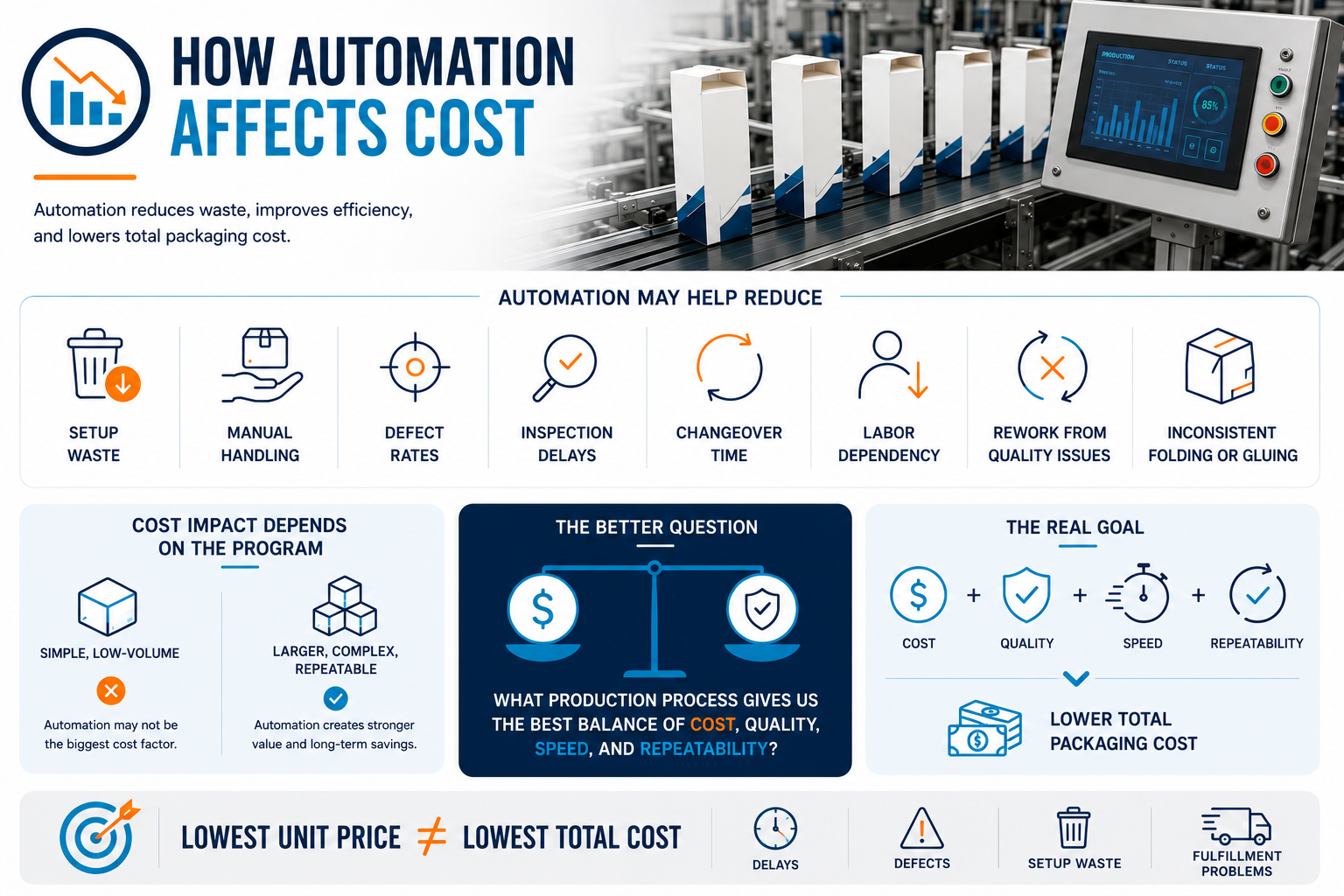
Instead, automation can reduce cost by improving production efficiency and reducing waste caused by errors, downtime, rework, manual handling, and inconsistent execution.
Automation may help reduce:
- Setup waste
- Manual handling
- Defect rates
- Inspection delays
- Changeover time
- Labor dependency
- Rework from quality issues
- Inconsistent folding or gluing
The cost impact depends on the program.
For a simple, low-volume carton, automation may not be the biggest cost factor. For larger or repeatable programs with multiple SKUs, tight tolerances, retail requirements, or recurring orders, automation can create stronger value because it improves repeatability.
The buyer should not ask only:
“What is the price per carton?”
The better question is:
“What production process gives us the best balance of cost, quality, speed, and repeatability?”
That shift matters because the lowest unit price does not always create the lowest total packaging cost if the program creates delays, defects, setup waste, or fulfillment problems.
Automation in Prepress and File Preparation
Prepress is one of the most common places folding carton projects slow down.
Before production begins, files need to be checked for:
- Correct dieline
- Panel orientation
- Bleed
- Safe zones
- Color setup
- Barcode placement
- Spot colors
- Coating layers
- Foil or embossing layers
- Image resolution
- Font handling
Automation and digital workflow tools can make this process more controlled, but they still depend on good input.
If the file is built incorrectly, automation may catch the issue faster. It will not make the file production-ready by itself.
This is why buyers should align dielines, specs, finishes, and artwork requirements early. A clean file can move faster. A messy file slows the entire project down.
Automation in Die-Cutting
Die-cutting determines the physical shape of the folding carton.
This step affects:
- Panel alignment
- Fold performance
- Tuck flap fit
- Window placement
- Glue tab accuracy
- Carton squareness
- Final assembly
Automation in die-cutting helps improve consistency and repeatability, especially when cartons include complex structures or tight tolerances.
This matters most when cartons include:
- Windows
- Hang tabs
- Specialty shapes
- Complex tuck closures
- Auto-bottom structures
- Multi-panel graphics
- Retail display features
- High-end finishing effects
More complex designs create more opportunities for misalignment. Automation helps manage that complexity, but the structure still needs to be engineered correctly.
The Paperboard Packaging Council’s Folding Carton Essentials training covers topics such as windowing, automatic packaging, cold and hot foil, tooling, and laminating, which reflects how many production variables can affect folding carton performance.
Automation in Folding and Gluing
Folding and gluing are where the flat carton becomes a usable package.
A carton may print correctly and die-cut correctly but still fail if it does not fold or glue consistently.
Automation in folding and gluing can improve:
- Glue placement consistency
- Fold accuracy
- Carton squareness
- Production speed
- Repeatability
- Reduced manual handling
- Finished carton consistency
This matters for both manual packing and automated filling.
If cartons are inconsistent, workers may struggle to open, fill, or close them. If cartons run on automated filling lines, inconsistency can cause jams, downtime, and rejected cartons.
For buyers, folding and gluing performance should be reviewed early when cartons use:
- Lightweight board
- Heavy board
- Specialty coatings
- Tight folds
- Unusual structures
- Auto-bottoms
- High-speed packing requirements
- Retail or pharmaceutical requirements
Automation helps improve consistency, but the carton still needs the right material, score design, glue specifications, and structural layout.
Automation in Quality Inspection
Quality inspection is one of the most important benefits of automation.
Manual inspection can miss defects, especially at higher production speeds or across larger runs. Automated inspection can help identify problems earlier and more consistently.
Inspection may focus on:
- Print defects
- Color variation
- Registration issues
- Missing graphics
- Die-cut accuracy
- Glue defects
- Barcode readability
- Coating or finishing issues
- Structural defects
For buyers, inspection matters because folding cartons often carry brand, compliance, and retail information. A defect is not always just cosmetic. It can affect barcode scanning, regulatory readability, shelf presentation, or customer perception.
Automated inspection works best when buyers define quality standards before production starts.
That includes:
- Critical panels
- Color expectations
- Barcode requirements
- Finish placement
- Acceptable tolerances
- Defect thresholds
If the project does not define what matters, inspection becomes harder to manage.
Automation and Multi-SKU Folding Carton Programs
Many folding carton buyers are managing more versions than before.
More SKUs can mean:
- More artwork versions
- More carton sizes
- More language versions
- More regulatory variations
- More promotional changes
- More retail-specific requirements
- More inventory complexity
Automation can help manage that complexity through better changeovers, digital workflow control, repeat job setup, and inspection consistency.
But automation does not eliminate SKU complexity. It only makes complexity easier to manage when the program is structured well.
Buyers should still evaluate:
- Which SKUs need unique cartons
- Which cartons can share structures
- Which sizes can be standardized
- Which artwork versions are necessary
- Which finishes add real value
- Which cartons require special handling
- Which SKUs justify higher production complexity
Automation is useful, but SKU discipline still matters.
Where Automation Does Not Solve the Problem
Automation is not a shortcut for poor packaging planning.
It will not fix:
- Incorrect dielines
- Wrong board grade
- Unclear specifications
- Poor artwork setup
- Weak structural design
- Unrealistic lead times
- Excessive version changes
- Bad barcode placement
- Overcomplicated finishes
- Cartons not designed for the filling process
This is one of the most important points for buyers.
Automation makes a good process faster and more consistent. It can also expose weak planning faster.
If the carton design is not aligned with the product, filling process, retail environment, and production requirements, automation will not make it successful.
What Buyers Should Confirm Before Production
Buyers do not need to know every machine specification. They need to know whether their folding carton program is ready to run consistently.
Before production, confirm:
Is the carton structure finalized?
Changing structure late can affect tooling, artwork, cost, and timing.
Is the dieline approved?
The dieline should match the actual carton style, size, board, and production requirements.
Are artwork files production-ready?
Files should include bleed, safe zones, correct color setup, barcode placement, and separated finishing layers when needed.
Is the board grade appropriate?
Material affects print quality, folding, gluing, stiffness, and filling performance.
Are finishes clearly specified?
Foil, embossing, coatings, varnish, and specialty effects should be intentional and documented.
Will the carton be packed manually or automatically?
Filling requirements affect structure, opening behavior, closure, and consistency.
How many versions are involved?
More versions require stronger version control and artwork management.
What quality standards matter most?
Buyers should define critical areas such as color, barcode readability, glue integrity, and front panel appearance.
Will this be a repeat program?
Repeatability changes how buyers should think about setup, tooling, specs, and cost.
These questions help automation support the program instead of simply reacting to problems.
What This Means for Cost and Lead Time
Automation can improve folding carton cost and lead time when the program is organized around production efficiency.
The biggest advantages usually come from:
- Faster setup
- More consistent output
- Better defect control
- Reduced manual variation
- Improved repeatability
- More efficient changeovers
- Better production planning
- Lower rework risk
But the benefit depends on preparation.
A well-prepared carton program can move faster through automated production. A poorly prepared program may still get delayed during file review, proofing, specification changes, or quality approval.
The buyer’s role is to make sure the project is clearly defined before production begins.
That includes structure, material, artwork, finishes, labeling, filling process, and timeline.
Final Takeaway
Automation is changing folding carton production by improving speed, consistency, inspection, setup efficiency, and repeatability.
But automation does not replace strong packaging planning.
The best results happen when automation is paired with clean files, approved dielines, correct materials, realistic tolerances, and clear production requirements.
For buyers, the goal is not just to find the fastest production option. The goal is to build a folding carton program that can run efficiently, repeat consistently, and support cost control over time.
Automation makes strong carton programs perform better. It does not make weak carton programs production-ready.
Partner With Brown Packaging
Brown Packaging helps buyers develop folding carton programs that are built for production, not just design approval.
We can support structure selection, material recommendations, dieline review, print method guidance, finishing decisions, and packaging specifications that help reduce delays, improve repeatability, and control cost.
Whether your folding cartons are for retail, food, beverage, cosmetics, healthcare, household goods, promotional packaging, or specialty products, we can help align the carton design with the production process and supply chain requirements.
Partner with Brown Packaging to build folding carton packaging that performs in production, on shelf, and across your operation.
References
Paperboard Packaging Council. (n.d.). Folding Carton Essentials. Paperboard Packaging Council. https://ppcu.paperbox.org/products/folding-carton-boot-camp-online
PMMI. (2024, May 3). 2022 The Future of Automation in Packaging and Processing. PMMI. https://www.pmmi.org/report/2022-future-automation-packaging-and-processing
PMMI. (2024, May 3). 2023 Packaging and Automation in the Warehouses of the Future. PMMI. https://www.pmmi.org/report/2023-packaging-and-automation-warehouses-future
PMMI. (n.d.). Packaging and Automation in the Warehouses of the Future. PMMI. https://www.pmmi.org/video/packaging-and-automation-in-the-warehouses-of-the-future
A folding carton may look simple once it reaches the shelf, but it goes through a controlled production process before it becomes a finished package. Every step — from paperboard
Folding carton production is becoming more automated because buyers are asking for faster timelines, tighter consistency, and more flexibility across more SKUs. Shorter product lifecycles, retail launch windows, labor pressure,
Folding carton style matters because structure affects more than appearance. The right carton can improve shelf presentation, packing speed, product access, closure security, storage efficiency, and overall cost. For retail
Pouch packaging trends in 2027 will be shaped by convenience, shelf impact, sustainability pressure, sealing performance, automation, ecommerce growth, and total packaging cost. Buyers will still want pouches that look
By submitting your information, you agree to our terms and conditions and privacy policy.

Home » How Automation Impacts Folding Carton Cost and Lead Times

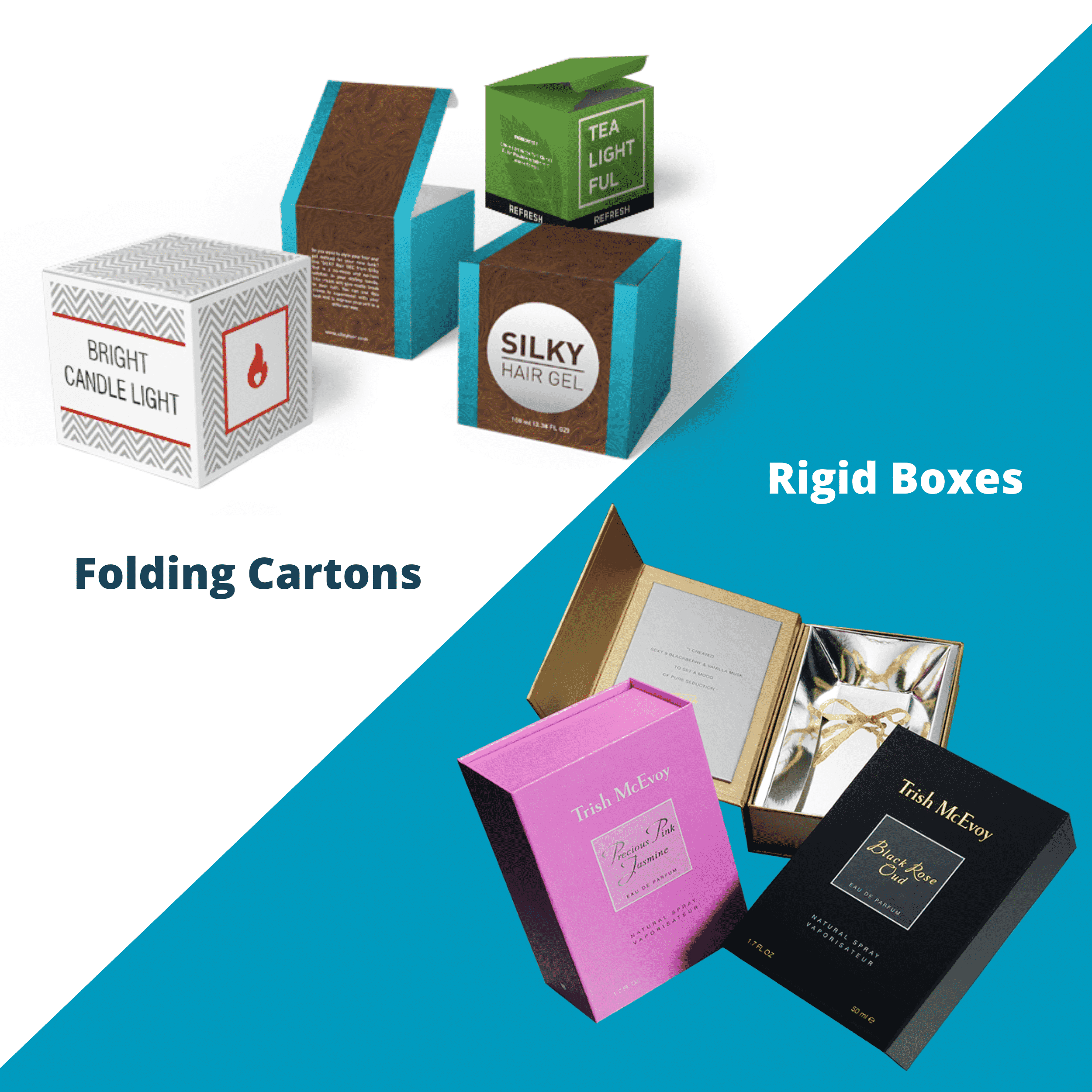

When it comes to packaging your products, the choice between folding cartons and rigid boxes is crucial. Both types serve similar purposes in protecting, displaying,
Straight Tuck End (STE) folding cartons are a popular and widely used type of packaging for consumer goods such as food, beverage, cosmetics, and household

Folding carton artwork can look finished on screen and still create problems once it reaches production. The dieline is where design, structure, printing, cutting, folding,