Home » Why Store Employees Redesign POP Displays
Why Store Employees Redesign POP Displays
Your POP display isn’t used the way you designed it.
It’s used the way the store needs it.
That means:
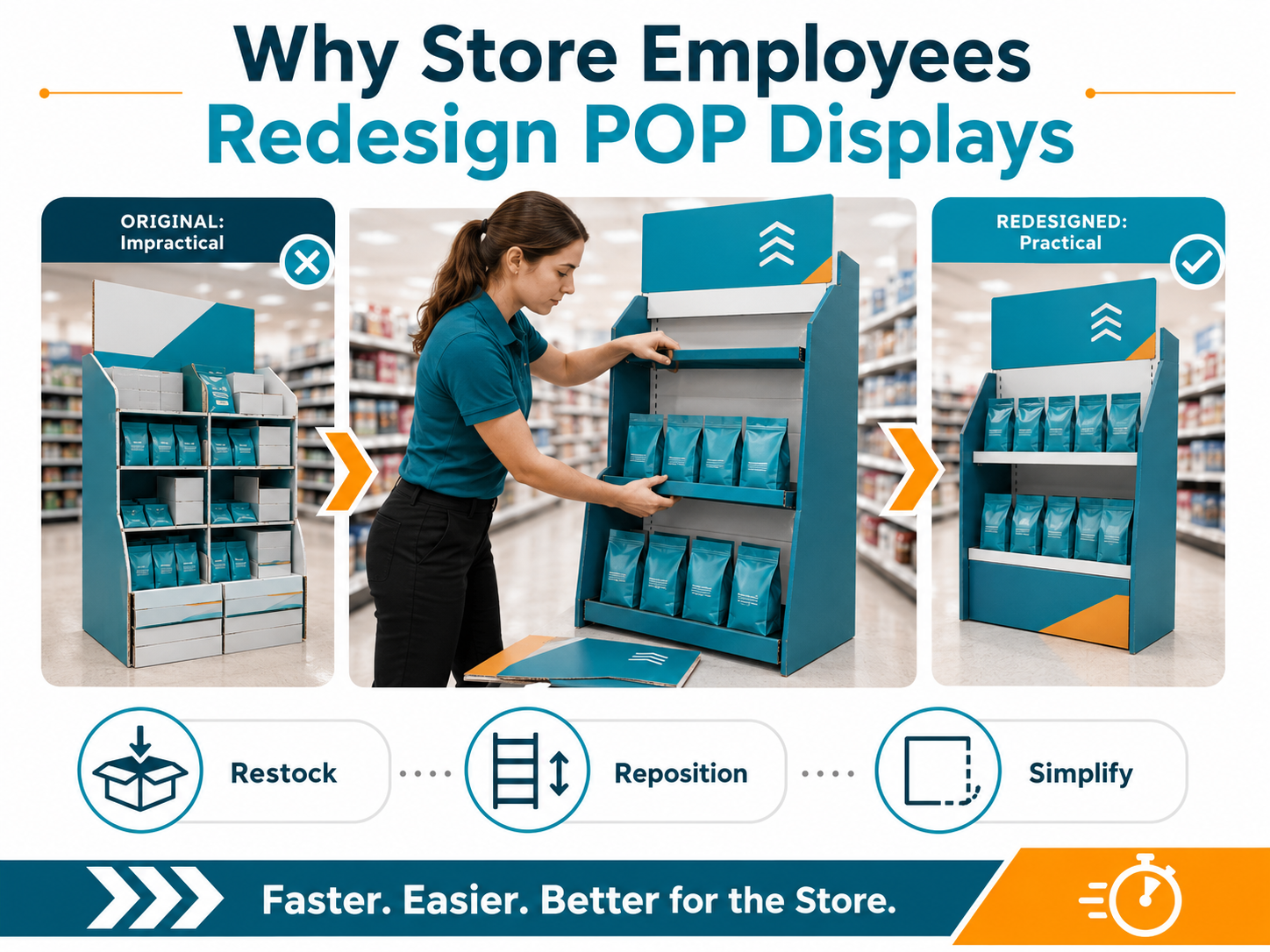
- Products get moved
- Inserts get removed
- Layouts get simplified
- Structure gets altered
Not because the design is bad—but because it doesn’t match real store behavior.
The Reality: Stores Optimize for Speed, Not Design
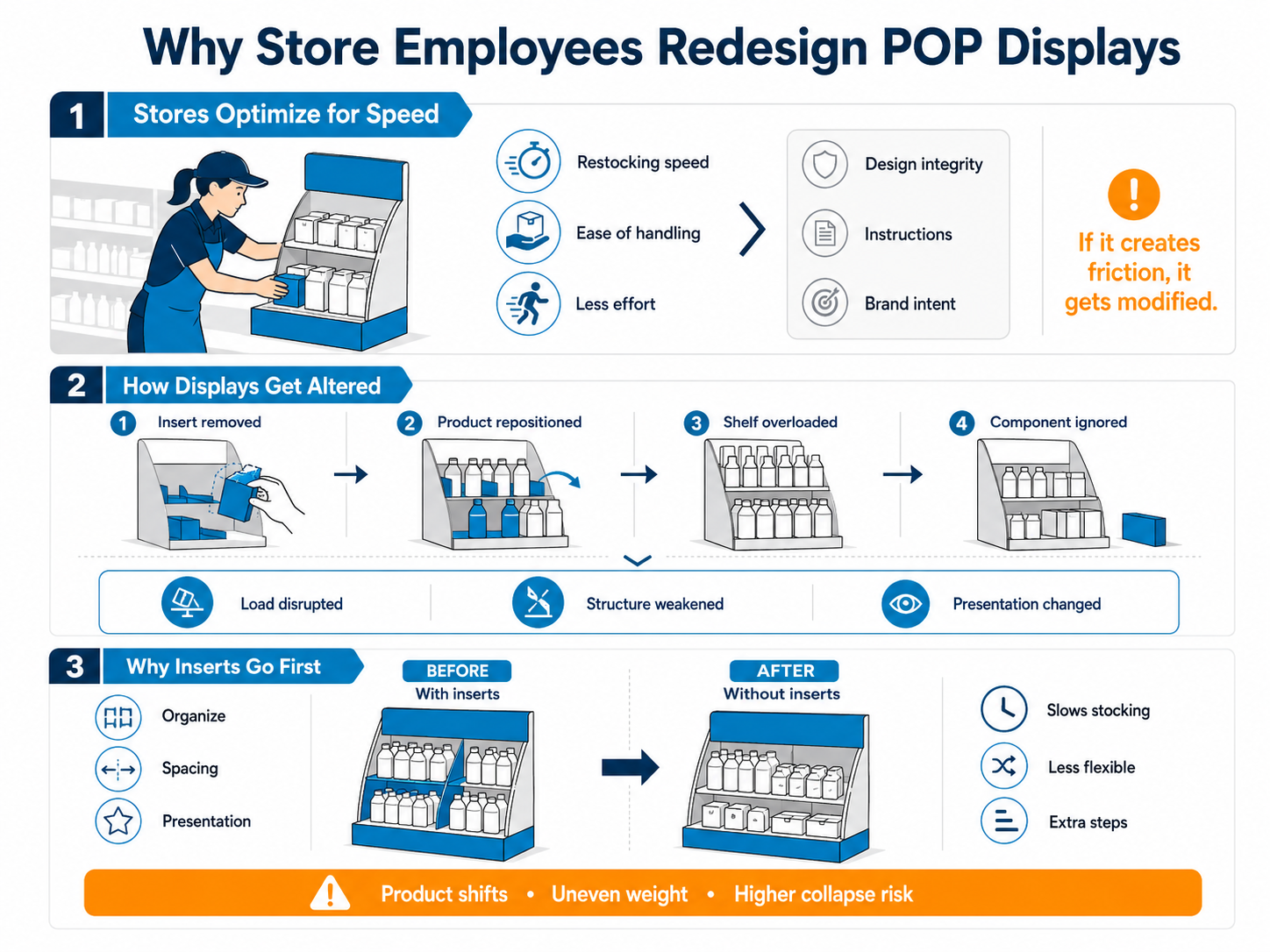
Store employees are focused on:
- Speed of restocking
- Ease of handling
- Minimizing effort
They are not focused on:
- Maintaining display integrity
- Following layout instructions
- Preserving brand intent
If your display creates friction:
👉 It gets modified
Common Ways Displays Get Altered
What actually happens in-store:
- Inserts removed to fit more product
- Products repositioned for easier access
- Shelves overloaded beyond intended capacity
- Components ignored or discarded during setup
These changes:
- Disrupt load distribution
- Reduce structural integrity
- Alter visual presentation
The display you designed is no longer the display in-store.
Why Inserts Are Often the First to Go
Inserts are designed to:
- Organize product
- Maintain spacing
- Improve presentation
But in-store, they:
- Slow down stocking
- Limit flexibility
- Add steps
So employees:
👉 Remove them
Result:
- Product shifts during use
- Uneven weight distribution
- Higher risk of collapse or misalignment
Overloading Happens More Than You Think
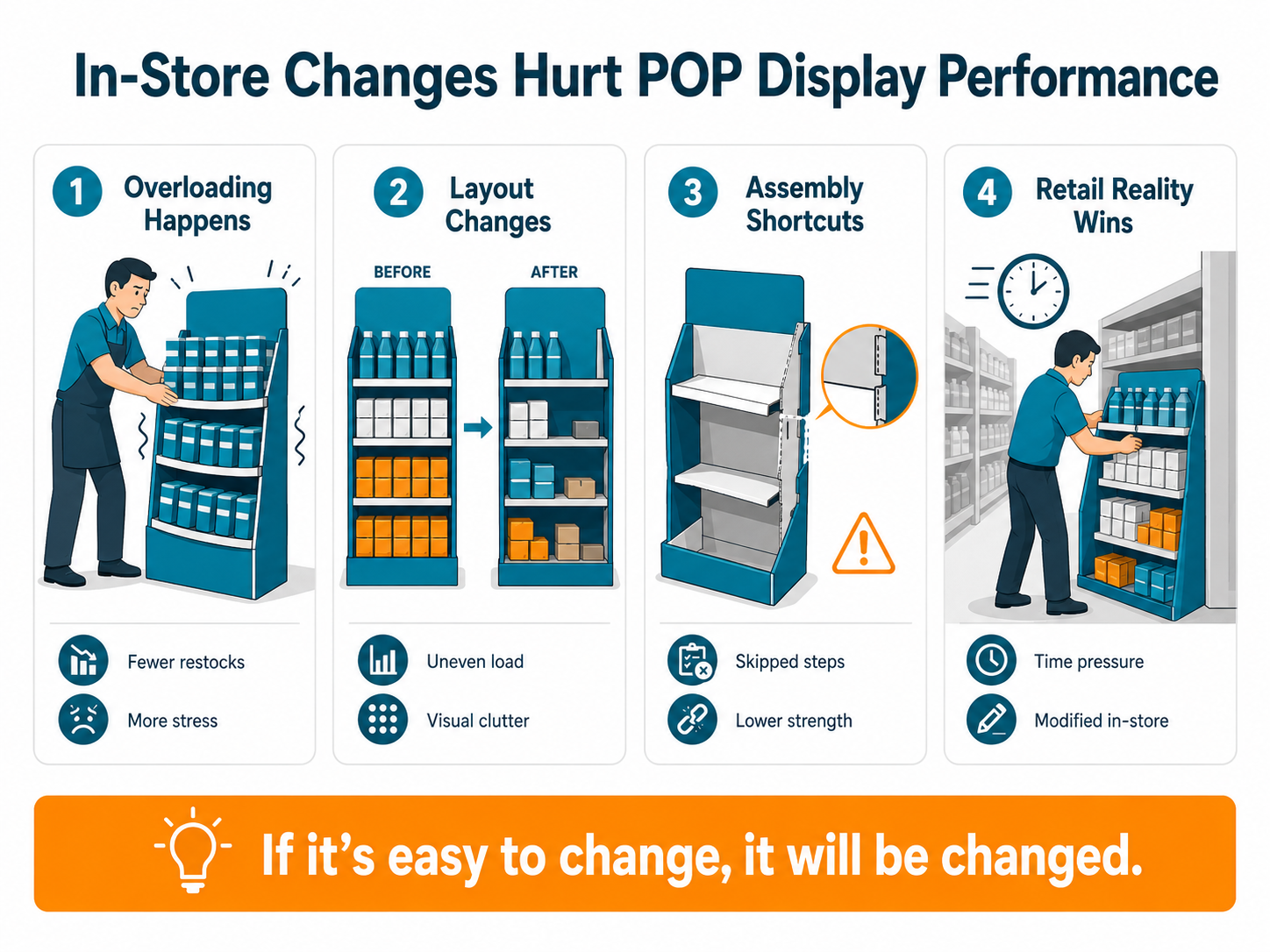
Displays are often loaded beyond intended capacity.
Why:
- Employees want fewer restocks
- More product = less work
This creates:
- Excess structural stress
- Shelf deformation
- Reduced lifespan of the display
Design load limits are rarely followed in real conditions.
Layout Changes Affect Performance
Original design:
- Balanced product placement
- Controlled visual presentation
In-store reality:
- High-demand items grouped together
- Empty spaces ignored
- Layout becomes inconsistent
This leads to:
- Uneven depletion
- Visual clutter or gaps
- Reduced shopper engagement
The display stops functioning as intended.
Assembly Shortcuts Reduce Structural Strength
If assembly is complex:
- Steps get skipped
- Components get misaligned
- Structural features aren’t fully engaged
This results in:
- Lower load capacity
- Instability under normal use
- Early failure in-store
If it’s easy to assemble wrong:
👉 It will be assembled wrong
Retail Environment Overrides Design Intent
Even perfect designs are affected by:
- Limited labor
- Time pressure
- Store layout constraints
Employees adapt displays to:
👉 What works for them—not what was designed
Ignoring this reality leads to performance gaps.
What High-Performing Displays Do Differently
They are designed for:
- Minimal setup complexity
- Flexible product placement
- Reduced reliance on inserts
- Tolerance for overloading and variation
They assume:
👉 The display will be modified—and still perform
Designing for Real Behavior, Not Ideal Conditions
Better designs:
- Guide behavior instead of requiring it
- Reduce decision-making at store level
- Maintain structure even with variation
This means:
- Fewer failure points
- More consistent execution
- Better overall performance
Where Brands Get It Wrong
- Designing for perfect execution
- Overcomplicating structure and layout
- Relying heavily on inserts and instructions
- Ignoring store-level behavior
- Not testing real-world usage scenarios
These mistakes turn good designs into poor performers.
How Brown Packaging Designs for Store-Level Reality
At Brown Packaging, POP displays are engineered for how they’re actually used—not how they’re intended to be used.
We focus on:
- Simplifying assembly and stocking
- Reducing reliance on removable components
- Designing for variation in product placement
- Maintaining performance under real store conditions
Because if the store changes your display—and it can’t handle it—it won’t last.
References
Underhill, P. (2009). Why We Buy: The Science of Shopping.
Shop! Association. (2023). Retail Execution and Merchandising Study.
NielsenIQ. (2022). In-Store Behavior Report.
Deloitte. (2022). Retail Operations and Labor Efficiency Study.
Soroka, W. (2009). Fundamentals of Packaging Technology (4th ed.). IoPP.
Your POP display isn’t used the way you designed it. It’s used the way the store needs it. That means: Products get moved Inserts get removed Layouts get simplified Structure
Lower cost per unit looks like a win. Until the display: Fails early Doesn’t get placed Doesn’t sell product Then it becomes expensive—fast. Because POP display cost isn’t about what
Many packaging systems pass lab testing—and still fail in real-world shipping. This disconnect happens because testing measures controlled conditions, while shipping introduces variables that are rarely accounted for. If your
Folding carton artwork can look finished on screen and still create problems once it reaches production. The dieline is where design, structure, printing, cutting, folding, and gluing all come together.
Home » Why Store Employees Redesign POP Displays