




Home » Holiday Multi-SKU Kitting: Streamline Your Packaging
Holiday Multi-SKU Kitting: Streamline Your Packaging
The Challenge of Multi-SKU Holiday Programs
During the holiday season, brands often shift from selling single products to curated sets, bundled assortments, and promotional kits—each combining multiple SKUs into one sellable unit. This strategy boosts perceived value, enables cross-selling, and aligns with gift-buying behaviors across retail and e-commerce. But while multi-SKU kits may look polished on shelves or in unboxing videos, behind the scenes they demand precision planning and execution.
For packaging managers, the holiday period brings tighter timelines and higher volumes—but also greater SKU complexity. That means more:
- Coordinated inventory requirements
- Custom inserts and structural builds
- Labeling and tracking of subcomponents
- Retail compliance across kit formats
Without an experienced kitting strategy in place, small errors can ripple across thousands of units—leading to delays, rework, or even chargebacks.
Key Elements of Successful Holiday Multi-SKU Kitting
Whether you’re packaging electronics with accessories, pairing skincare SKUs into gift sets, or bundling tools and manuals for a new product launch, each element of the kit must be accounted for both functionally and visually. Successful multi-SKU holiday kitting requires:
- Structural Design for Multi-Component Fit
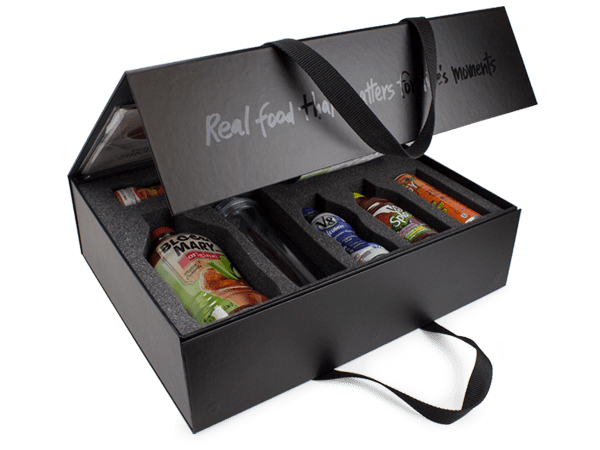
Die-cut corrugated inserts, folding cartons, and rigid partitions help hold items in place and prevent shifting. Components must remain secure in transit, but also present well when opened. - Accurate SKU Mapping and Inventory Coordination
Kits should be mapped with exact SKU usage to avoid over/understocking individual items. Version control is also key—especially for products with seasonal variants. - Efficient Line Setup for Packout
The kitting process should minimize touchpoints. That means smart workstation layout, batching logic, and easy identification of each component using barcodes or pre-sorted totes. - Retail & E-Commerce Compliance
Holiday kits often go to big-box, online, and regional retailers—each with different compliance rules for outer labeling, pallet configuration, and product orientation.
Why Early Planning for Multi-SKU Kitting Matters
Lead time compression is the biggest enemy of multi-SKU kitting during the holidays. The more SKUs in a kit, the more touchpoints and chances for delay—especially if custom components like printed cartons or foam inserts are involved. Waiting until Q4 to finalize packaging or book kitting services leads to:
- Backordered components
- Limited fulfillment labor
- Higher expedited costs
- Reduced flexibility for promotional changes
Brands that succeed in holiday kitting begin planning by mid-to-late summer, allowing time for design revisions, sample approvals, and fulfillment reservations.
How Brown Packaging Supports Multi-SKU Kitting
We support clients through every stage of holiday kitting, offering:
- Packaging design for organized, protective multi-item kits
- Sourcing and production of custom inserts, trays, folding cartons, and RSC boxes
- In-house or partnered kitting, co-packing, and display assembly
- Inventory tracking and labeling per SKU, batch, and destination
- Retail and e-commerce fulfillment with routing compliance
Whether it’s 500 units or 50,000+, our kitting process is built to handle high volume without compromising on quality, speed, or accuracy.
Final Takeaway
Multi-SKU kits are one of the most powerful tools for driving holiday sales—but they’re also among the most operationally demanding. From packaging configuration to inventory planning and fulfillment, every element needs to work in sync. The earlier you begin, the smoother your holiday programs will run.
Let’s get your holiday kits right—start the conversation with Brown Packaging today.
With new tariff proposals and continued trade uncertainty, 2026 is shaping up to be another pivotal year for packaging sourcing strategy. Many companies that shifted production away from China in
Following multiple rounds of tariff changes and trade policy adjustments, 2026 marks a turning point for U.S. packaging buyers. Many who previously transitioned from China to domestic or nearshore suppliers
Shifting packaging production from China to the U.S. can help stabilize costs, reduce tariff exposure, and shorten lead times. But the transition process requires careful planning. For packaging buyers, the
RSC boxes are known for their efficiency and versatility, but their performance ultimately comes down to strength. Buyers often see numbers like ECT, BCT, and burst strength on specifications —
Home » Holiday Multi-SKU Kitting: Streamline Your Packaging