Home » Why Some POP Displays Never Make It to the Floor
Why Some POP Displays Never Make It to the Floor
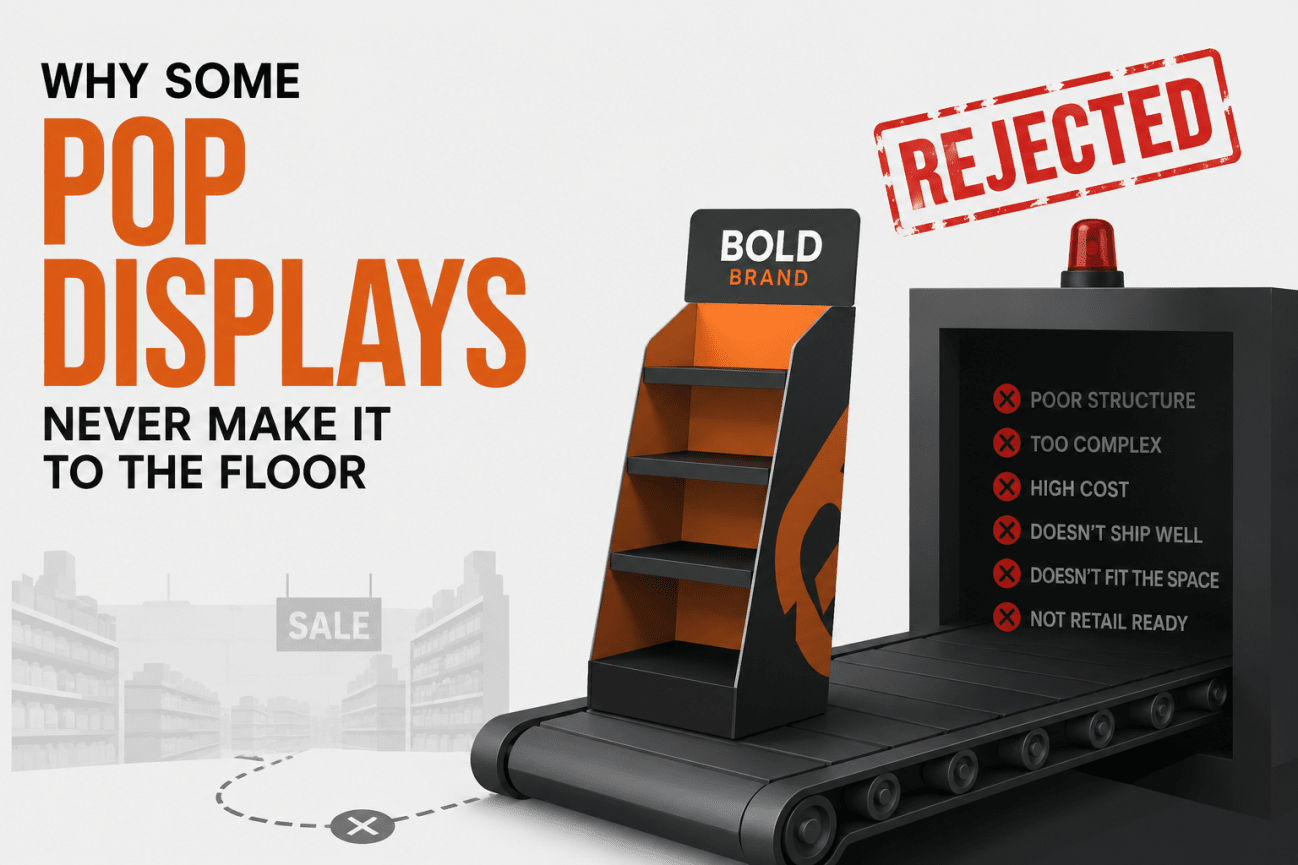
A POP display can be perfectly designed, well-produced, and shipped on time…
…and still never get placed.
This isn’t a design failure—it’s an execution failure.
And it’s more common than most brands realize.
The Reality: Placement Is Not Guaranteed
Getting a display into a store doesn’t mean it reaches the floor.
Between delivery and placement:
- Displays sit in backrooms
- Get deprioritized
- Or never get assembled
If it doesn’t get placed:
👉 It doesn’t sell
Backroom Congestion Stops Execution
Retail backrooms are crowded and chaotic.
Displays compete with:
- Inventory overflow
- Other promotional materials
- Limited storage space
If your display:
- Takes up too much room
- Isn’t easy to stage
It gets pushed aside.
Assembly Friction Kills Placement
If setup is difficult:
- Employees delay it
- Skip steps
- Or ignore it completely
Common issues:
- Too many components
- Unclear instructions
- Time-consuming assembly
If it takes effort:
👉 It won’t get done
No Immediate Incentive = No Priority
Store employees prioritize:
- Restocking shelves
- Customer service
- High-urgency tasks
A display is:
👉 Optional work
If there’s no urgency or clear value:
- It gets delayed
- Or never executed
Retailer Approval Doesn’t Mean Execution
Even approved displays can fail in-store.
Why:
- Store managers make local decisions
- Space may already be allocated
- Layouts change
This leads to:
- Displays left in storage
- Displays placed in low-impact areas
- Displays removed early
Approval ≠ placement
Size and Footprint Can Work Against You
Large displays:
- Require more space
- Are harder to position
- Create friction during setup
If a display doesn’t fit easily:
👉 It gets skipped
Smaller, flexible designs:
👉 Get placed faster and more often
Timing Is a Major Failure Point
Displays arrive:
- Too early → sit in backroom
- Too late → miss promotional window
Retail operates on tight schedules.
If timing is off:
👉 Execution breaks
What High-Performing Displays Do Differently
They are designed for:
- Fast, simple setup
- Minimal footprint
- Clear purpose and placement
- Low effort for store staff
They remove friction at every step.
Designing for Placement, Not Just Production
Better displays:
- Assume limited time and labor
- Simplify assembly and handling
- Fit easily into store environments
They’re built to:
👉 Get to the floor—not just out of the warehouse
Where Brands Get It Wrong
- Overcomplicating setup
- Ignoring store-level constraints
- Assuming approval guarantees placement
- Designing oversized displays
- Missing timing windows
These issues stop performance before it starts.
How Brown Packaging Designs for Real Execution
At Brown Packaging, displays are engineered for placement—not just production.
We focus on:
- Reducing setup friction
- Designing for real store environments
- Aligning structure with retail behavior
- Ensuring displays actually reach the floor
Because a display that never gets placed…
👉 never had a chance to perform
References
Shop! Association. (2023). Retail Execution Study.
NielsenIQ. (2022). In-Store Execution Report.
Deloitte. (2022). Retail Operations Study.
Underhill, P. (2009). Why We Buy: The Science of Shopping.
Soroka, W. (2009). Fundamentals of Packaging Technology.
Meta Description
Some POP displays never reach the floor. Learn how backroom, setup, and timing issues impact placement.
A POP display can be perfectly designed, well-produced, and shipped on time… …and still never get placed. This isn’t a design failure—it’s an execution failure. And it’s more common than
Your POP display isn’t used the way you designed it. It’s used the way the store needs it. That means: Products get moved Inserts get removed Layouts get simplified Structure
Lower cost per unit looks like a win. Until the display: Fails early Doesn’t get placed Doesn’t sell product Then it becomes expensive—fast. Because POP display cost isn’t about what
Many packaging systems pass lab testing—and still fail in real-world shipping. This disconnect happens because testing measures controlled conditions, while shipping introduces variables that are rarely accounted for. If your
Home » Why Some POP Displays Never Make It to the Floor