


Home » When Digital Printing Stops Making Financial Sense
When Digital Printing Stops Making Financial Sense
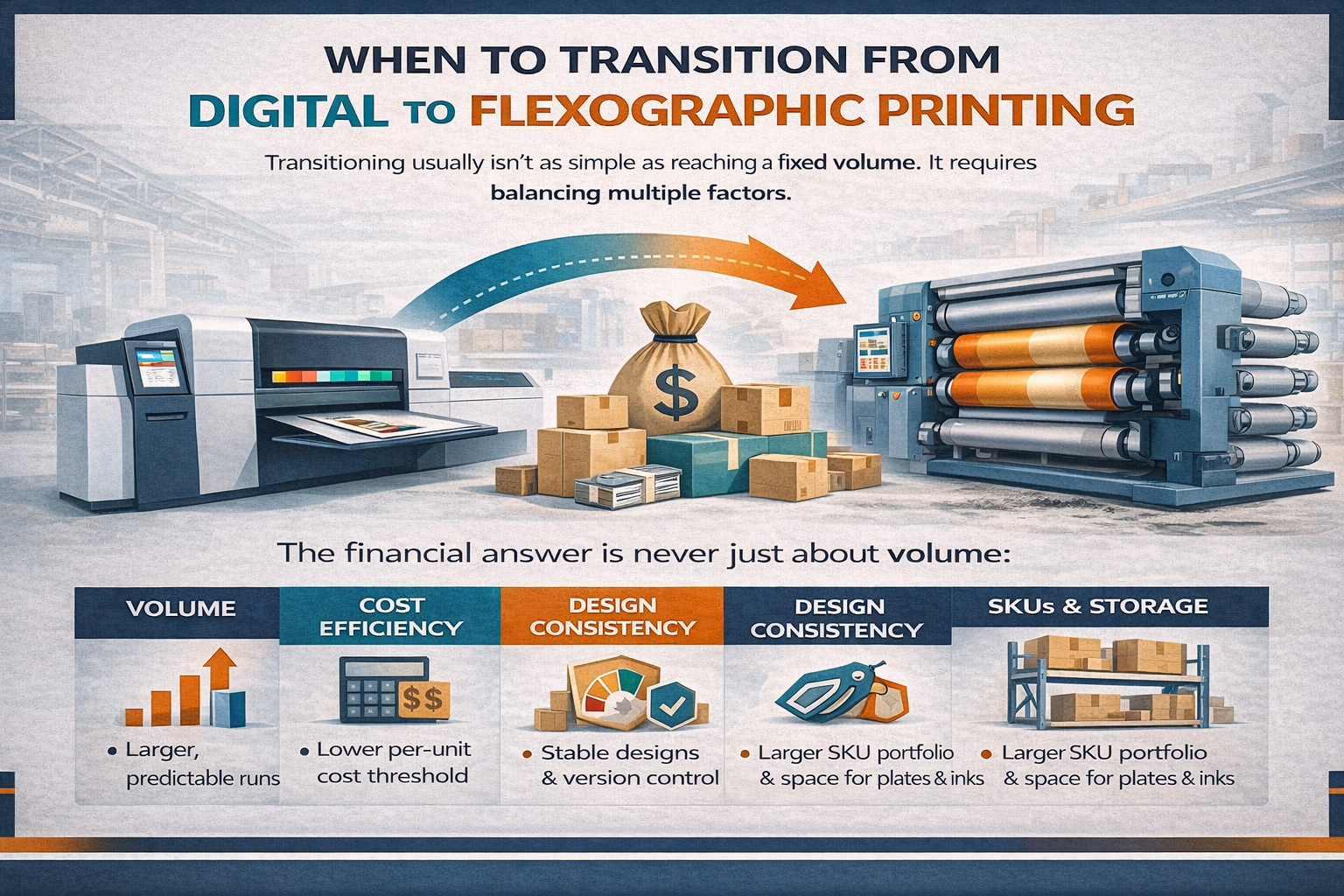
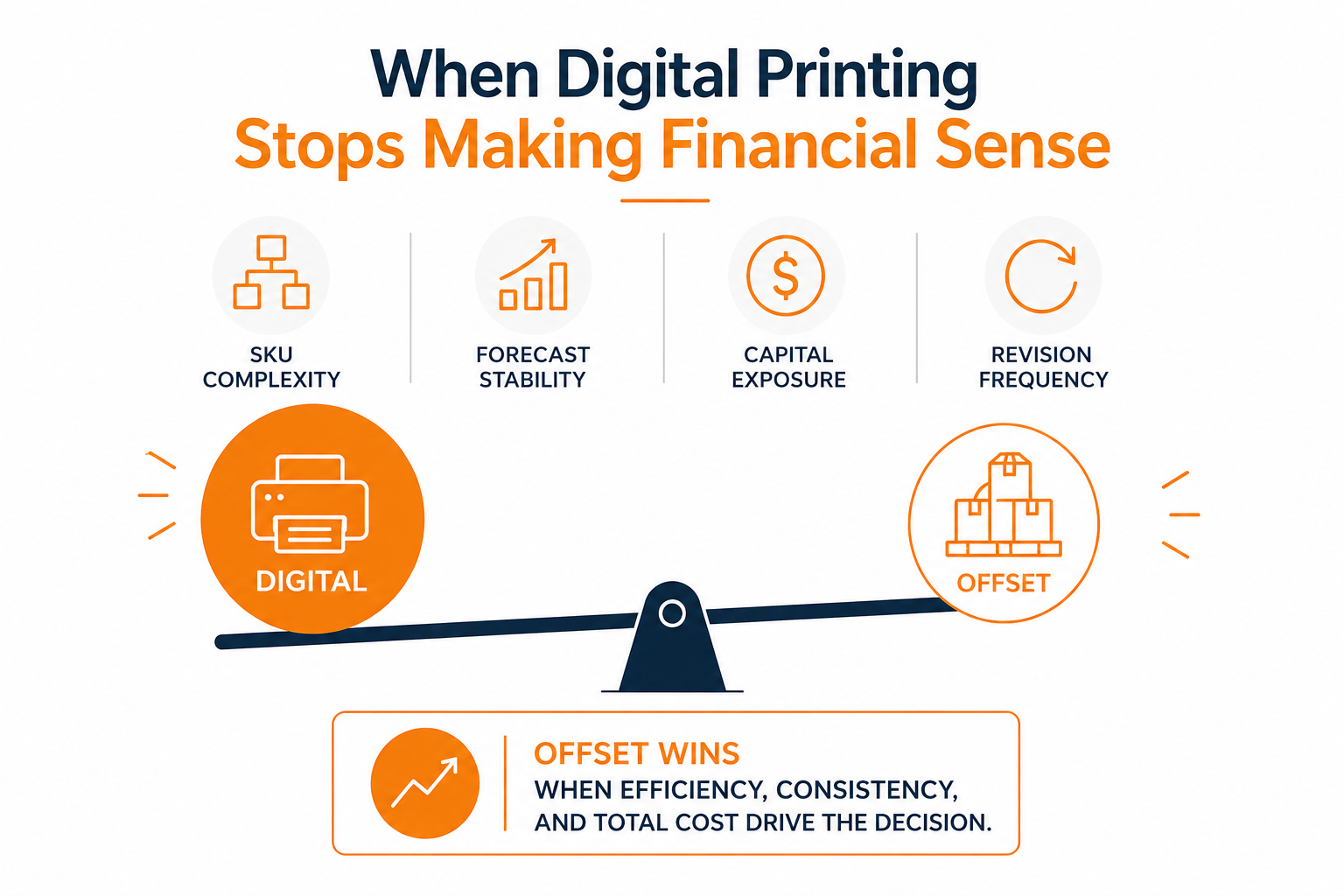
Digital printing is often positioned as the automatic choice for short runs. But the real financial breakpoint isn’t defined by volume alone — it’s determined by SKU complexity, forecast stability, capital exposure, and revision frequency. Understanding when digital stops making sense requires evaluating total program cost, not just per-unit pricing.
What Most Buyers Get Wrong About the Breakpoint
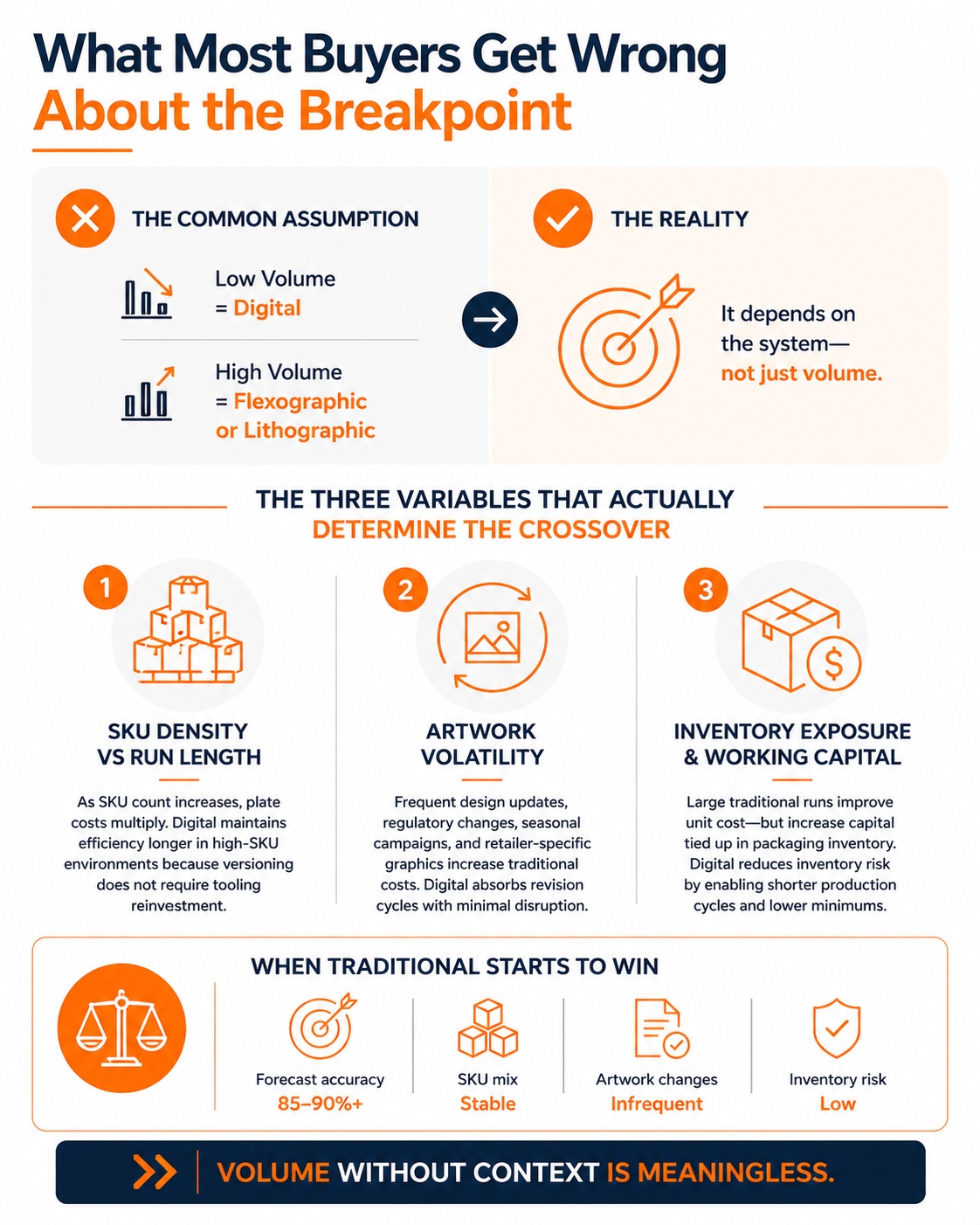
The common assumption is simple:
Low volume = digital.
High volume = flexographic or lithographic.
In reality, the crossover depends on:
- SKU density
- Artwork volatility
- Plate amortization
- Inventory write-off risk
- Working capital tolerance
A 150,000-unit annual program across 12 SKUs behaves very differently than 150,000 units concentrated into one stable SKU. Volume without context is meaningless.
The Three Variables That Actually Determine the Crossover
SKU Density vs Run Length
As SKU count increases, traditional plate costs multiply. Each version may require separate plates, setup time, and changeovers. Digital printing maintains efficiency longer in high-SKU environments because versioning does not require tooling reinvestment.
Artwork Volatility
Frequent design updates, regulatory changes, seasonal campaigns, and retailer-specific graphics dramatically shift economics. Traditional methods penalize volatility through new plates and downtime. Digital absorbs revision cycles with minimal disruption.
Inventory Exposure and Working Capital
Large traditional runs improve unit cost — but increase capital tied up in packaging inventory. If demand shifts, that inventory becomes obsolete. Digital reduces inventory risk by enabling shorter production cycles and lower minimum commitments.
The breakpoint typically emerges when:
- Forecast accuracy exceeds 85–90%
- SKU mix stabilizes
- Artwork changes become infrequent
- Storage and capital constraints are minimal
At that point, flexographic or lithographic methods often create stronger per-unit economics.
Where Digital Stops Making Financial Sense
Digital printing becomes less advantageous when:
- One or two SKUs dominate predictable volume
- Brand graphics remain stable over long production cycles
- Inventory turns are consistent
- Cost-per-unit sensitivity outweighs flexibility needs
When flexibility no longer offsets risk, scale efficiencies from traditional printing begin to dominate.
The Strategic Hybrid Model
For many growing brands and industrial programs, the optimal strategy isn’t exclusive. A hybrid approach may include:
- Digital printing for test markets, seasonal SKUs, and regional versions
- Flexographic or lithographic printing for stable, high-volume core products
This reduces obsolescence exposure while capturing scale efficiencies where appropriate.
The Bottom Line
The financial breakpoint isn’t about volume alone — it’s about risk tolerance, SKU complexity, and capital strategy. Buyers who evaluate total program cost instead of unit cost in isolation make stronger long-term print decisions.
Contact Brown Packaging to review your SKU mix, forecast stability, and volume projections to determine the most strategic print approach for your program.
Sources
- PRINTING United Alliance – Print production economics and cost modeling
- Flexible Packaging Association (FPA) – Digital print adoption and SKU expansion trends
- PMMI – The Association for Packaging and Processing Technologies – Packaging line efficiency and inventory data
- McKinsey & Company – Working capital optimization research
- Deloitte Supply Chain Reports – Forecast volatility and operational risk analysis
Digital printing is often positioned as the automatic choice for short runs. But the real financial breakpoint isn’t defined by volume alone — it’s determined by SKU complexity, forecast stability,
Digital printing is often the right starting point for growing brands and expanding SKU portfolios. But growth eventually raises a critical question: when does it make financial sense to transition
Most POP display programs become inefficient over time—not because of poor design, but because of too many variations. Different sizes, different footprints, different structures. It feels flexible—but it creates: Higher
Packaging performance testing is designed to verify that packaging can withstand the stresses of distribution. Tests such as drop testing, compression testing, and vibration testing simulate transportation conditions and help
Home » When Digital Printing Stops Making Financial Sense