Home » Digital vs Flexo vs Litho for POP Displays
Digital vs Flexo vs Litho for POP Displays
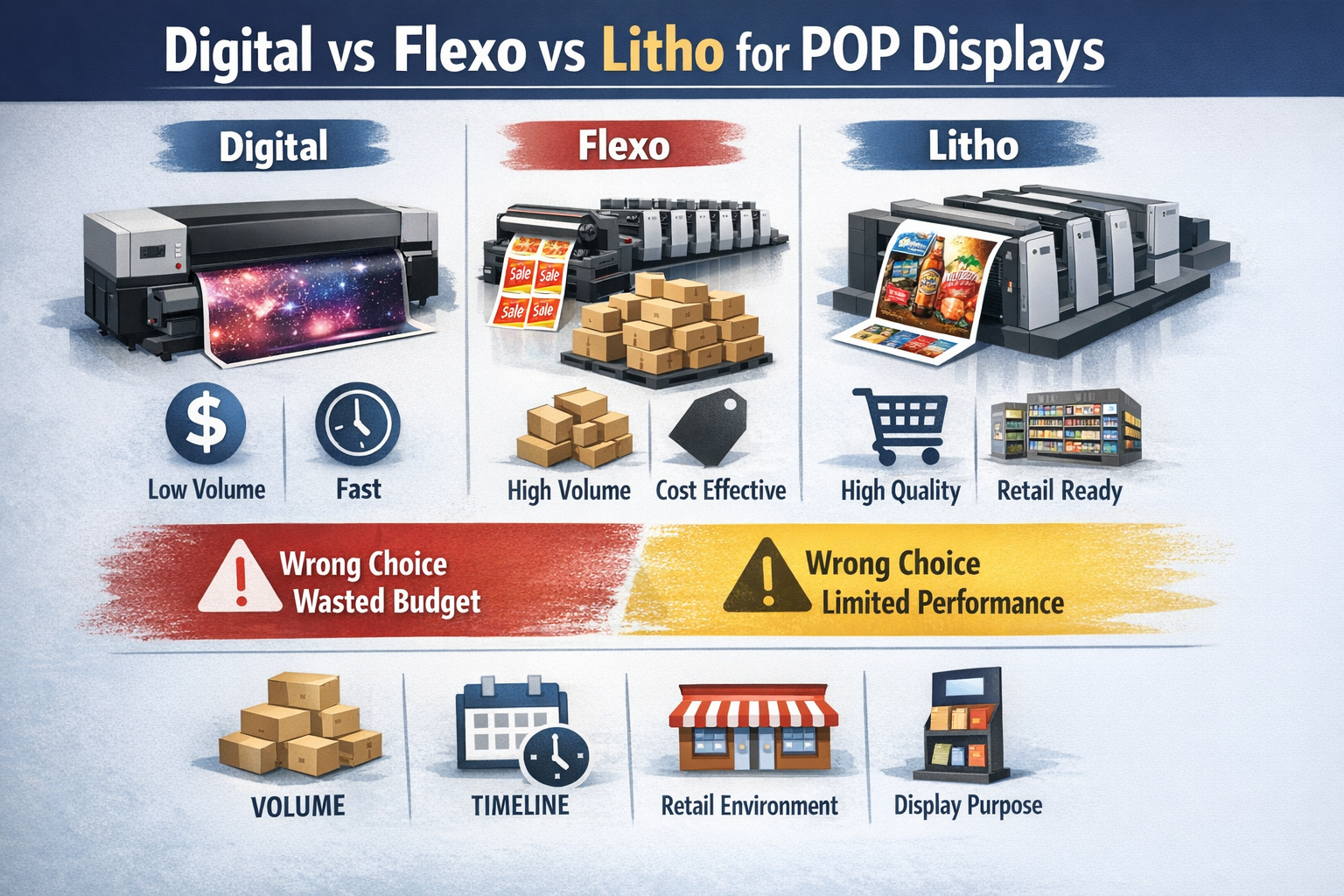
Print is one of the biggest cost drivers in POP displays—and one of the most misunderstood.
Most decisions are made based on how it looks, not when it makes sense.
The reality: the wrong print method can either:
- Waste budget, or
- Limit performance in-store
The right choice depends on volume, timeline, retail environment, and display purpose.
Digital Print: Speed and Flexibility
Digital printing is built for short runs and fast turnaround.
Where It Works Best
- Low to mid-volume programs
- Rapid product launches
- Versioned or regional campaigns
- Testing new display concepts
Advantages
- No plates or setup costs
- Quick production timelines
- Easy design changes and customization
- High-quality graphics for most retail environments
Limitations
- Higher cost per unit at scale
- Slightly less consistency vs traditional methods in large runs
Best use case:
When speed and flexibility outweigh volume efficiency.
Flexo Print: Cost Efficiency at Scale
Flexographic printing is the most cost-effective option for high-volume runs.
Where It Works Best
- Large national rollouts
- Simple to moderate graphic designs
- Long-term display programs
Advantages
- Low cost per unit at high volumes
- Fast production once set up
- Direct print on corrugated (no lamination needed)
Limitations
- Lower graphic resolution compared to litho
- Limited color gradients and detail
- Higher upfront plate costs
Best use case:
When volume is high and graphics don’t need premium detail.
Litho-Laminate: Premium Presentation
Litho-laminate is used when visual impact is critical.
Where It Works Best
- High-end retail environments
- Premium product displays
- Brand-driven campaigns
Advantages
- Highest print quality and resolution
- Sharp images, gradients, and color accuracy
- Strong shelf presence and perceived value
Limitations
- Higher cost
- Longer production timelines
- Additional lamination process
Best use case:
When visual perception directly impacts buying decisions.
The Biggest Mistake: Choosing Based on Appearance Alone
Many brands default to litho because it “looks best.”
But:
- Not every retail environment requires premium graphics
- Not every product benefits from higher print spend
- Not every program justifies the cost
This leads to:
- Overspending without ROI improvement
- Misaligned production strategy
Matching Print Method to Retail Environment
Different environments require different approaches:
- Club stores / bulk retail → Flexo often performs well
- Big box retail → Digital or flexo depending on program
- Specialty / premium retail → Litho-laminate
The key is aligning print quality with:
- Shopper expectations
- Product positioning
- Display lifespan
Volume Changes Everything
Print economics shift based on scale:
- Low volume → Digital is most efficient
- Mid volume → Digital or flexo depending on complexity
- High volume → Flexo becomes dominant
- Premium programs → Litho justified regardless of volume
Ignoring volume leads to incorrect cost decisions.
Hybrid Strategies (Where Smart Brands Win)
Some of the best programs combine methods:
- Digital for test runs → Flexo for scale
- Litho for key panels → Flexo for structure
- Digital for regional variation → standardized base design
This balances:
- Cost
- Speed
- Visual impact
Where Brands Get It Wrong
- Overusing litho for non-premium environments
- Choosing flexo when graphics require higher detail
- Ignoring volume when selecting print method
- Not planning for scalability
- Treating print as purely aesthetic
These mistakes increase cost without improving performance.
What the Right Decision Looks Like
The best print choice:
- Matches program volume
- Aligns with retail environment
- Supports display lifespan
- Balances cost vs visual impact
It’s not about the best print method—it’s about the right one for the job.
How Brown Packaging Aligns Print Strategy with Performance
At Brown Packaging, print selection is based on program goals—not assumptions.
We help brands:
- Choose the most cost-effective method for their volume
- Align print quality with retail expectations
- Balance speed, flexibility, and scalability
- Avoid overspending on unnecessary print upgrades
Because the right print decision doesn’t just improve appearance—it improves overall program efficiency and ROI.
References
Soroka, W. (2009). Fundamentals of Packaging Technology (4th ed.). IoPP.
Flexographic Technical Association (FTA). (2023). Flexography Principles & Practices.
Printing Industries of America. (2022). Digital vs Traditional Print Methods Guide.
Freedonia Group. (2023). Packaging Printing Market Analysis.
Shop! Association. (2023). Retail Display Production Guidelines.
A folding carton may look simple once it reaches the shelf, but it goes through a controlled production process before it becomes a finished package. Every step — from paperboard
Folding carton production is becoming more automated because buyers are asking for faster timelines, tighter consistency, and more flexibility across more SKUs. Shorter product lifecycles, retail launch windows, labor pressure,
Folding carton style matters because structure affects more than appearance. The right carton can improve shelf presentation, packing speed, product access, closure security, storage efficiency, and overall cost. For retail
Pouch packaging trends in 2027 will be shaped by convenience, shelf impact, sustainability pressure, sealing performance, automation, ecommerce growth, and total packaging cost. Buyers will still want pouches that look
Home » Digital vs Flexo vs Litho for POP Displays