


window.uetq = window.uetq || []; window.uetq.push(‘event’, ‘submit_lead_form’,{ event_label:‘SUBMIT MESSAGE’ }); window.lintrk('track', { conversion_id: 10271009 }); window.lintrk('track', { conversion_id: 10271017 });

How Weight Distribution Impacts POP Display Lifespan

How Weight Distribution Impacts POP Display Lifespan

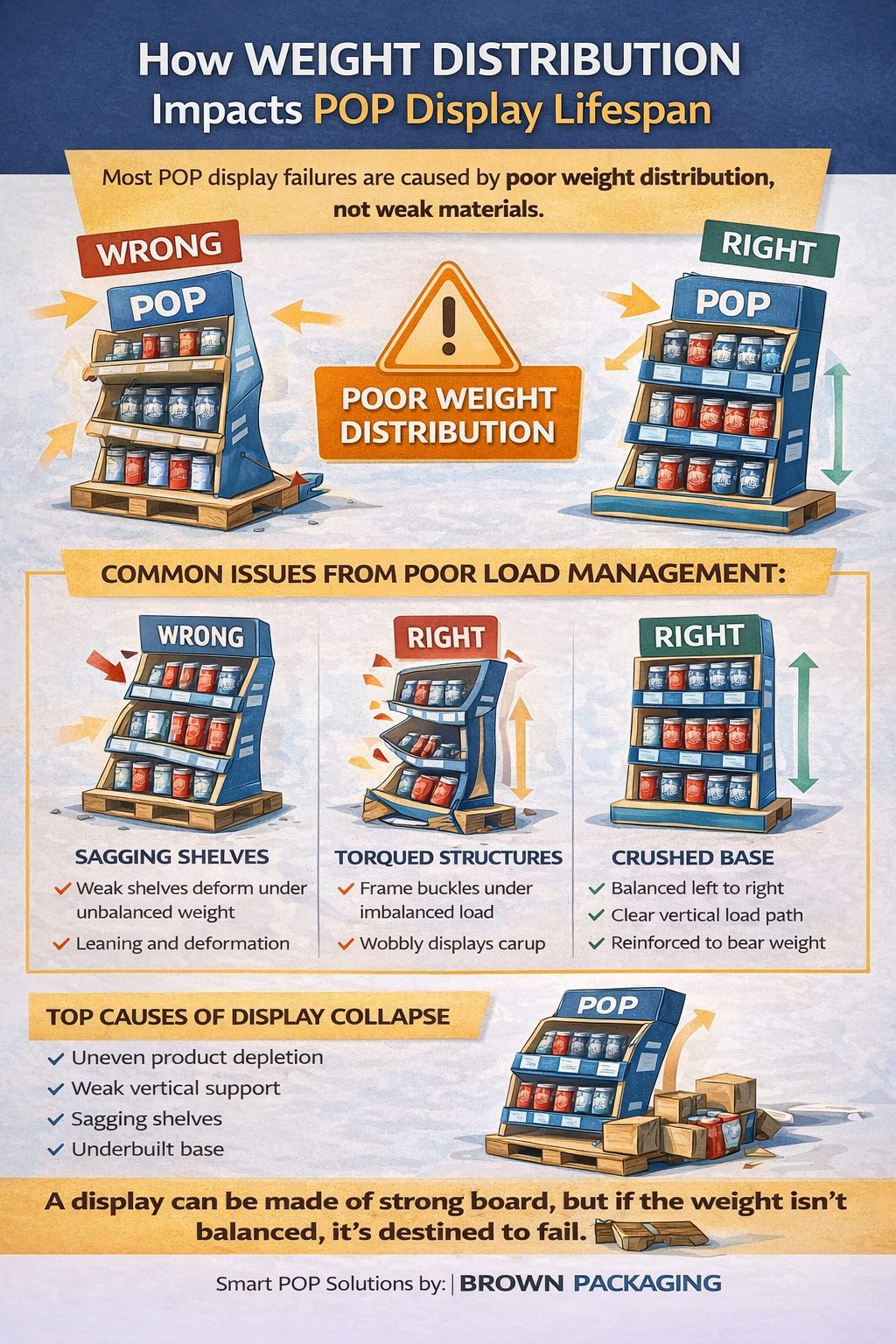
Most POP display failures aren’t caused by weak materials—they’re caused by poor weight distribution.

A display can use the right board, the right flute, and still fail early if the load isn’t balanced correctly.

This is one of the most overlooked factors in display design—and one of the biggest drivers of mid-cycle collapse, leaning structures, and shelf failure.

Why Weight Distribution Matters

POP displays are dynamic.

From day one to week three:

  • Products are removed unevenly
  • Weight shifts across shelves
  • Load concentrates in specific areas

If the structure isn’t designed for these changes:

  • Stress builds at weak points
  • Panels begin to deform
  • Failure accelerates over time

It’s not about total weight—it’s about how that weight is supported.

The Problem with “Even Load” Assumptions

Most displays are designed assuming:

  • Even product placement
  • Uniform weight distribution
  • Full stock across all shelves

But in reality:

  • One SKU sells faster than another
  • One side empties first
  • Customers pull from the same area repeatedly

This creates:

  • Uneven load distribution
  • Torsional stress (twisting)
  • Localized structural fatigue

Designing for ideal conditions leads to real-world failure.

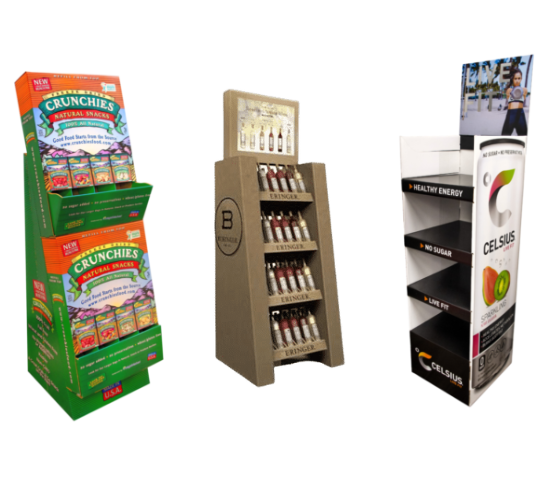
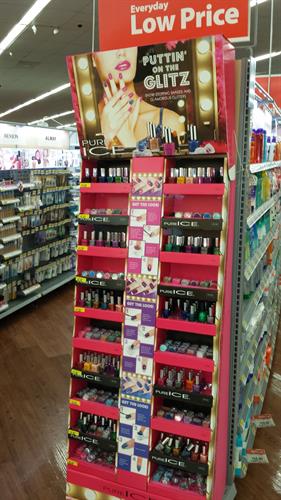
Floor Displays

Shelf-Level Load Failures

Shelves take the most direct stress.

Common issues:

  • Unsupported spans across wide shelves
  • Insufficient board strength for load weight
  • No reinforcement under high-density products

Results:

  • Sagging shelves
  • Product misalignment
  • Visual degradation

Once a shelf begins to sag, the entire display starts losing integrity.

Vertical Load Path: The Backbone of the Display

Weight needs a clear path from top to bottom.

Strong designs:

  • Transfer load through vertical supports
  • Distribute weight evenly to the base
  • Reinforce stress points at each level

Weak designs:

  • Rely on panels that weren’t meant to carry load
  • Interrupt load paths with cutouts or weak joints
  • Create pressure points that lead to collapse

If the load path is broken, the display won’t hold.

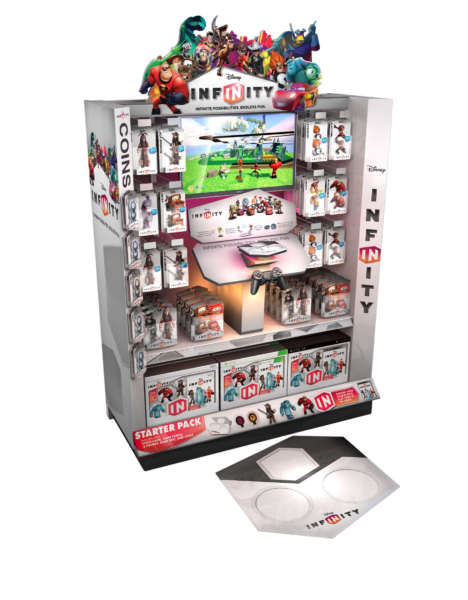
Custom POP displays

Base Strength Is Critical—and Often Ignored

The base carries all accumulated weight.

Failures happen when:

  • Base panels are underbuilt
  • Load isn’t evenly distributed across the footprint
  • Pallet integration is weak or inconsistent

This leads to:

  • Leaning displays
  • Bottom-level crushing
  • Full structural instability

A weak base guarantees failure—even if everything above it is designed correctly.

Product Type Changes Everything

Not all products behave the same.

  • Heavy, dense products → concentrated load stress
  • Lightweight items → less structural strain but more movement
  • Mixed SKUs → uneven distribution over time

Design must match:

  • Weight per shelf
  • Total load across display
  • How product is removed during shopping

Ignoring this leads to mismatched performance.

Dynamic Load vs Static Load

Static load = full display, untouched
Dynamic load = real retail conditions

Dynamic factors include:

  • Repeated product removal
  • Replenishment cycles
  • Customer interaction

Displays must be engineered for dynamic load conditions, not just static weight.

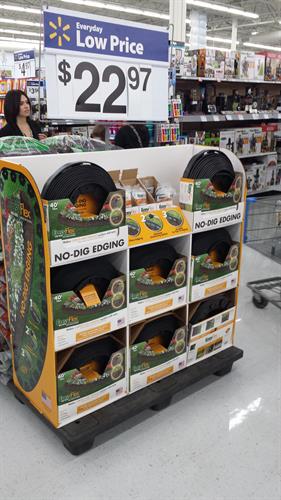
Half Pallet POP Display

The Compounding Effect of Imbalance

Small imbalances create larger problems over time:

  • Slight uneven load → shelf stress
  • Shelf stress → structural deformation
  • Deformation → instability
  • Instability → failure

This progression happens gradually—but once it starts, it accelerates quickly.

What High-Performing Displays Do Differently

They:

  • Distribute weight evenly across all load-bearing components
  • Reinforce high-stress areas proactively
  • Maintain clear vertical load paths
  • Account for uneven product depletion
  • Strengthen base structures for long-term support

They’re engineered for real-world usage—not theoretical load conditions.

Where Brands Get It Wrong

  • Designing for full, even loads only
  • Underestimating product weight concentration
  • Ignoring base reinforcement
  • Overusing cutouts that weaken structure
  • Not testing under dynamic conditions

These issues don’t show up in renderings—they show up in stores.

How Brown Packaging Engineers for Load Performance

At Brown Packaging, POP displays are designed with weight distribution as a core structural factor.

We focus on:

  • Engineering clear load paths from top to base
  • Matching board strength to real product weight
  • Reinforcing shelves and high-stress zones
  • Designing for uneven depletion and replenishment

Because if the load isn’t supported correctly, the display won’t last—and it won’t sell.

References

Soroka, W. (2009). Fundamentals of Packaging Technology (4th ed.). IoPP.
ASTM International. (2022). Corrugated Packaging Structural Standards.
TAPPI. (2021). Corrugated Board Testing Methods.
ISTA. (2023). Transit and Load Testing Protocols.
Shop! Association. (2023). Retail Display Structural Guidelines.

Most Recent Posts:
Retail Ready Packaging vs POP Displays

Retail-ready packaging (RRP) and POP displays are often treated as interchangeable. On paper, they both improve product presentation and efficiency. In reality, they serve completely different roles in retail execution.

Read More »
Subscribe To Our Newsletter

By submitting your information, you agree to our terms and conditions and privacy policy.

custom printed counter top display, pet packaging
POP Display
Facebook
Twitter
LinkedIn
Pinterest
Relevant Posts