Home » Retail Ready Packaging vs POP Displays
Retail Ready Packaging vs POP Displays
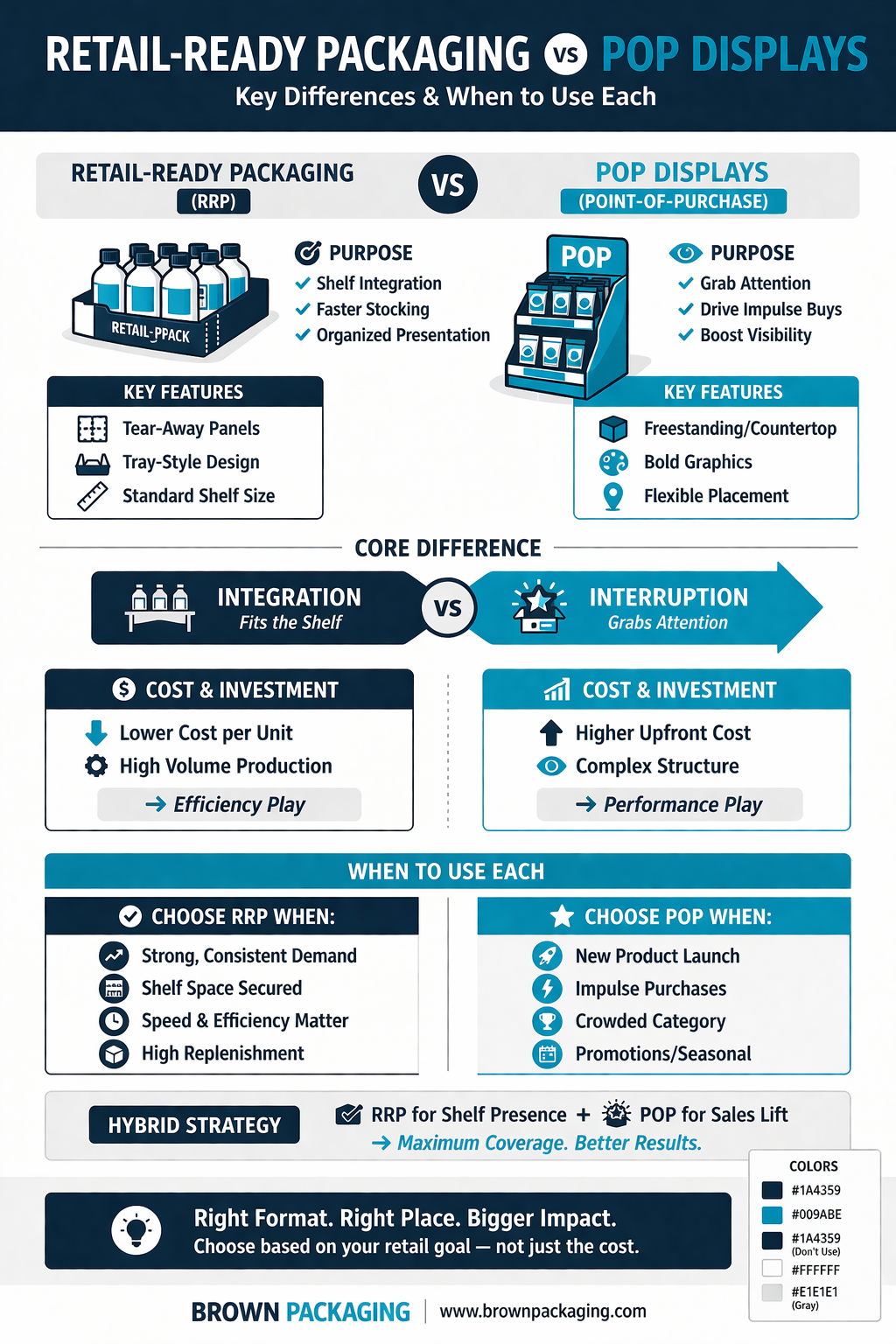
Retail-ready packaging (RRP) and POP displays are often treated as interchangeable. On paper, they both improve product presentation and efficiency. In reality, they serve completely different roles in retail execution.
Choosing the wrong one doesn’t just impact appearance—it affects placement, sell-through, labor, and total cost.
What Retail-Ready Packaging Is Designed To Do
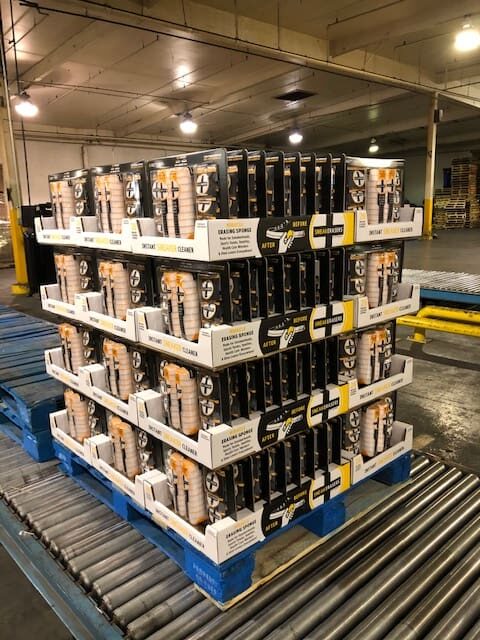
Retail-ready packaging is built for shelf integration.
Its primary purpose is to:
- Move product quickly from backroom to shelf
- Reduce stocking time
- Maintain clean, organized shelf presentation
Typical characteristics:
- Perforated tear-away panels
- Tray-style corrugated structures
- Standardized dimensions for shelving systems
RRP works best when the goal is efficiency within existing shelf space, not disruption.
What POP Displays Are Designed To Do
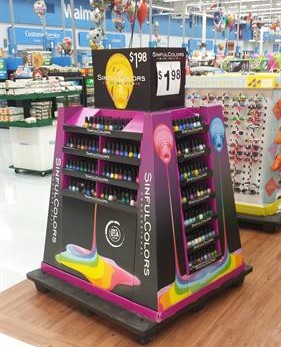
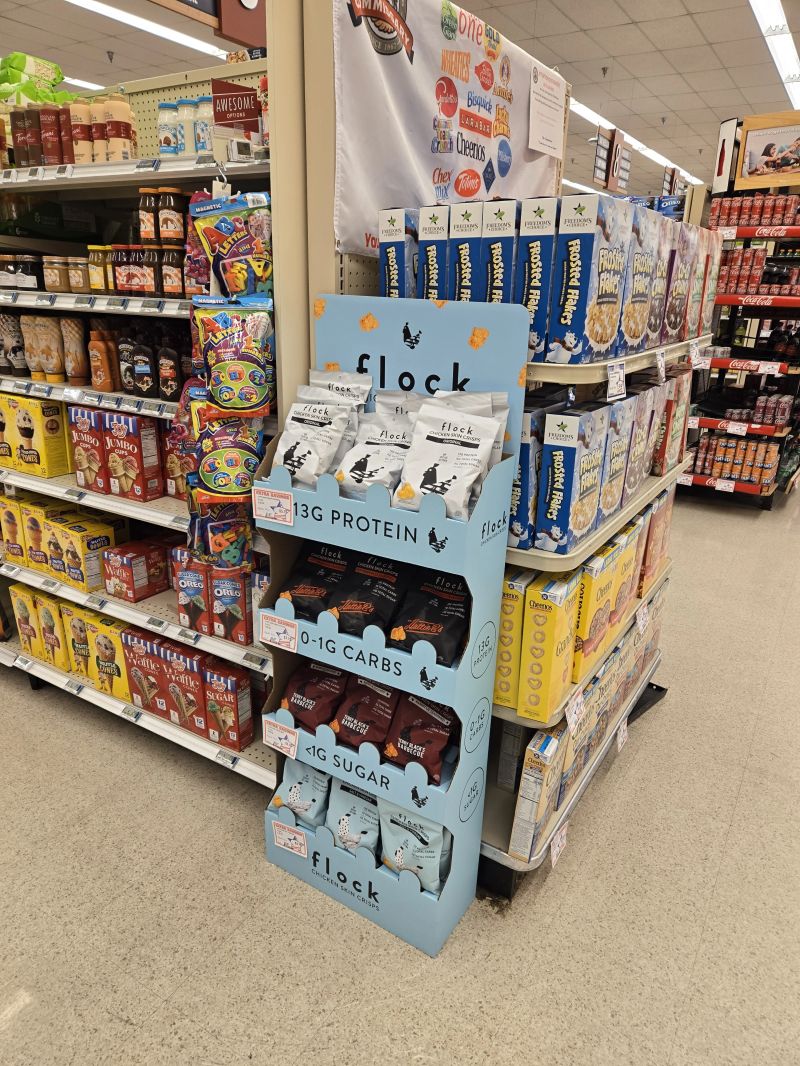
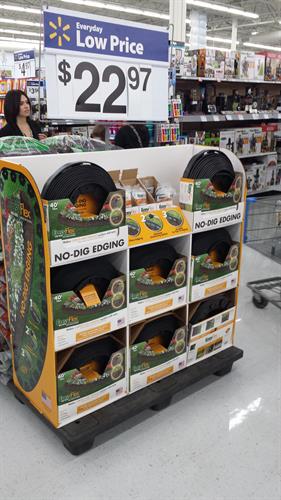
POP displays are built for interruption and visibility.
Their purpose is to:
- Capture attention outside the shelf
- Drive impulse purchases
- Increase product exposure
Typical characteristics:
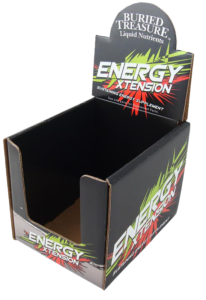
- Freestanding or countertop structures
- Larger graphic areas
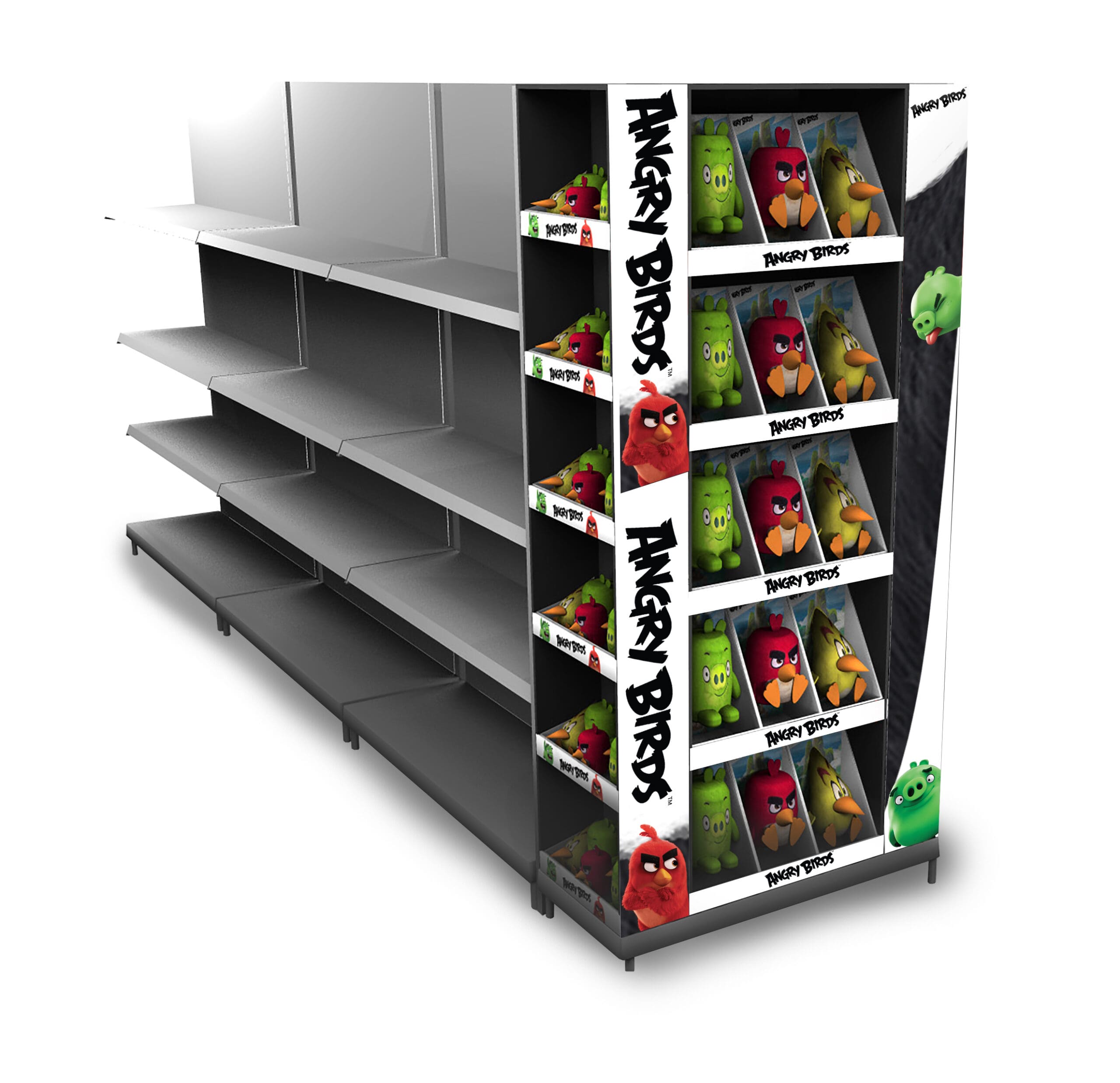
- Flexible placement (endcaps, aisles, entrances)
POP displays create incremental sales opportunities, not just operational efficiency.
The Core Difference: Integration vs Interruption
This is the line most brands miss.
- RRP integrates into the shelf
- POP displays interrupt the shopping flow
RRP supports what shoppers are already looking for.
POP displays influence what they weren’t planning to buy.
Both are valuable—but for different reasons.
Cost Structure Differences
RRP is typically:
- Lower cost per unit
- Simpler in structure
- Designed for high-volume production
POP displays are:
- Higher upfront cost
- More complex structurally
- Designed for visibility and performance
But cost alone is misleading.
RRP improves operational efficiency
POP displays drive incremental revenue
They solve different problems.
Retail Execution Differences
RRP:
- Fast to stock
- Minimal labor required
- Fits into standard shelf systems
POP Displays:
- Require placement approval
- May involve assembly
- Depend on store-level execution
Retailers prefer RRP for efficiency—but rely on POP displays for sales activation.
When RRP Is the Better Choice
Use RRP when:
- Products already have strong demand
- Shelf space is secured
- Speed and consistency matter most
- High-volume replenishment is required
RRP is ideal for steady, repeatable sales.
When POP Displays Are the Better Choice
Use POP displays when:
- Launching new products
- Driving impulse purchases
- Competing in crowded categories
- Running promotions or seasonal programs
POP displays are designed to create demand—not just fulfill it.
Where Brands Get It Wrong
- Using RRP when visibility is needed
- Using POP displays when shelf efficiency is the priority
- Assuming one format can replace the other
- Choosing based on cost instead of objective
These decisions directly impact retail performance.
The Hybrid Opportunity (Where Smart Brands Win)
Many high-performing programs combine both:
- RRP for baseline shelf presence
- POP displays for promotional lift
This creates:
- Consistent availability
- Incremental sales opportunities
- Better overall retail coverage
It’s not about choosing one—it’s about using each where it performs best.
How Brown Packaging Helps Define the Right Approach
At Brown Packaging, we help brands align packaging format with retail strategy—not assumptions.
We evaluate:
- Product velocity and placement
- Retailer requirements
- Cost vs performance tradeoffs
- Supply chain and replenishment needs
The goal is to ensure your packaging doesn’t just fit the shelf—but drives results across the entire retail environment.
References
GS1. (2023). Retail Ready Packaging (RRP) Guidelines.
ECR Retail Loss Group. (2022). Shelf-Ready Packaging Best Practices.
Shop! Association. (2023). In-Store Display Standards & Benchmarks.
Soroka, W. (2009). Fundamentals of Packaging Technology (4th ed.). IoPP.
Freedonia Group. (2023). Corrugated & Retail Display Market Analysis.
Digital printing is often positioned as the automatic choice for short runs. But the real financial breakpoint isn’t defined by volume alone — it’s determined by SKU complexity, forecast stability,
Digital printing is often the right starting point for growing brands and expanding SKU portfolios. But growth eventually raises a critical question: when does it make financial sense to transition
Most POP display programs become inefficient over time—not because of poor design, but because of too many variations. Different sizes, different footprints, different structures. It feels flexible—but it creates: Higher
Packaging performance testing is designed to verify that packaging can withstand the stresses of distribution. Tests such as drop testing, compression testing, and vibration testing simulate transportation conditions and help
Home » Retail Ready Packaging vs POP Displays