window.uetq = window.uetq || []; window.uetq.push(‘event’, ‘submit_lead_form’,{ event_label:‘SUBMIT MESSAGE’ }); window.lintrk('track', { conversion_id: 10271009 }); window.lintrk('track', { conversion_id: 10271017 });

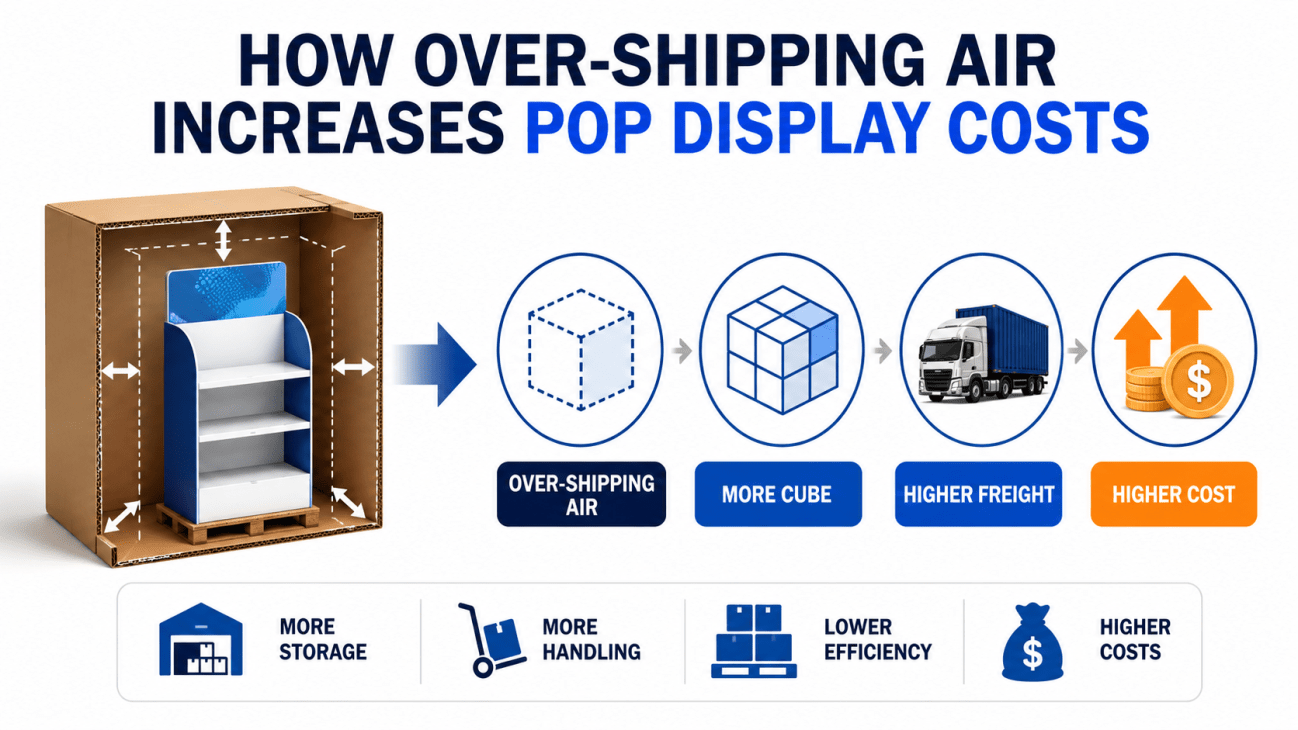
How Over-Shipping Air Increases POP Display Costs

How Over-Shipping Air Increases POP Display Costs

Most POP display programs don’t lose money on materials.

They lose it in:
👉 empty space

Displays are often shipped with:

  • Excess void space
  • Poor stacking efficiency
  • Low pallet utilization

You’re not just shipping displays—
👉 You’re shipping air

And it adds up fast.

The Hidden Cost: Cube Inefficiency

Freight is based on:

  • Volume (cube)
  • Not just weight

If your packaging:

  • Doesn’t maximize space
  • Leaves gaps between units

You pay for:
👉 unused volume

This increases:

  • Cost per unit shipped
  • Overall program spend

Without changing the display itself.

The Hidden Cost: Cube Inefficiency POP Display

Flat-Pack Doesn’t Always Mean Efficient

Flat-pack is often assumed to reduce cost.

But poor flat-pack design can:

  • Leave unused space between components
  • Prevent tight stacking
  • Create inconsistent pallet loads

Result:
👉 More units per shipment lost to air

Flat-pack only works if it’s:
👉 engineered for density

Flat-Pack Doesn’t Always Mean Efficient

Pre-Assembled Displays Can Be Worse

Pre-assembled displays:

  • Take up more space
  • Limit stacking options
  • Increase risk of inefficient pallet layouts

Without optimization:

  • You ship fewer units per pallet
  • Freight cost per display increases

Convenience comes at a cost—if not designed properly.

Pre-Assembled Displays Can Be Worse

Pallet Configuration Drives Everything

How displays fit on a pallet determines:

  • Units per load
  • Stability during shipping
  • Overall freight efficiency

Common issues:

  • Misaligned dimensions
  • Wasted edge space
  • Inconsistent stacking patterns

Even small inefficiencies:
👉 Multiply across shipments

Pallet Display Configuration Drives Everything

Void Space Between Components Adds Up

Inside packaging:

  • Gaps between parts
  • Loose configurations
  • Poor nesting

These create:

  • Inefficient use of space
  • More cartons needed
  • Higher freight cost per program

If components don’t fit tightly:
👉 You’re paying for nothing

Shipping More Loads Than Necessary

Inefficient pack-out leads to:

  • More pallets
  • More truckloads
  • More handling

Each adds:

  • Freight cost
  • Labor cost
  • Risk of damage

This is where:
👉 Small inefficiencies become large expenses

The Compounding Effect Across Programs

One inefficient shipment isn’t the issue.

But across:

  • Thousands of units
  • Multiple locations
  • Repeated programs

You get:
👉 Significant cost leakage

All from space that wasn’t optimized.

Custom corrugated pop floor display with bin shelfs

What Efficient Programs Do Differently

They:

  • Maximize units per pallet
  • Eliminate unnecessary void space
  • Design components to nest tightly
  • Align dimensions with pallet standards

They treat shipping as:
👉 A design variable—not an afterthought

Where Brands Get It Wrong

  • Assuming flat-pack is automatically efficient
  • Ignoring pallet configuration during design
  • Not optimizing component layout
  • Overlooking cube vs weight cost impact
  • Treating freight as fixed instead of controllable

These mistakes quietly increase total program cost.

How Brown Packaging Optimizes Freight Efficiency

At Brown Packaging, POP displays are designed with:
👉 shipping efficiency built in

We focus on:

  • Pack-out optimization to reduce void space
  • Pallet configuration that maximizes density
  • Structural design that supports tight nesting
  • Reducing freight cost per unit across programs

Because reducing air isn’t just about shipping—
👉 It’s about improving total cost efficiency.

References

Deloitte. (2022). Supply Chain Optimization Report.
Freedonia Group. (2023). Packaging Logistics Analysis.
McKinsey & Company. (2021). Freight and Efficiency Study.
ISTA. (2023). Packaging and Transport Guidelines.
Soroka, W. (2009). Fundamentals of Packaging Technology.

Most Recent Posts:
Moisture Control in Pet Food Packaging

Excess moisture in pet food packaging can cause mold growth, nutrient degradation, clumping, and product spoilage. Effective moisture control combines barrier material selection, packaging design, and controlled production environments to

Read More »
Subscribe To Our Newsletter
custom printed countertop display with pouches
POP Display

By submitting your information, you agree to our terms and conditions and privacy policy.

Facebook
Twitter
LinkedIn
Pinterest
Relevant Posts