


Home » Compression Set and Recovery in Foam Cushioning Materials
Compression Set and Recovery in Foam Cushioning Materials
In packaging, foam isn’t just about initial protection — it’s about maintaining performance over the entire shipping or storage cycle. Compression set and recovery characteristics determine whether foam continues to provide shock absorption after being loaded, stacked, or stored for long periods.
What Is Compression Set?
- Definition: The permanent deformation a foam retains after being compressed for a defined time and temperature.
- Why It Matters: A foam that takes a high compression set loses thickness and cushioning capability, leaving products more vulnerable to impact damage.
- Typical Measurement: Reported as a percentage loss of original thickness after the load is removed.
Recovery Rate and Load Retention
- Recovery Rate: How quickly foam returns to its original dimensions after load removal.
- Load Retention: The ability to maintain performance over repeated load cycles — crucial for returnable and reusable packaging.
- High recovery and load retention mean the foam can be used multiple times without replacement.
Factors Affecting Compression Set
- Foam Chemistry:
- Crosslinked PE typically offers lower compression set than non-crosslinked.
- PU foams may be softer but often exhibit higher permanent deformation under load.
- Density: Higher-density foams resist deformation better but may be heavier and costlier.
- Environmental Conditions: Heat and humidity accelerate compression set in most foam materials.
Testing and Standards
- ASTM D3574 Test D: Measures compression set under specified load and temperature.
- ASTM D3574 Test B1/B2: Evaluates indentation force deflection for load-bearing properties.
- ASTM D1055: For rubber-like cellular materials, often applicable to certain elastomeric foams.
Design Strategies
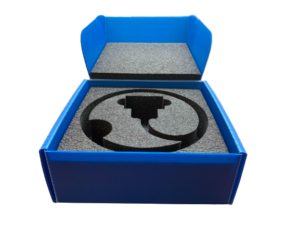
- Load Distribution: Use ribbed or contoured inserts to spread weight across more surface area.
- Material Blends: Combining foams with different recovery characteristics can balance softness and durability.
- Replace on Schedule: In closed-loop systems, track cycle counts and replace foam before performance degradation risks product safety.
References
ASTM International. (2021). ASTM D3574-21: Standard test methods for flexible cellular materials—Slab, bonded, and molded urethane foams. ASTM International. https://www.astm.org/d3574-21.html
ASTM International. (2014). ASTM D1055-14: Standard specification for rubber cellular sheeting—Closed cell. ASTM International. https://www.astm.org/d1055-14.html
Not every POP display should be optimized for the lowest cost. In some cases, spending more isn’t inefficient—it’s necessary. Because the real question isn’t:👉 “What does it cost?” It’s:👉 “What
Most POP displays are designed to look good at production. But that’s not where they’re tested. They’re tested here:👉 The supply chain Between the warehouse and the store floor, displays
Most cost savings in packaging come from:👉 Ordering more volume But increasing MOQ isn’t always possible. Storage is limited Cash flow is constrained Demand is uncertain So the real question
Minimum order quantities (MOQs) aren’t arbitrary. They exist because packaging production has fixed costs that don’t scale down—only up. When you order one unit, you still pay for:👉 The entire
Home » Compression Set and Recovery in Foam Cushioning Materials