Home » When It Makes Sense to Spend More on a POP Display
When It Makes Sense to Spend More on a POP Display
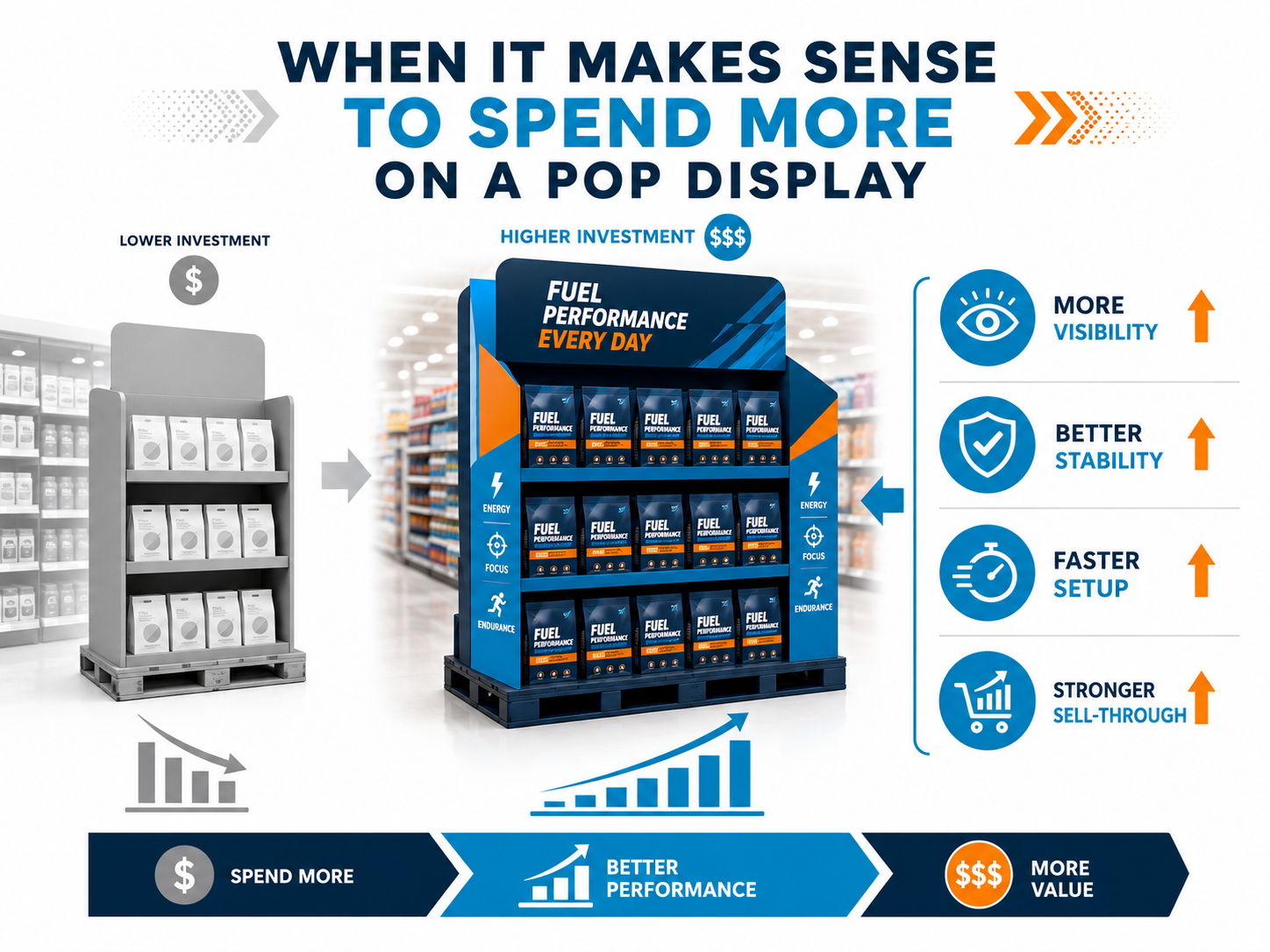
Not every POP display should be optimized for the lowest cost.
In some cases, spending more isn’t inefficient—it’s necessary.
Because the real question isn’t:
👉 “What does it cost?”
It’s:
👉 “What does it return?”
The Mistake: Treating All Displays the Same
Many programs apply the same logic across all displays:
- Reduce cost
- Simplify structure
- Minimize materials
But not all displays:
- Serve the same purpose
- Sit in the same location
- Drive the same level of sales
A one-size cost approach:
👉 Misses high-impact opportunities
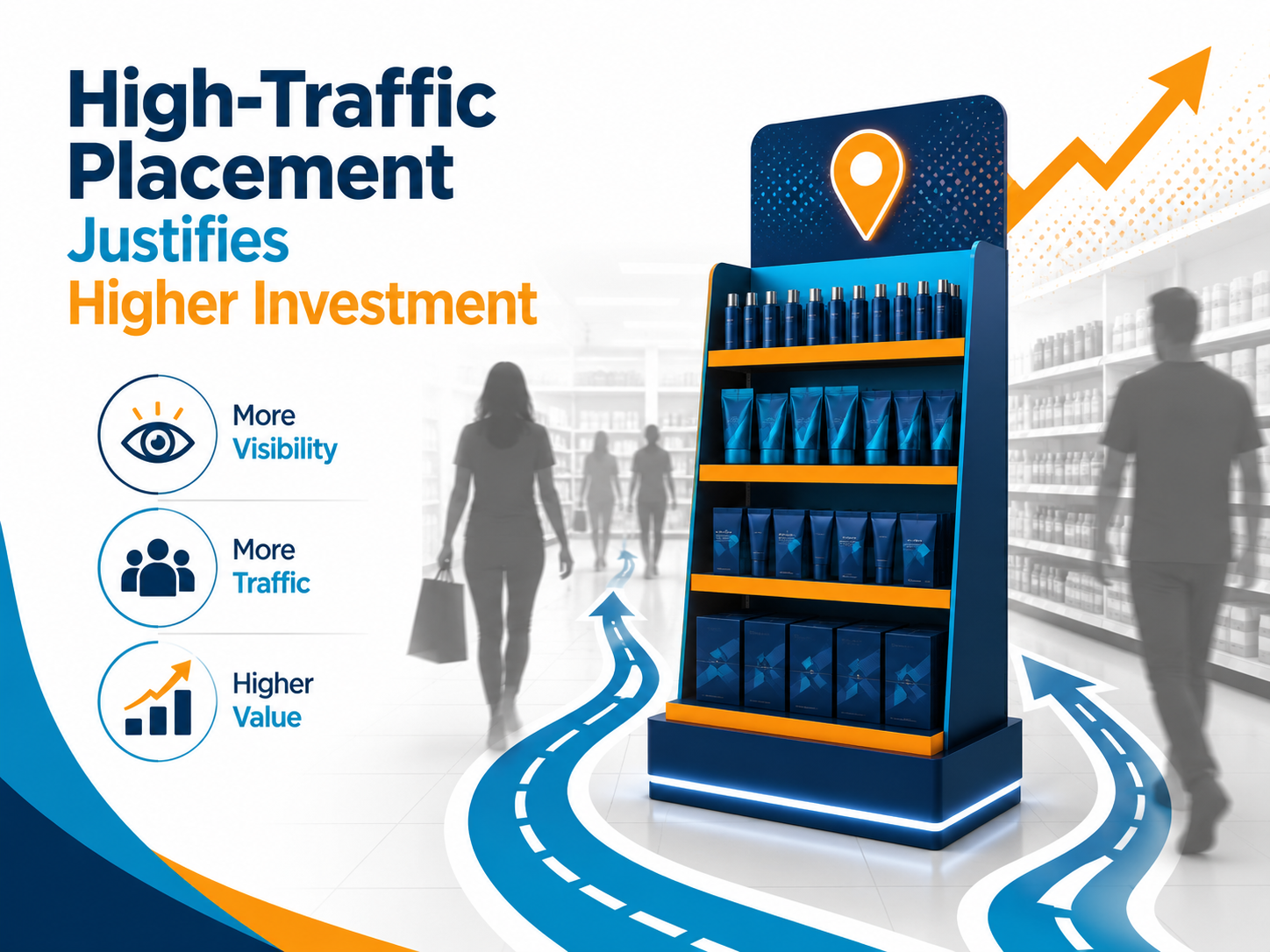
High-Traffic Placement Justifies Higher Investment
Displays placed in:
- Endcaps
- Store entrances
- Checkout zones
Get:
- Higher visibility
- More interaction
- Greater sales potential
In these locations:
👉 A stronger display can drive significantly more revenue
Cutting cost here:
👉 Reduces return where it matters most
High-Margin Products Change the Equation
If product margin is high:
- Every additional sale has greater impact
This means:
- Better display performance = higher ROI
Spending more on:
- Structure
- Visibility
- Durability
Makes sense when:
👉 Profit per unit supports it
Longer Programs Require Better Durability
Short-term display:
- Can tolerate lighter construction
Long-term program:
- Requires structural stability over time
If a display is expected to:
- Last weeks or months
- Handle repeated replenishment
Then:
👉 Underbuilding becomes expensive
Failure leads to:
- Replacement
- Lost selling time
- Retail dissatisfaction
Competitive Categories Demand Stronger Presence
In crowded retail environments:
- Multiple brands compete for attention
A basic display:
- Blends in
A well-designed, higher-quality display:
- Stands out
- Drives engagement
In these scenarios:
👉 Visibility directly impacts sales
Execution Risk Can Justify Higher Spend
Displays that are:
- Easier to assemble
- More stable
- More intuitive
Reduce:
- Setup errors
- Placement failures
- Store-level friction
Investing in:
👉 Better execution design
Often improves:
- Placement rate
- Consistency across stores
Freight and Damage Reduction Can Offset Cost
Higher-quality designs can:
- Improve pack-out
- Reduce damage rates
- Increase pallet efficiency
This lowers:
- Freight cost per usable unit
- Replacement cost
Spending more upfront:
👉 Can reduce downstream costs
When Spending More Does NOT Make Sense
Higher cost isn’t always justified.
Avoid over-investing when:
- Product margin is low
- Placement is low-visibility
- Program duration is short
- Retail execution is uncertain
In these cases:
👉 Simpler designs are more efficient
The Real Metric: Return, Not Cost
A higher-cost display is justified when it:
- Increases sell-through
- Extends lifespan
- Improves placement success
- Reduces operational friction
If it doesn’t improve performance:
👉 It’s not worth the cost
What High-Performing Programs Do Differently
They:
- Align display investment with retail impact
- Spend more where ROI is highest
- Reduce cost where impact is lowest
- Evaluate performance—not just price
They treat cost as:
👉 Strategic—not fixed
Where Brands Get It Wrong
- Applying cost reduction across all displays
- Ignoring placement and visibility impact
- Underinvesting in high-opportunity locations
- Overinvesting in low-impact programs
- Not tying spend to ROI
These decisions limit performance.
How Brown Packaging Aligns Cost with Performance
At Brown Packaging, display investment is based on:
👉 Where it drives results
We help brands:
- Identify high-impact opportunities
- Align structure and materials with ROI potential
- Balance cost with performance across programs
- Maximize return—not just minimize spend
Because the goal isn’t to spend less—
👉 It’s to get more from what you spend.
References
Freedonia Group. (2023). Retail Display Market Analysis.
Shop! Association. (2023). Retail Performance Study.
NielsenIQ. (2022). Shopper Behavior and Display Impact.
Deloitte. (2022). Retail Strategy Report.
Soroka, W. (2009). Fundamentals of Packaging Technology.
Not every POP display should be optimized for the lowest cost. In some cases, spending more isn’t inefficient—it’s necessary. Because the real question isn’t:👉 “What does it cost?” It’s:👉 “What
Most POP displays are designed to look good at production. But that’s not where they’re tested. They’re tested here:👉 The supply chain Between the warehouse and the store floor, displays
Most cost savings in packaging come from:👉 Ordering more volume But increasing MOQ isn’t always possible. Storage is limited Cash flow is constrained Demand is uncertain So the real question
Minimum order quantities (MOQs) aren’t arbitrary. They exist because packaging production has fixed costs that don’t scale down—only up. When you order one unit, you still pay for:👉 The entire
Home » When It Makes Sense to Spend More on a POP Display