

Home » Choosing Folding Cartons: A Buyer’s Guide
Choosing Folding Cartons: A Buyer’s Guide
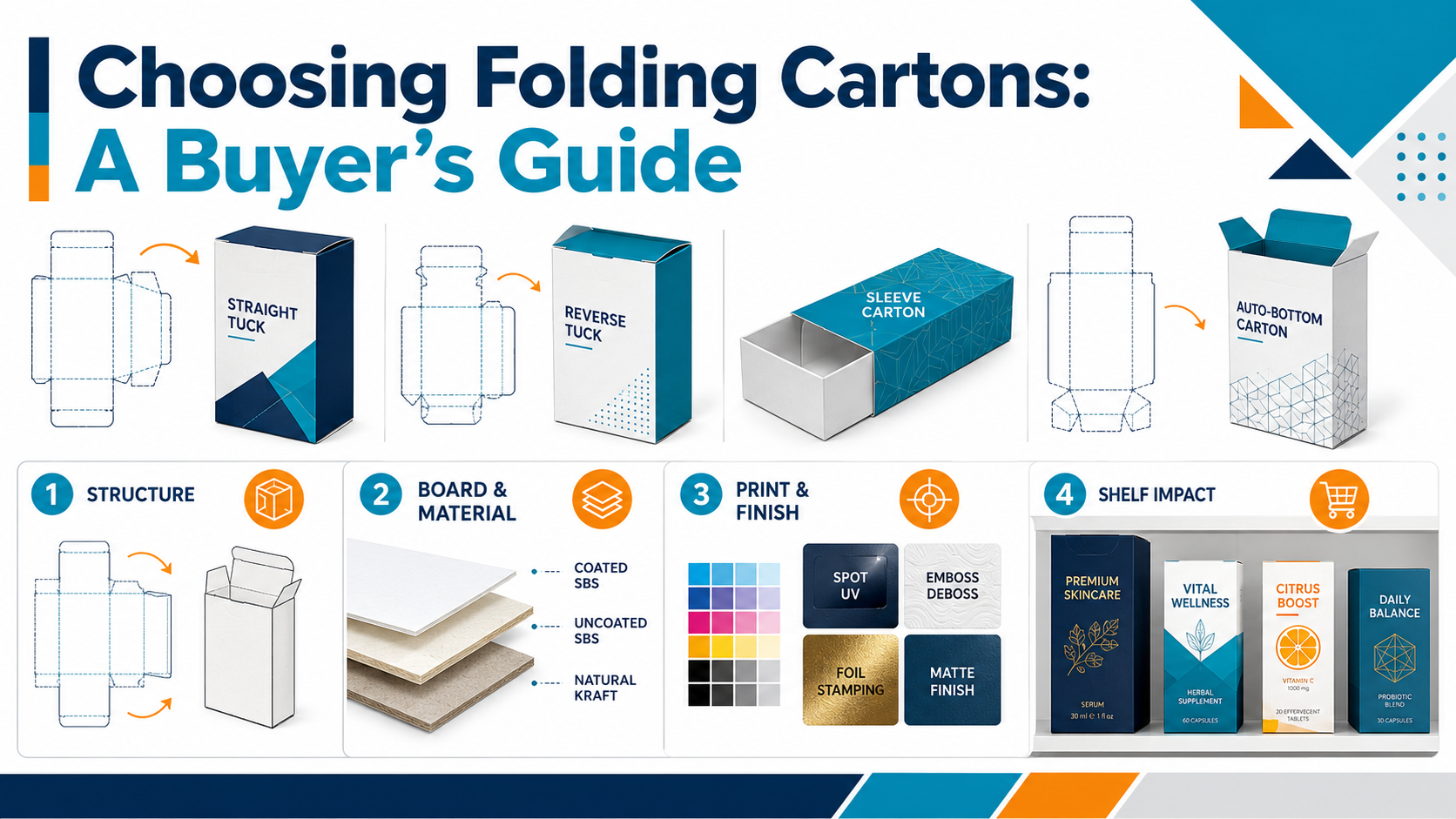
Folding cartons are often treated as a simple retail packaging option, but the best folding carton programs are built around more than appearance. The right carton has to balance product fit, shelf presentation, material choice, print quality, filling requirements, storage efficiency, and supply chain performance.
For buyers, the decision is not just whether a folding carton can hold the product. The better question is: which folding carton structure, board grade, print method, and finish will support the product’s retail, operational, and cost requirements?
Folding cartons are commonly used for consumer products because they are lightweight, printable, customizable, and efficient to store before use. Many folding carton suppliers also emphasize design flexibility, print embellishments, flat-packed efficiency, product visibility through windows, and compatibility with manual or automated packing lines.
This blog focuses on how buyers should evaluate folding cartons as a complete packaging system — not just a printed paperboard box.
What Makes Folding Cartons Different
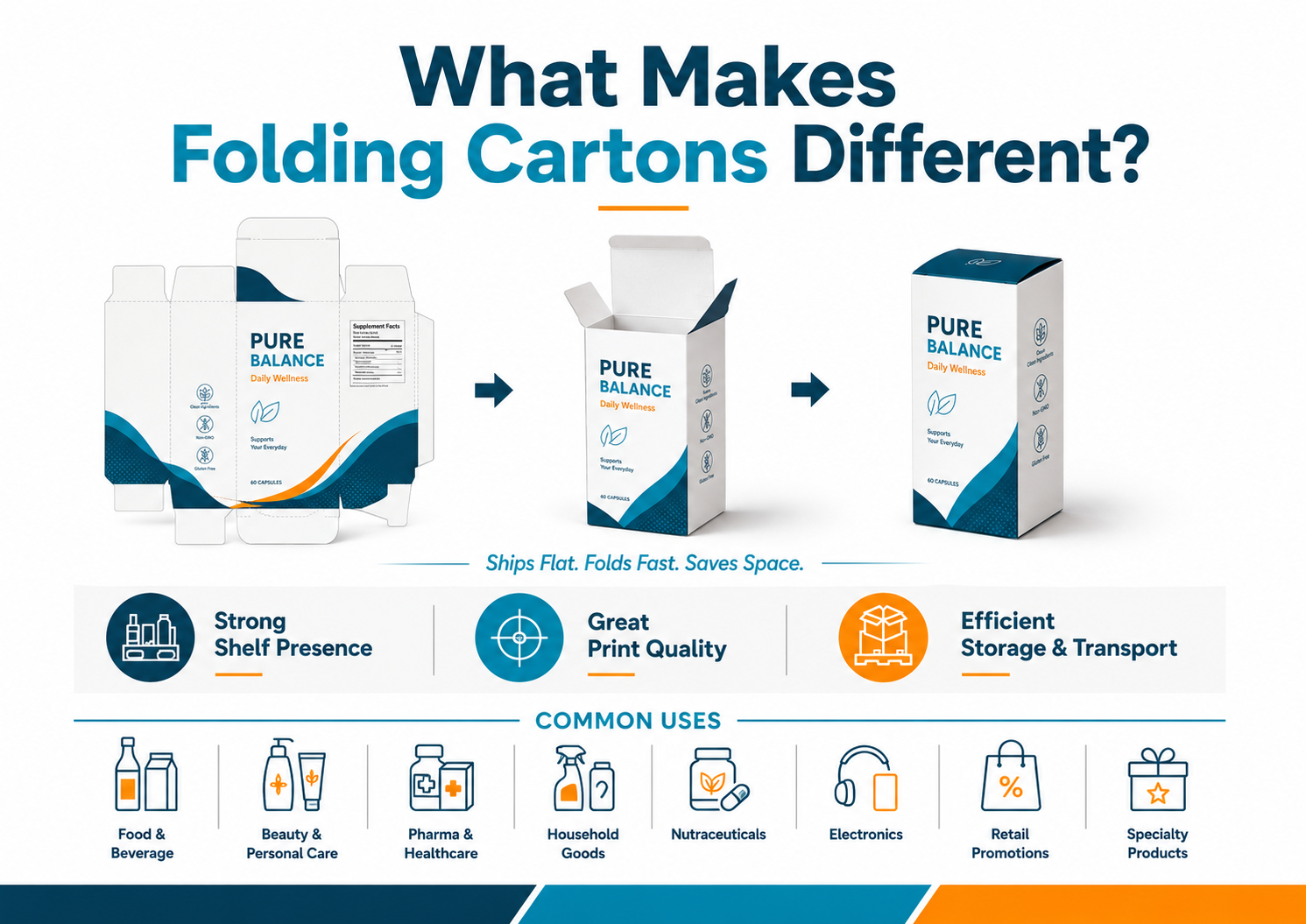
A folding carton is typically made from paperboard that is printed, cut, creased, folded, and glued into a finished package. Unlike rigid boxes, folding cartons are usually shipped flat and formed before or during packing, which helps reduce storage and transportation space before the product is filled.
That flat-packed efficiency is one of the biggest reasons folding cartons are used across retail and consumer packaging.
Folding cartons are commonly used for:
- Food and beverage products
- Beauty and personal care
- Pharmaceuticals and healthcare
- Household goods
- Nutraceuticals
- Small electronics
- Promotional retail packaging
- Specialty consumer products
They work best when the package needs strong shelf presence, good print quality, efficient storage, and enough structure to protect lightweight or moderately weighted products.
Customization Is More Than Shape
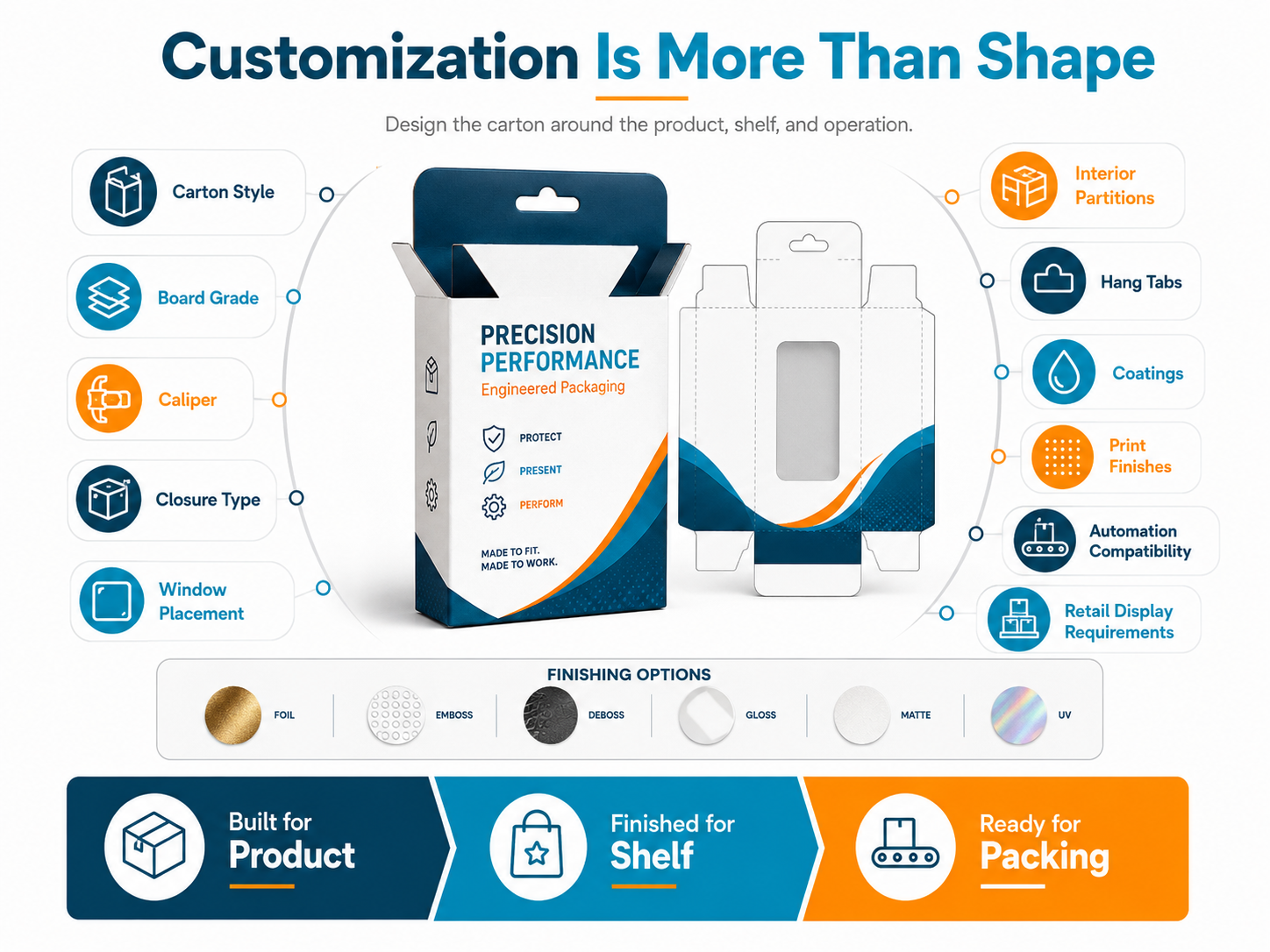
Many companies describe folding cartons as customizable, but buyers should think beyond basic shape or size.
Customization can include:
- Carton style
- Board grade
- Caliper
- Closure type
- Window placement
- Interior partitions
- Hang tabs
- Coatings
- Print finishes
- Automation compatibility
- Retail display requirements
A carton can be simple and cost-efficient, or it can be highly finished with foil, embossing, textured effects, window patches, or specialty coatings. Folding carton suppliers commonly offer embellishments such as hot stamping, cold foil, textured effects, metallic ink, UV gloss, varnish, embossing, and other premium finishes.
The important question is whether those features support the product’s actual selling environment.
A premium cosmetic carton may benefit from foil stamping and embossing. A frozen food carton may need stronger moisture resistance. A pharmaceutical carton may prioritize print clarity, compliance information, and consistent folding performance.
Customization only adds value when it supports the product, buyer expectations, and supply chain requirements.
Shelf Impact and Print Quality
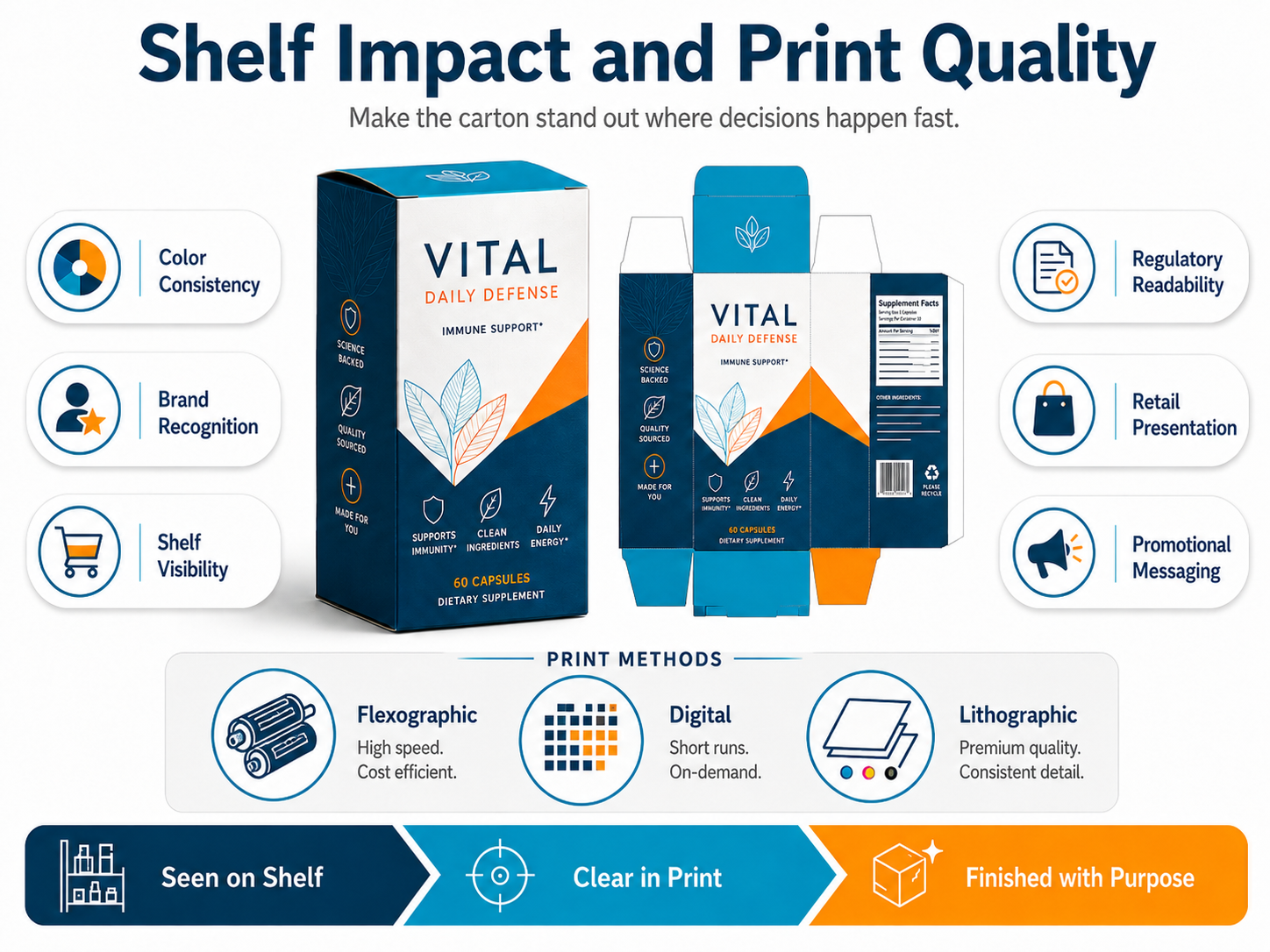
Folding cartons are often chosen because they provide a strong printable surface for branding, product information, and retail presentation.
This matters because retail buyers and consumers often make decisions quickly at the shelf. A carton has to communicate product value, category fit, usage, compliance details, and brand identity within limited space.
Print quality affects:
- Color consistency
- Brand recognition
- Shelf visibility
- Perceived product quality
- Regulatory readability
- Retail presentation
- Promotional messaging
For high-end retail categories, specialty finishes can help a carton stand out. Foil stamping, embossing, debossing, spot UV, gloss varnish, matte coatings, and textured effects can create stronger visual and tactile impact.
But print upgrades should be selected carefully.
More finishing is not always better. Every added effect can impact cost, lead time, tooling, registration tolerance, and production complexity. The goal is not to use every finish available. The goal is to choose the finish that improves shelf performance without adding unnecessary production cost.
Product Visibility and Window Patches
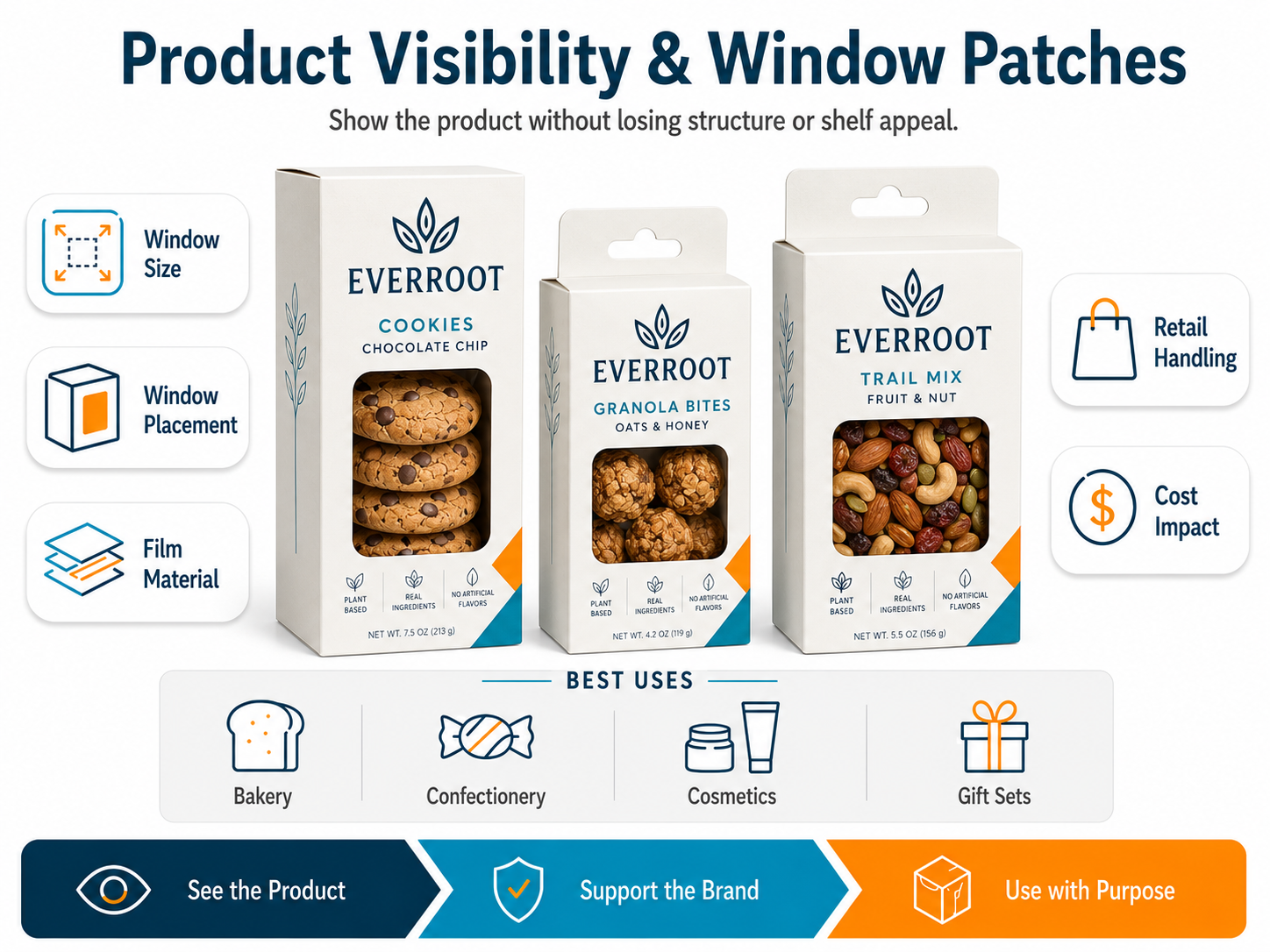
Window patches can help consumers see the product before purchase.
This is useful for products where appearance, color, freshness, texture, or arrangement influences buying decisions. Folding carton providers commonly offer window patches as an option to increase product visibility while maintaining the carton’s structure and branding surface.
Window cartons are often used for:
- Bakery products
- Confectionery
- Cosmetics
- Toys
- Gift sets
- Housewares
- Specialty food
- Retail multipacks
However, windows also add complexity.
Buyers should consider:
Window Size
A larger window improves visibility but may reduce panel strength.
Window Placement
The window should show the right part of the product without weakening key structural areas.
Film Material
The patch material must match product visibility, barrier needs, and production requirements.
Retail Handling
Windows can scuff, dent, or become less visually clean if the carton is handled heavily.
Cost Impact
Window patching adds material and converting steps.
Product visibility is valuable when it supports the sale. But it should not compromise carton performance or inflate cost without a clear retail benefit.
Board Grade and Material Selection
The paperboard matters as much as the design.
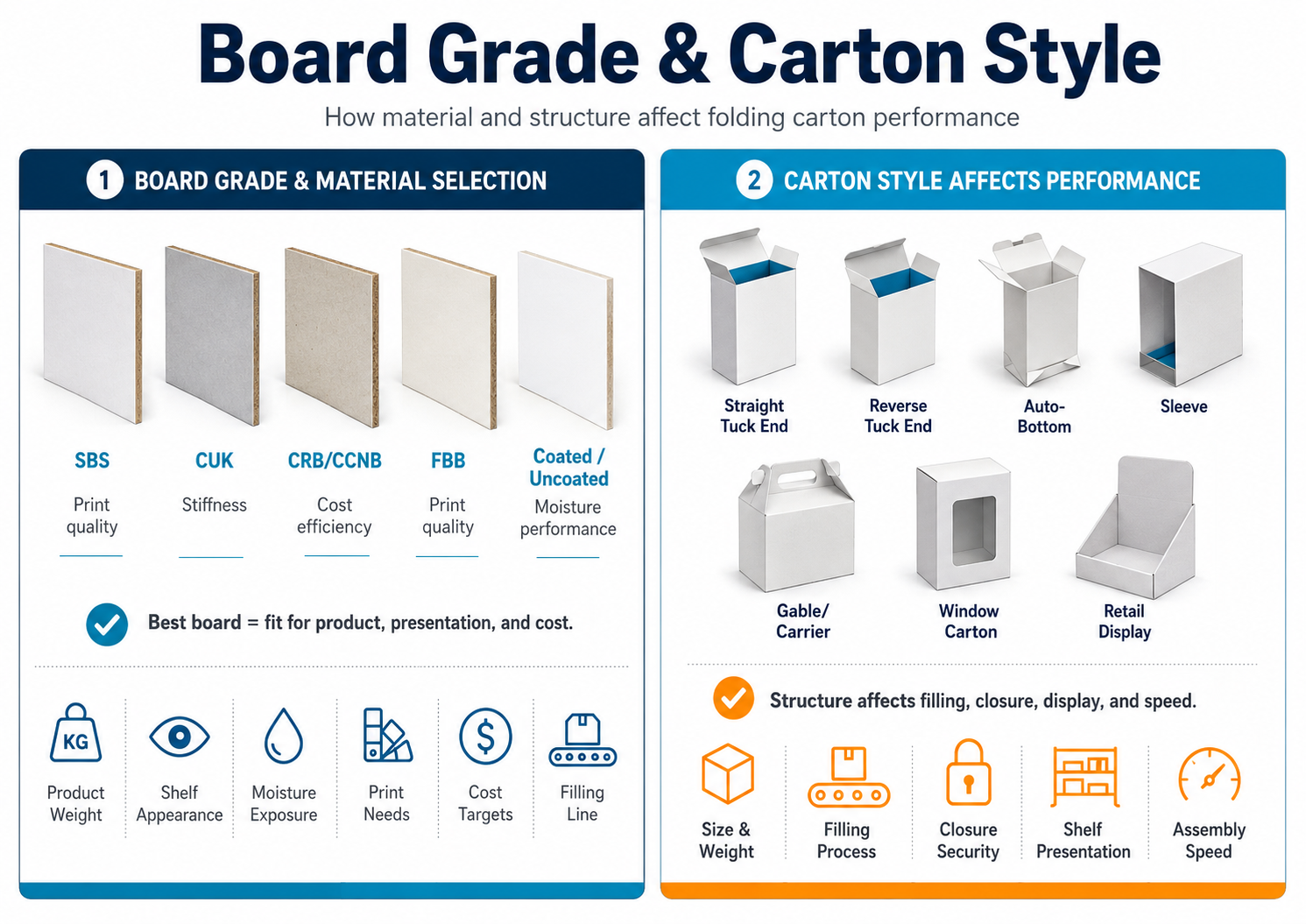
Common folding carton board options include SBS, CUK, CRB/CCNB, FBB, and other coated or uncoated paperboard grades. Different grades offer different balances of print quality, stiffness, strength, cost, appearance, and moisture performance.
Buyers should evaluate material based on:
- Product weight
- Shelf appearance
- Moisture exposure
- Print requirements
- Finishing requirements
- Retail category expectations
- Folding and scoring performance
- Cost targets
- Filling line requirements
A luxury retail carton may need a clean white surface for high-end graphics. A beverage carrier may need stronger tear resistance. A refrigerated product may require better moisture performance. A value-tier carton may prioritize cost efficiency over premium finish.
The best board is not the most expensive option. It is the board that fits the product’s performance, presentation, and cost requirements.
Carton Style Affects Performance
Folding cartons come in many styles, and the structure affects how the package opens, closes, stacks, fills, and displays.
Common folding carton styles include:
- Straight tuck end
- Reverse tuck end
- Auto-bottom
- Snap lock bottom
- Sleeve cartons
- Tray cartons
- Gable or carrier styles
- Two-piece cartons
- Window cartons
- Retail display cartons
Different styles serve different purposes. Straight tuck cartons are common for retail products where clean front and back panels matter. Auto-bottom cartons can speed up packing because the bottom forms quickly. Sleeves work well when the product or tray provides internal support. Carrier cartons are useful for beverage or multipack applications.
Folding carton style selection should be based on more than appearance. It should consider product size, weight, filling process, shelf presentation, closure security, assembly speed, and cost. Folding carton style guides commonly note that size, weight, opening style, and product interaction all affect which carton structure makes sense.
A carton that looks good in a rendering can still fail if it is slow to assemble, hard to fill, weak at the closure, or poorly matched to the product.
Manual vs. Automated Packing Requirements
One detail buyers often overlook is how the carton will be packed.
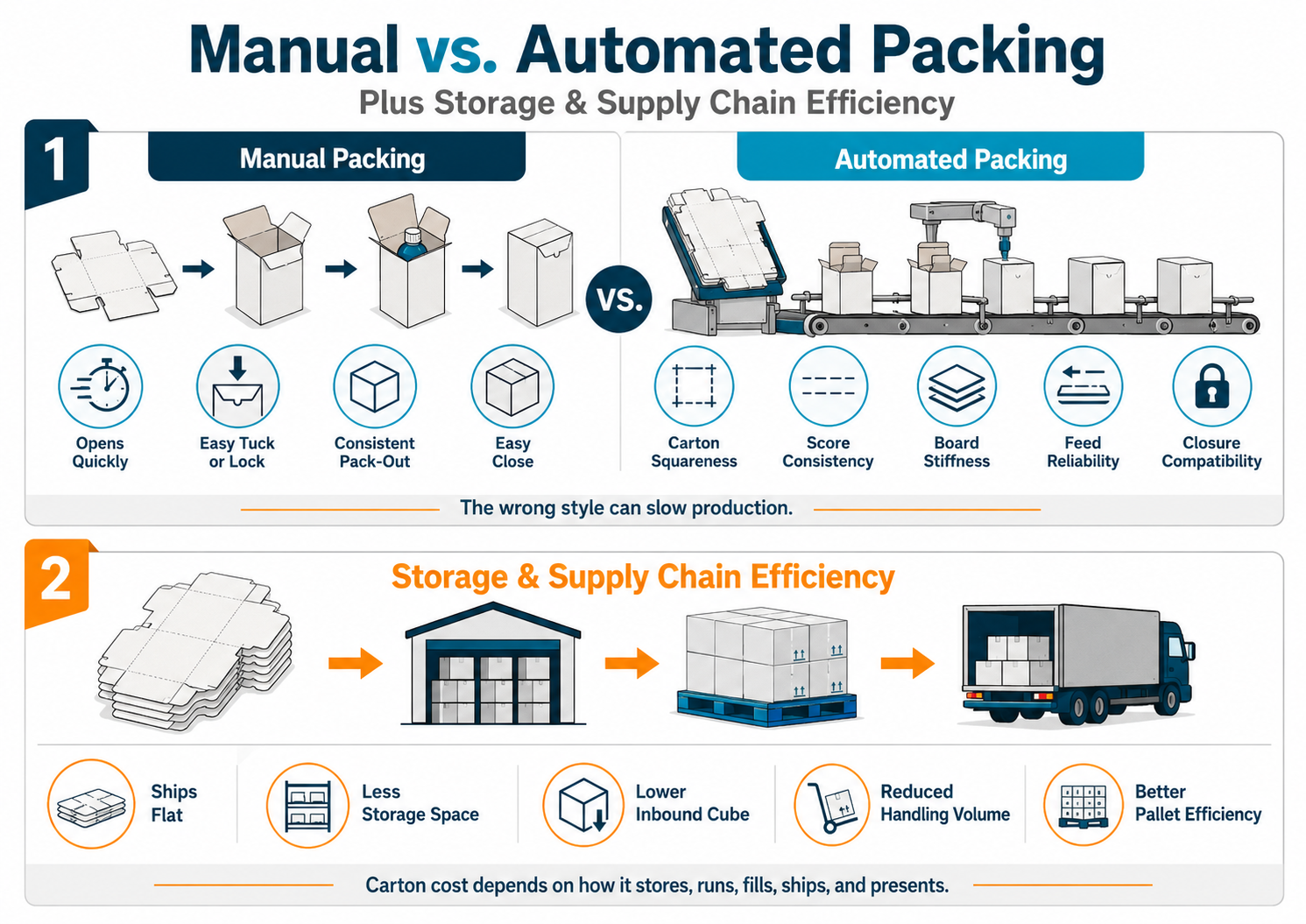
Some folding cartons are designed for manual assembly. Others are designed to run on automated or semi-automated packaging lines. Folding carton suppliers often highlight that cartons can be designed for a variety of manual or automated folding techniques.
This matters because the wrong carton style can slow production.
For manual packing, buyers should consider:
- How quickly the carton opens
- How easily it locks or tucks
- Whether workers can pack consistently
- Whether the product fits without adjustment
- Whether the carton is easy to close
For automated packing, buyers should consider:
- Carton squareness
- Score consistency
- Board stiffness
- Glue seam strength
- Machine tolerance
- Carton opening behavior
- Feed reliability
- Closure compatibility
A carton that saves material but slows the line may not reduce total cost. A slightly more expensive structure may be the better choice if it improves throughput and reduces labor or machine downtime.
Storage and Supply Chain Efficiency
Folding cartons are usually flat-packed before use, which creates storage and handling advantages.
Flat-packed cartons can reduce:
- Inbound shipping cube
- Warehouse storage space
- Handling volume
- Pre-fill transportation cost
- Inventory footprint
This is one of the practical advantages of folding cartons compared with more rigid packaging formats. Multiple packaging sources note that folding cartons ship or store flat, which supports storage and transportation efficiency.
However, storage efficiency depends on the carton design and production setup.
Buyers should consider:
Carton Blank Size
Larger blanks take more storage space and may affect converting efficiency.
Carton Complexity
More complex structures may require special handling or increase setup time.
Packing Line Flow
The carton should be easy to stage, erect, fill, and close.
Master Case Compatibility
Finished cartons may need to fit efficiently into shippers, retail cases, or displays.
Palletization
Both flat cartons and finished units should be evaluated for pallet efficiency.
The carton is only one part of the packaging system. Its true cost depends on how it stores, runs, fills, ships, and presents.
Where Folding Carton Projects Go Wrong
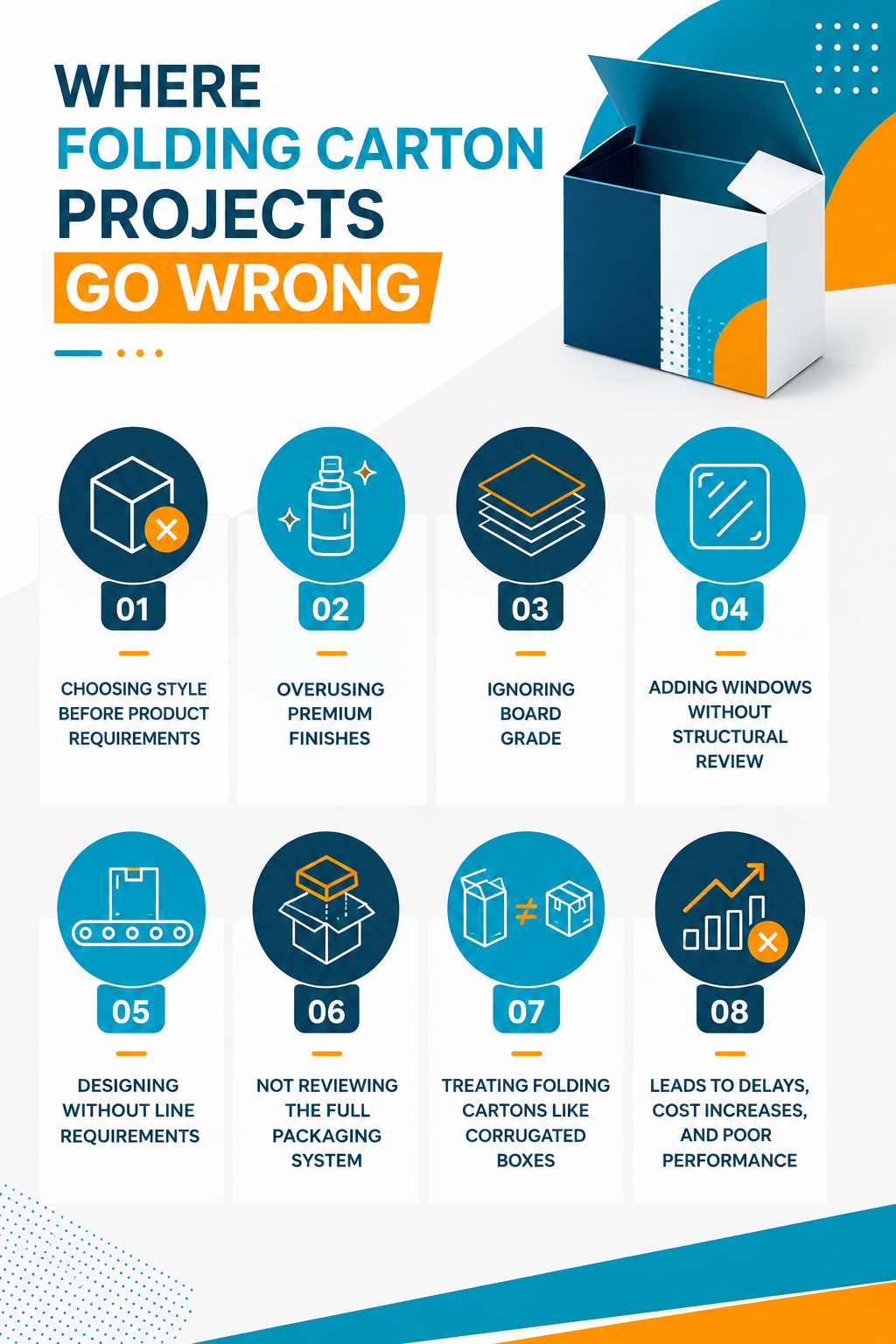
Folding cartons can create problems when buyers focus only on graphics or unit price.
Common mistakes include:
Choosing Style Before Product Requirements
The carton may look good but fail to support the product’s weight, shape, or filling process.
Overusing Premium Finishes
Foil, embossing, varnish, and specialty coatings can add value, but they also add cost and complexity.
Ignoring Board Grade
The wrong board can affect stiffness, print quality, moisture resistance, and shelf presentation.
Adding Windows Without Structural Review
A window can improve visibility but weaken the panel or increase converting cost.
Designing Without Line Requirements
A carton must work with the way it will be packed, whether manually or on automated equipment.
Not Reviewing the Full Packaging System
The carton should be evaluated with inserts, trays, master cases, displays, and shipping requirements.
Treating Folding Cartons Like Corrugated Boxes
Folding cartons are excellent for retail presentation and lightweight consumer products, but they are not a replacement for corrugated shipping protection in heavy-duty applications.
These issues can lead to delays, cost increases, quality problems, or packaging that performs poorly after launch.
What Buyers Should Evaluate Before Choosing a Folding Carton
Before approving a folding carton design, buyers should ask:
What is the product’s size and weight?
The structure and board grade must support the product.
How will the carton be filled?
Manual and automated packing require different design considerations.
What is the retail environment?
Shelf position, display type, competition, and consumer visibility matter.
Does the product need visibility?
A window may help, but it must be structurally and economically justified.
What print quality is required?
Premium graphics may require higher-grade board, coatings, or specialty finishes.
How will the carton be stored before use?
Flat-packed efficiency matters, especially for high-volume programs.
How will finished cartons ship?
Cartons may need to work with master cases, shippers, pallet patterns, or retail displays.
What cost drivers matter most?
Material, printing, finishing, setup, labor, freight, and storage should all be considered.
Does the carton need to support compliance?
Food, healthcare, pharmaceutical, and regulated products may require specific labeling or material requirements.
The right folding carton is selected around the full use case — not just the front panel design.
Final Takeaway
Folding cartons are valuable because they combine printability, customization, shelf impact, and storage efficiency in a lightweight retail packaging format.
But they are not one-size-fits-all.
The best folding carton design depends on the product, board grade, carton style, print requirements, filling process, storage needs, and retail environment.
A strong folding carton program should help the product stand out on shelf while still supporting production efficiency, supply chain performance, and cost control.
The goal is not just a better-looking carton. It is a better-performing packaging system.
Partner With Brown Packaging
Brown Packaging can help develop folding carton solutions that align structure, material, print, finishing, and supply chain requirements.
We support custom folding cartons for retail, food, beverage, beauty, personal care, healthcare, household goods, promotional packaging, and specialty consumer products. Whether your project requires high-impact graphics, window patches, specialty finishes, flat-packed efficiency, or a carton designed for manual or automated filling, we can help build a solution around your product and operation.
Partner with Brown Packaging to create folding cartons that perform on shelf, in production, and across the supply chain.
References
GLBC. (2026). Folding cartons: Custom packaging for every industry. Great Little Box Company. https://www.glbc.com/blog/folding-carton-packaging/
Graphic Packaging International. (n.d.). Folding cartons for food, beverage, and consumer products. https://www.graphicpkg.com/solutions/packaging-solutions/folding-cartons/
Smurfit Westrock. (n.d.). Folding carton packaging. https://www.smurfitwestrock.com/products/packaging/paperboard/folding-cartons
Smurfit Westrock. (n.d.). Folding cartons for consumer goods. https://www.smurfitwestrock.com/products/packaging/paperboard/folding-cartons/consumer-goods
Sustainable packaging in 2027 will be less about broad claims and more about proof, performance, compliance, and cost control. Buyers will still care about recyclable materials, recycled content, and lower
Sustainable packaging in 2027 will be less about broad claims and more about proof, performance, compliance, and cost control. Buyers will still care about recyclable materials, recycled content, and lower
A folding carton may look simple once it reaches the shelf, but it goes through a controlled production process before it becomes a finished package. Every step — from paperboard
Folding carton production is becoming more automated because buyers are asking for faster timelines, tighter consistency, and more flexibility across more SKUs. Shorter product lifecycles, retail launch windows, labor pressure,
By submitting your information, you agree to our terms and conditions and privacy policy.

Home » Choosing Folding Cartons: A Buyer’s Guide

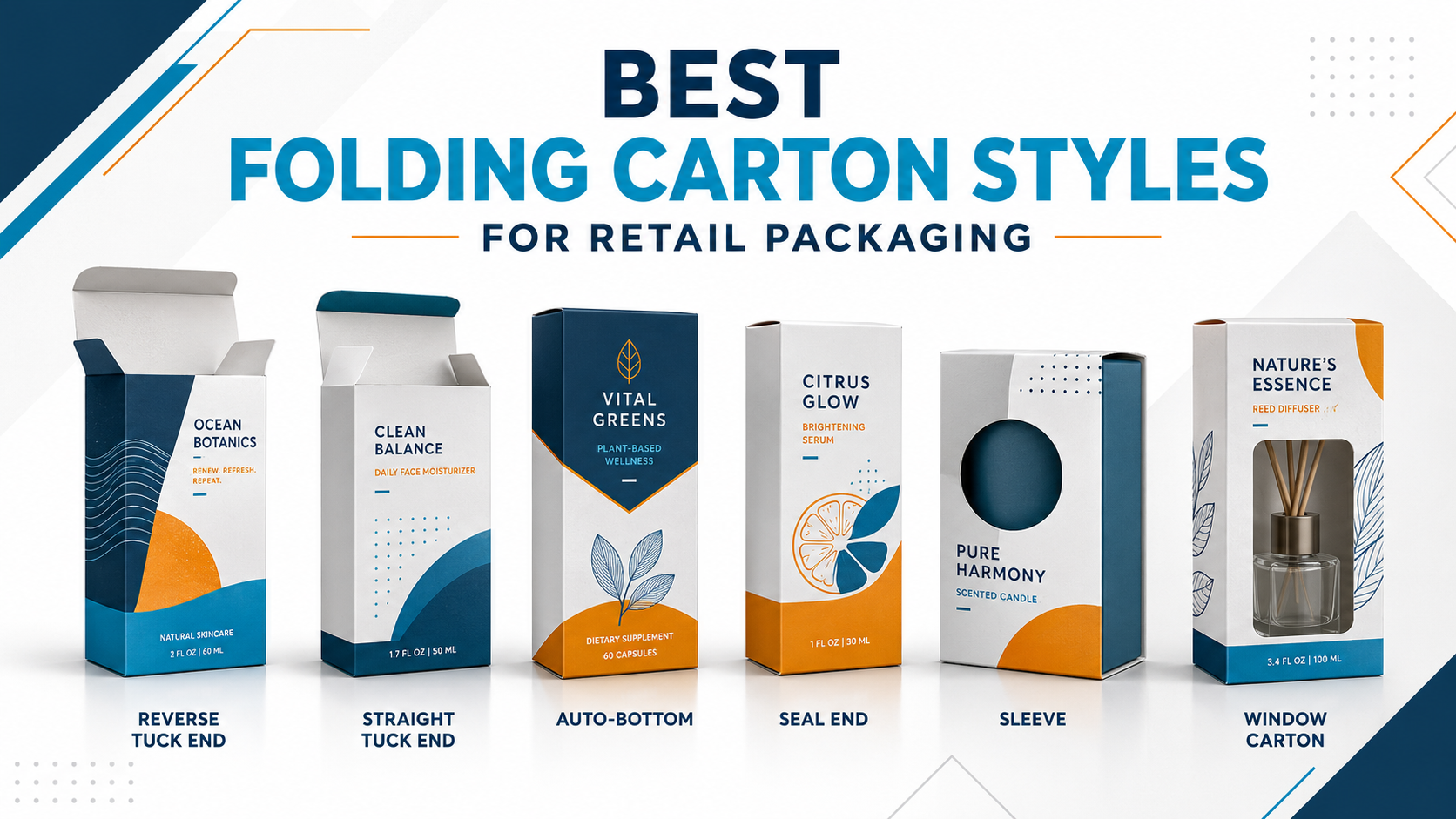

Folding carton style matters because structure affects more than appearance. The right carton can improve shelf presentation, packing speed, product access, closure security, storage efficiency,
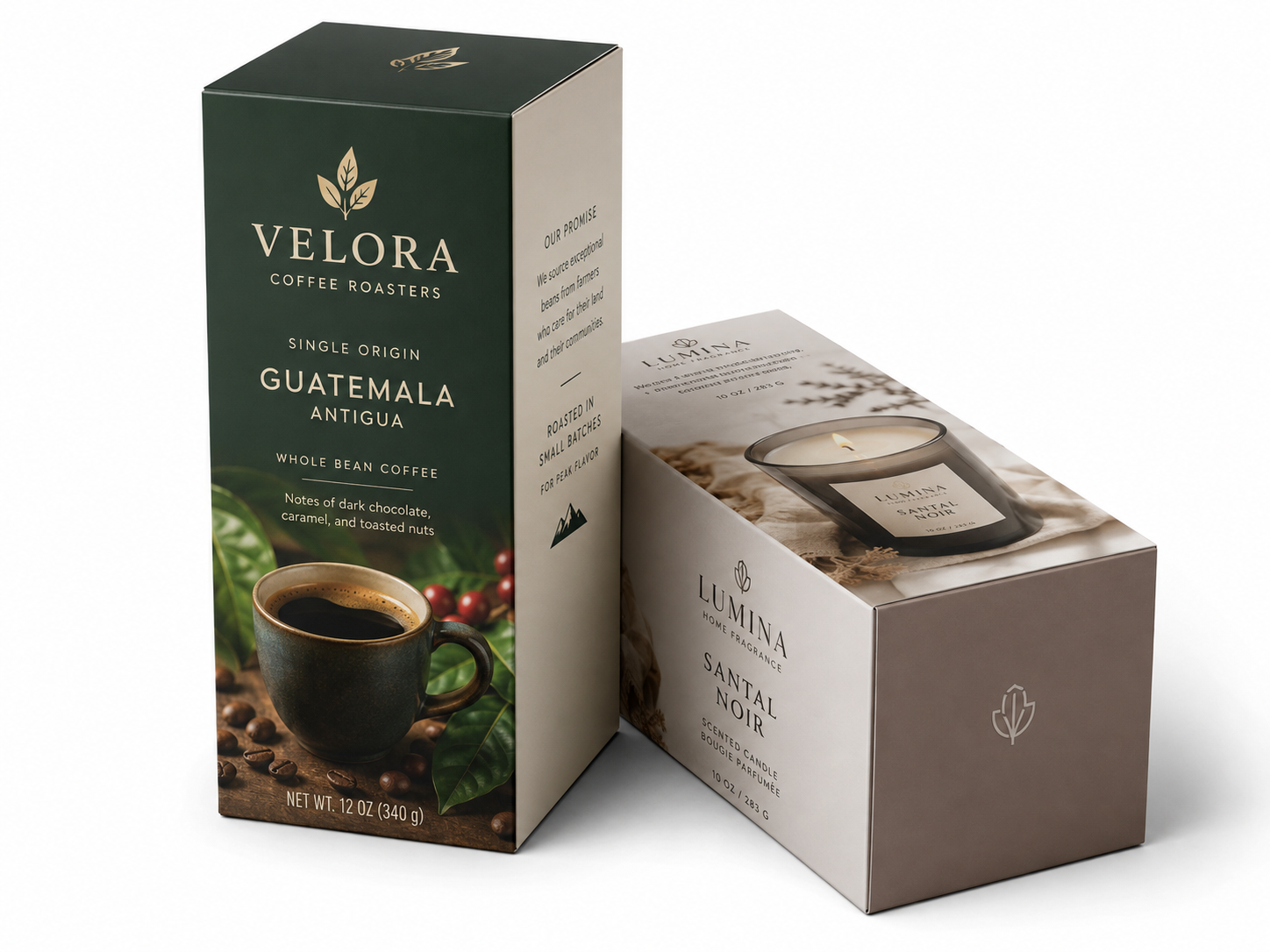
Folding carton artwork can look finished on screen and still create problems once it reaches production. The dieline is where design, structure, printing, cutting, folding,
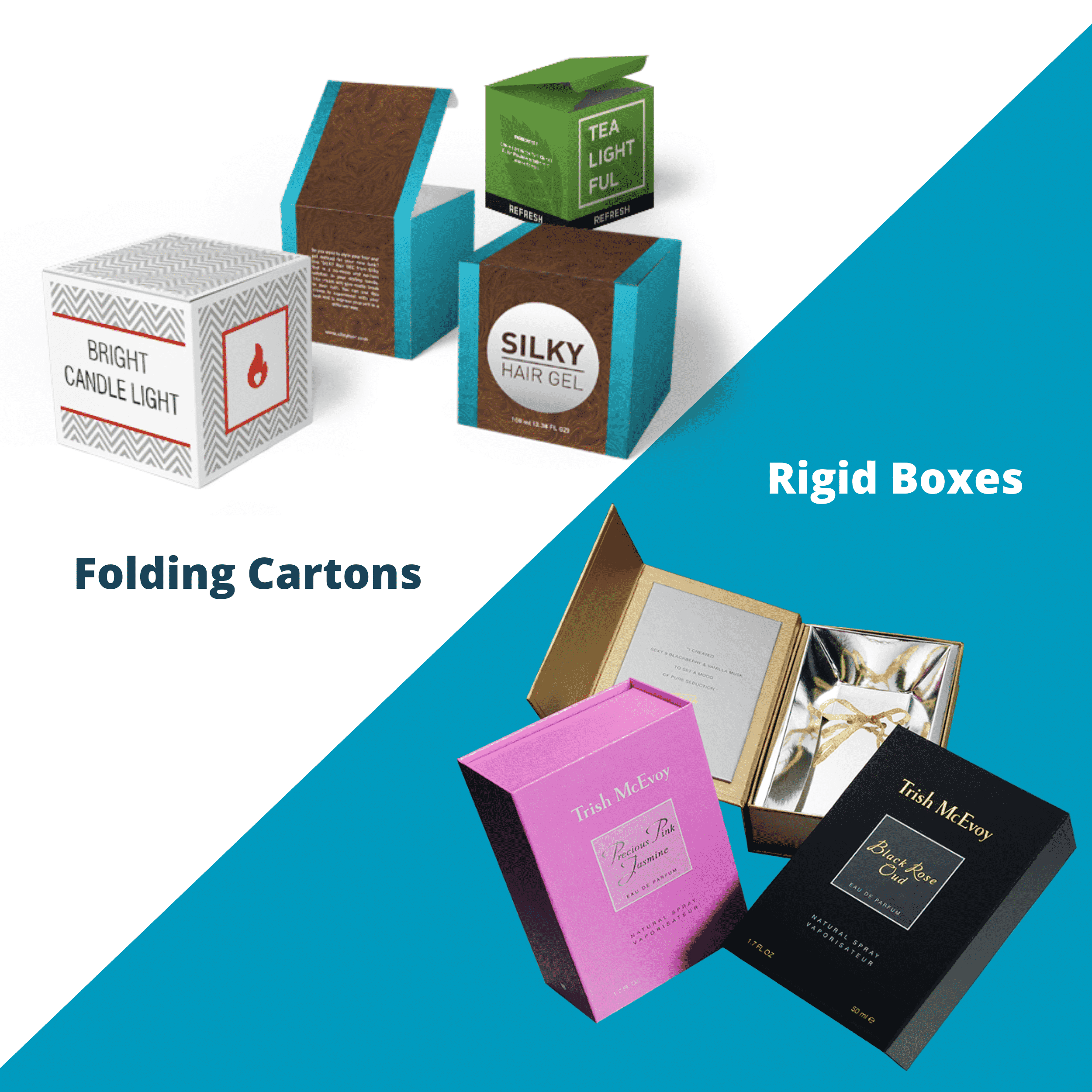
When it comes to packaging your products, the choice between folding cartons and rigid boxes is crucial. Both types serve similar purposes in protecting, displaying,