Home » What Happens to POP Displays After They Leave the Warehouse
What Happens to POP Displays After They Leave the Warehouse
Most POP displays are designed to look good at production.
But that’s not where they’re tested.
They’re tested here:
👉 The supply chain
Between the warehouse and the store floor, displays go through:
- Stacking
- Transport
- Handling
- Repositioning
And this is where most failures actually happen.
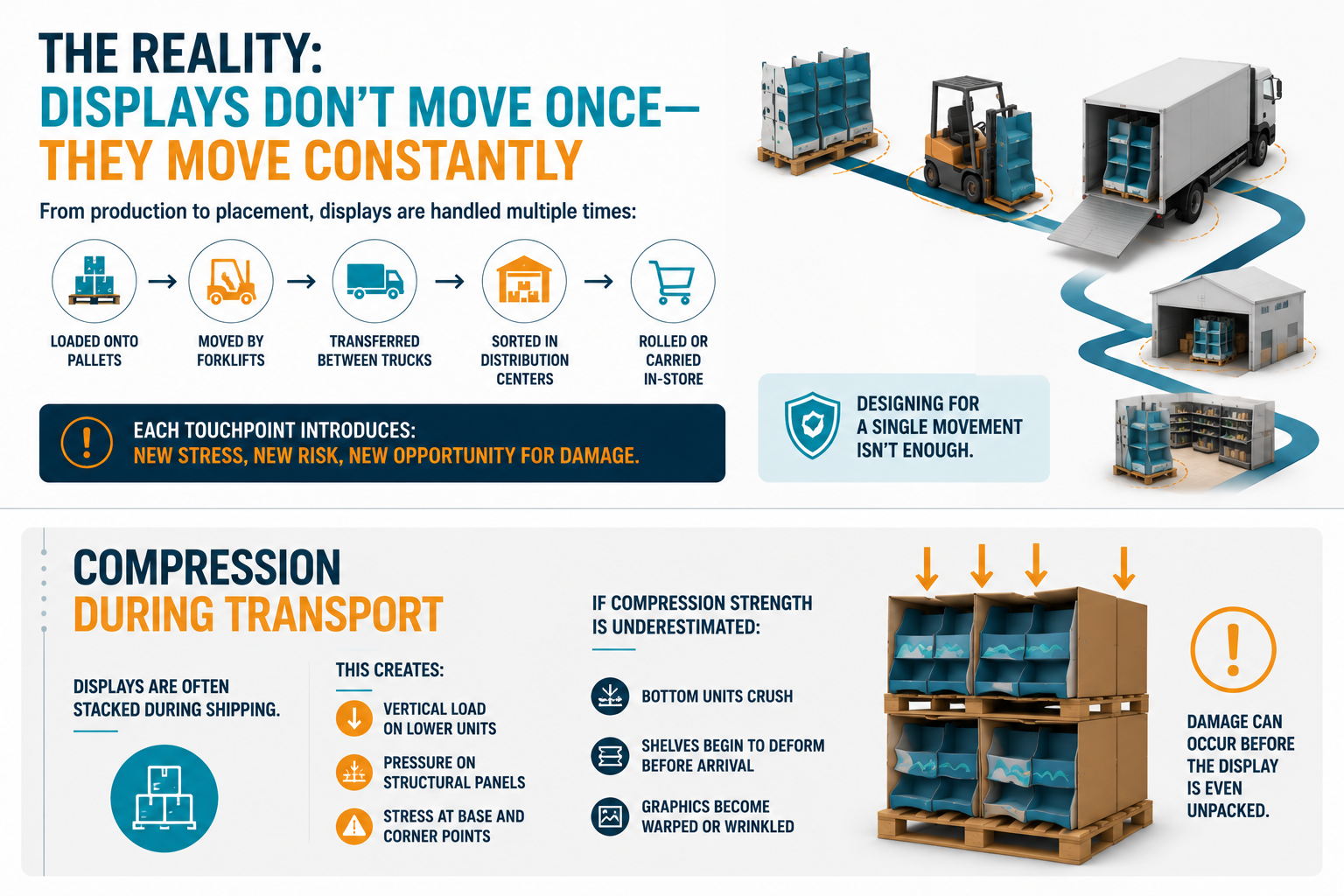
The Reality: Displays Don’t Move Once—They Move Constantly
From production to placement, displays are handled multiple times:
- Loaded onto pallets
- Moved by forklifts
- Transferred between trucks
- Sorted in distribution centers
- Rolled or carried in-store
Each touchpoint introduces:
👉 New stress, new risk, new opportunity for damage
Designing for a single movement isn’t enough.
Compression During Transport
Displays are often stacked during shipping.
This creates:
- Vertical load on lower units
- Pressure on structural panels
- Stress at base and corner points
If compression strength is underestimated:
- Bottom units crush
- Shelves begin to deform before arrival
- Graphics become warped or wrinkled
Damage can occur before the display is even unpacked.
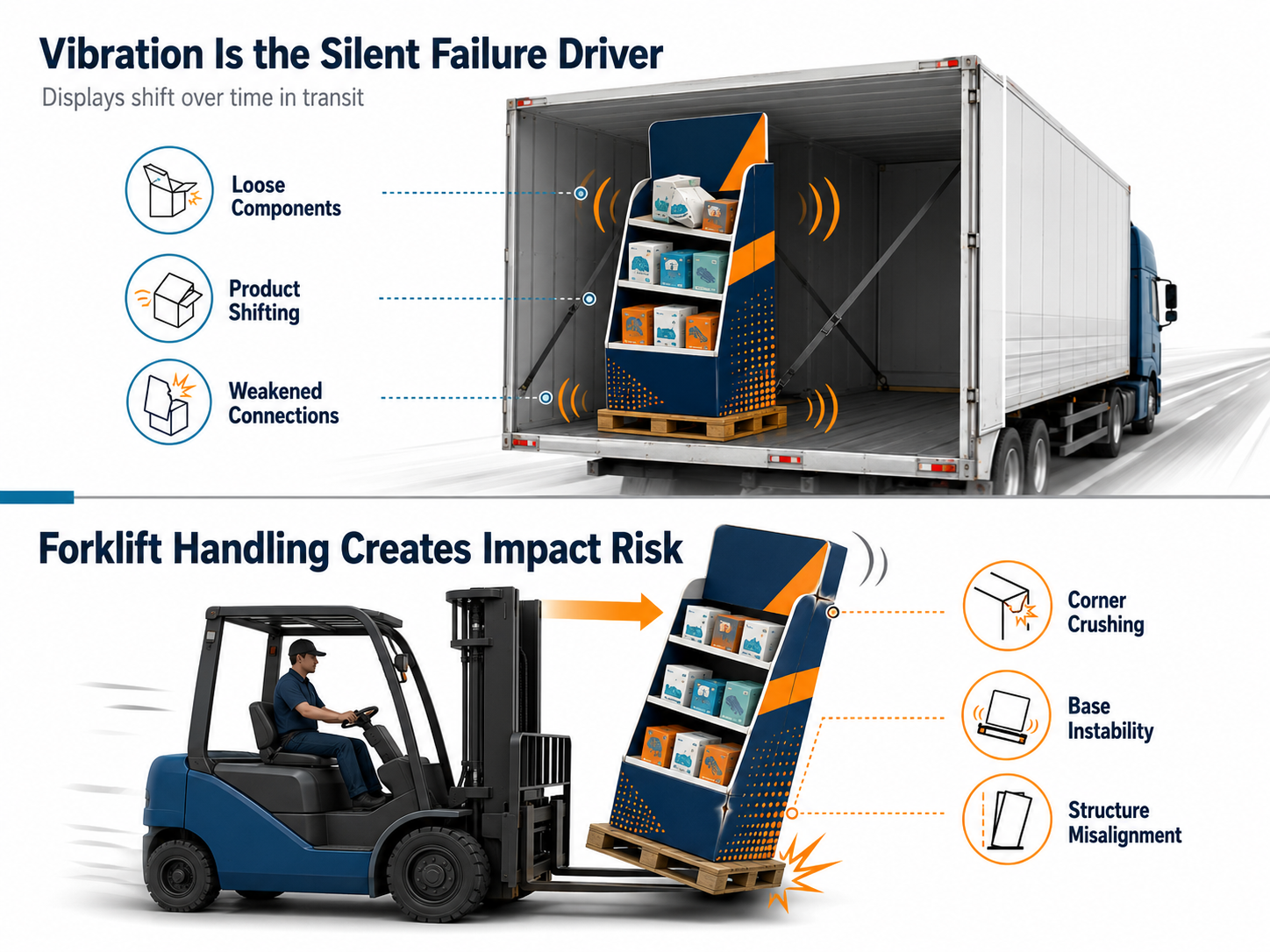
Vibration Is the Silent Failure Driver
During transit:
- Trucks create constant vibration
- Displays shift slightly over time
This leads to:
- Loose components
- Product shifting inside the display
- Gradual weakening of structural connections
Even if the display looks intact:
👉 Internal performance may already be compromised
Forklift Handling Creates Impact Risk
Displays are rarely handled gently.
Forklifts introduce:
- Sudden lifting and lowering
- Uneven pressure on pallet edges
- Occasional impact or misalignment
This can cause:
- Corner crushing
- Base instability
- Misalignment of the structure
If the base is weak, everything above it is affected.
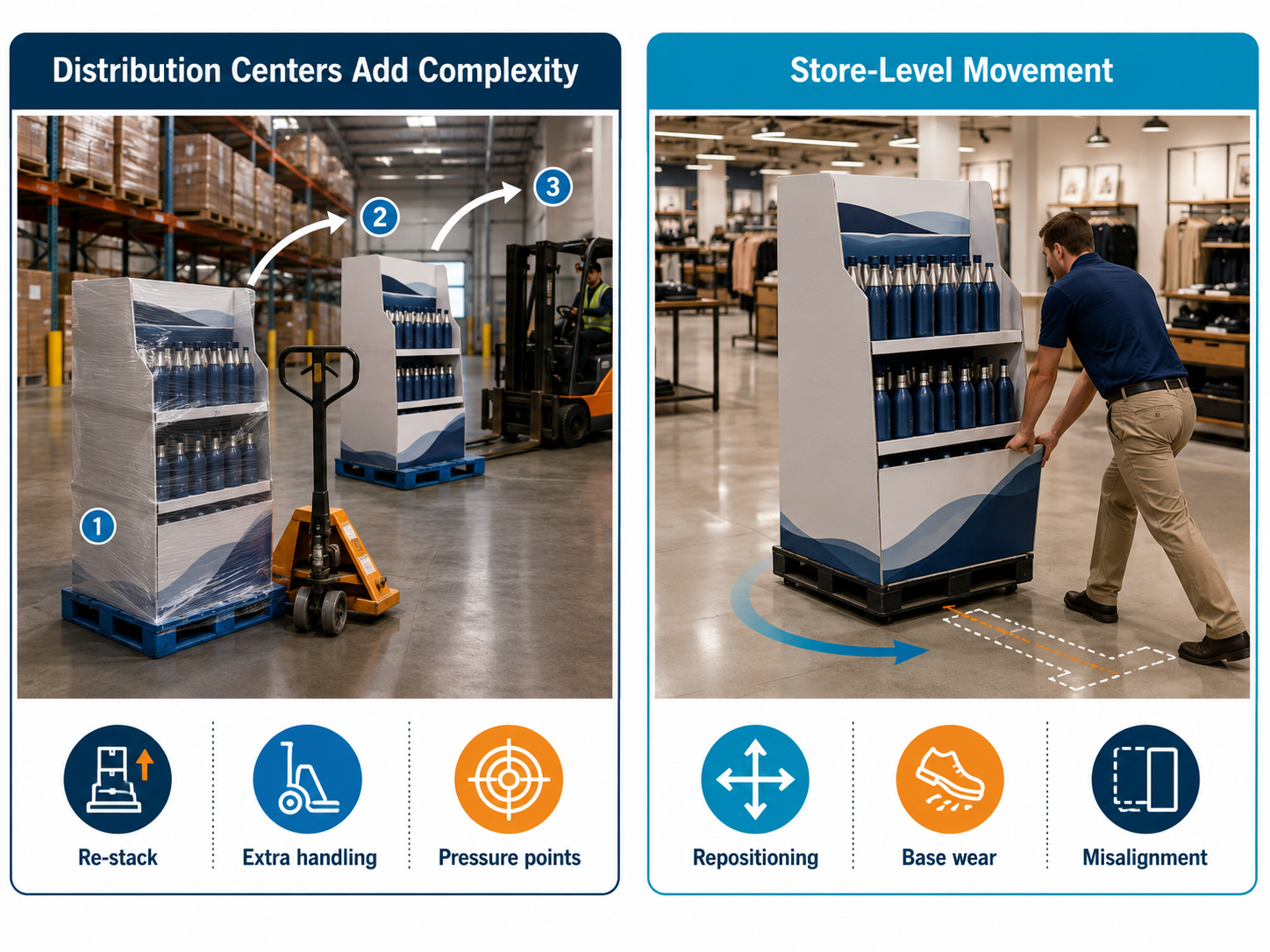
Distribution Centers Add More Complexity
At distribution centers:
- Displays are sorted and re-stacked
- Pallets may be broken down and rebuilt
This creates:
- Additional handling cycles
- Inconsistent stacking patterns
- New pressure points
Each step increases the chance of:
👉 Structural fatigue before store arrival
Store-Level Movement Is Often Overlooked
Once in-store, displays are still not safe.
They may be:
- Dragged across floors
- Moved to different locations
- Repositioned multiple times
This leads to:
- Base wear and weakening
- Shifted load distribution
- Structural misalignment
The display’s environment is constantly changing.
Assembly and Setup Introduce Final Risk
Even after surviving transit:
- Displays may be assembled incorrectly
- Components may be missing or damaged
- Load may be placed unevenly
This can:
- Reduce structural strength
- Create immediate instability
- Accelerate failure during use
The last step is often where everything breaks down.
Why “It Looked Fine at Production” Doesn’t Matter
Most failures happen:
👉 After the display leaves the warehouse
Because:
- Real-world conditions are dynamic
- Handling is inconsistent
- Stress accumulates over time
A display that passes inspection:
👉 Can still fail before it ever sells product
What Durable Displays Are Designed For
High-performing displays account for:
- Compression during stacking
- Vibration during transit
- Impact during handling
- Movement at store level
- Inconsistent assembly
They’re engineered for:
👉 The journey—not just the starting point
Where Brands Get It Wrong
- Designing for appearance instead of transport conditions
- Underestimating handling frequency
- Ignoring vibration and internal movement
- Treating the pallet and display as separate systems
- Not testing real-world scenarios
These gaps lead to hidden failures.
How Brown Packaging Designs for the Full Journey
At Brown Packaging, POP displays are engineered to perform from production to placement.
We focus on:
- Structural integrity under compression and movement
- Secure pack-out to prevent internal shifting
- Pallet integration for stability
- Reducing failure points across the supply chain
Because if a display doesn’t survive the journey, it never gets the chance to perform.
References
ISTA. (2023). Transit Testing Protocols.
ASTM International. (2022). Packaging and Distribution Standards.
TAPPI. (2021). Corrugated Board Testing Methods.
Soroka, W. (2009). Fundamentals of Packaging Technology (4th ed.). IoPP.
Shop! Association. (2023). Retail Display Guidelines.
Most POP displays are designed to look good at production. But that’s not where they’re tested. They’re tested here:👉 The supply chain Between the warehouse and the store floor, displays
Most cost savings in packaging come from:👉 Ordering more volume But increasing MOQ isn’t always possible. Storage is limited Cash flow is constrained Demand is uncertain So the real question
Minimum order quantities (MOQs) aren’t arbitrary. They exist because packaging production has fixed costs that don’t scale down—only up. When you order one unit, you still pay for:👉 The entire
Most POP display programs don’t lose money on materials. They lose it in:👉 empty space Displays are often shipped with: Excess void space Poor stacking efficiency Low pallet utilization You’re
Home » What Happens to POP Displays After They Leave the Warehouse