Home » How to Measure POP Display ROI Without Guesswork
How to Measure POP Display ROI Without Guesswork
Most brands invest in POP displays without clearly measuring performance.
They look at sales after rollout and assume the display worked—or didn’t. But without isolating variables, that’s just guessing.
If you can’t quantify impact, you can’t optimize it.
Start with a Baseline
Before measuring lift, you need to know what “normal” looks like.
Baseline metrics include:
- Average weekly sales per store (without display)
- Product velocity by location type
- Existing shelf placement performance
Without this, you can’t determine whether the display actually drove incremental revenue—or just captured existing demand.
Measure Sales Lift (The Core KPI)
This is the most important metric.
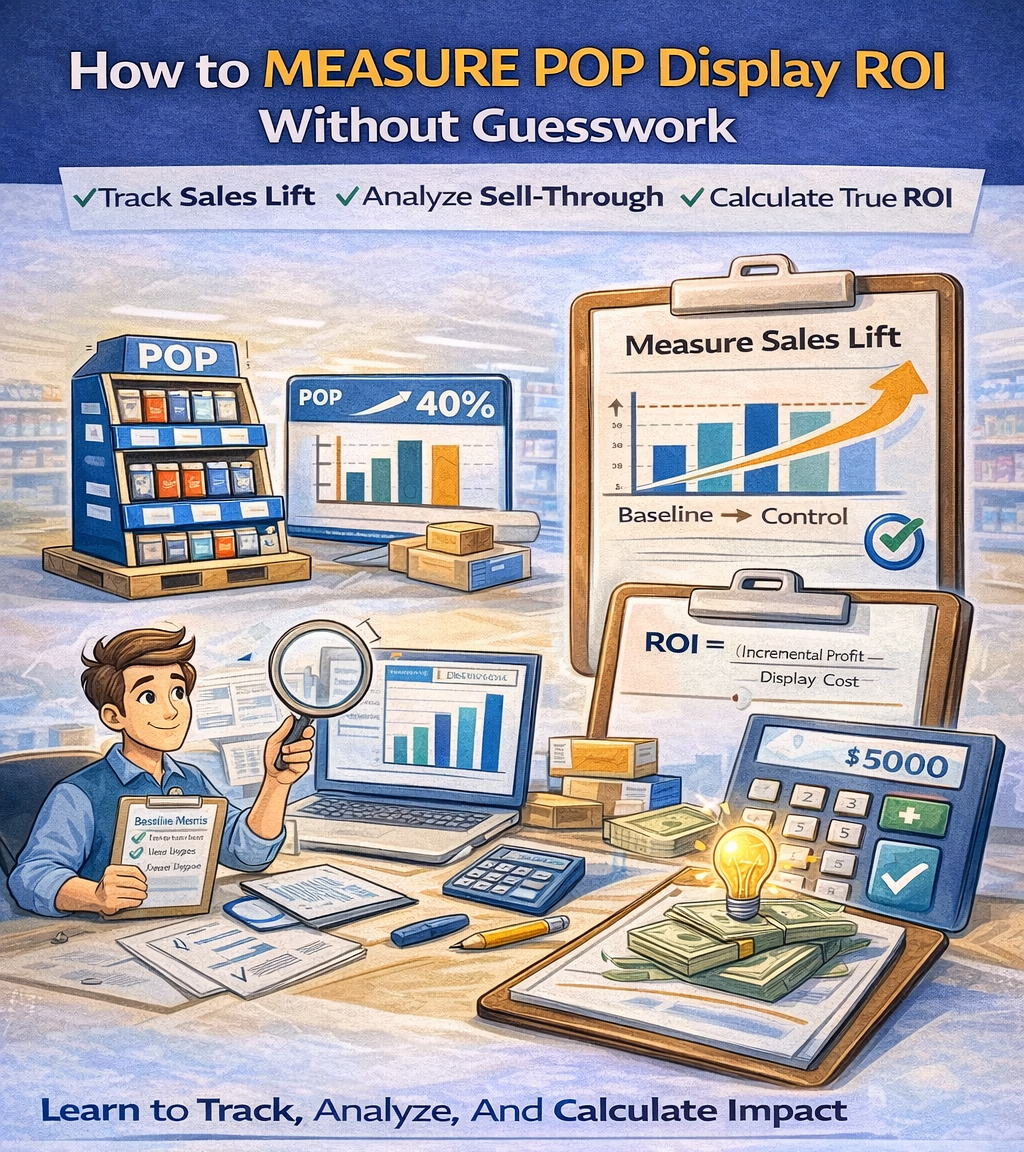
Sales Lift = % increase in sales compared to baseline
Example:
- Baseline: 50 units/week
- With display: 70 units/week
- Lift: +40%
But here’s where most brands mess up:
They don’t compare against control stores.
Always compare:
- Stores with display
vs - Similar stores without display
This isolates the display’s actual impact.
Track Sell-Through Rate
Sell-through shows how efficiently inventory moves.
Sell-Through = Units sold ÷ Units shipped
Why it matters:
- High sell-through = strong display performance
- Low sell-through = poor visibility, placement, or accessibility
If inventory sits, the display isn’t working—regardless of how it looks.
Monitor Time-to-Empty (Velocity Indicator)
How fast does the display sell out?
This tells you:
- Whether inventory levels are correct
- If replenishment is needed
- How strong demand really is
Fast sell-through with no replenishment = missed revenue
Slow movement = weak execution or poor design
Evaluate Retail Execution
Not all displays make it to the floor—or stay there.
Track:
- % of displays placed correctly
- % of displays fully stocked
- % removed early
A great display design means nothing if execution fails.
Common issues:
- Poor assembly
- Store-level non-compliance
- Lack of replenishment
Measure Engagement (If Available)
For higher-level programs, you can track:
- Shopper interaction (via observation or sensors)
- Dwell time near display
- Product touch rate
Even simple in-store feedback from reps can reveal:
- Are customers noticing it?
- Are they engaging with it?
This is often overlooked—but highly valuable.
Calculate True ROI
Here’s the simplified formula:
ROI = (Incremental Profit – Display Cost) ÷ Display Cost
Key inputs:
- Incremental sales (not total sales)
- Product margin
- Display production + logistics cost
Example:
- Incremental profit: $50,000
- Display cost: $10,000
- ROI: 400%
That’s how displays should be evaluated—not by aesthetics or assumptions.
Where Most Brands Get It Wrong
- No control group comparison
- No baseline data
- Measuring revenue instead of incremental lift
- Ignoring execution issues
- Focusing only on unit cost
Without structure, even good displays look average.
Turning Data into Decisions
Once you track performance, you can optimize:
- Which display types perform best
- Which retailers drive the highest ROI
- What structural or design changes improve lift
- Where to scale—or cut—programs
This is where POP becomes a repeatable growth channel, not a one-off expense.
How Brown Packaging Supports ROI-Driven Displays
At Brown Packaging, POP display programs are designed with performance measurement in mind.
We help brands:
- Align display design with retail objectives
- Identify key performance metrics before rollout
- Optimize structures for sell-through and replenishment
- Reduce failure points that impact ROI
Because a display that can’t be measured can’t be improved—and won’t scale.
Most brands invest in POP displays without clearly measuring performance. They look at sales after rollout and assume the display worked—or didn’t. But without isolating variables, that’s just guessing. If
Most cost-cutting in POP displays happens in the wrong place. Brands reduce board grade, simplify structure too aggressively, or cut print quality—only to see: Higher damage rates Poor retail execution
Oil prices don’t just affect fuel—they ripple through nearly every part of packaging. When oil rises, packaging costs follow.When oil drops, costs don’t always fall as quickly. That’s because oil
Most POP display failures aren’t caused by weak materials—they’re caused by poor weight distribution. A display can use the right board, the right flute, and still fail early if the
Home » How to Measure POP Display ROI Without Guesswork