

window.uetq = window.uetq || []; window.uetq.push(‘event’, ‘submit_lead_form’,{ event_label:‘SUBMIT MESSAGE’ }); window.lintrk('track', { conversion_id: 10271009 }); window.lintrk('track', { conversion_id: 10271017 });

Why Your Boxes Pass Testing but Fail in Shipping

Why Your Boxes Pass Testing but Fail in Shipping

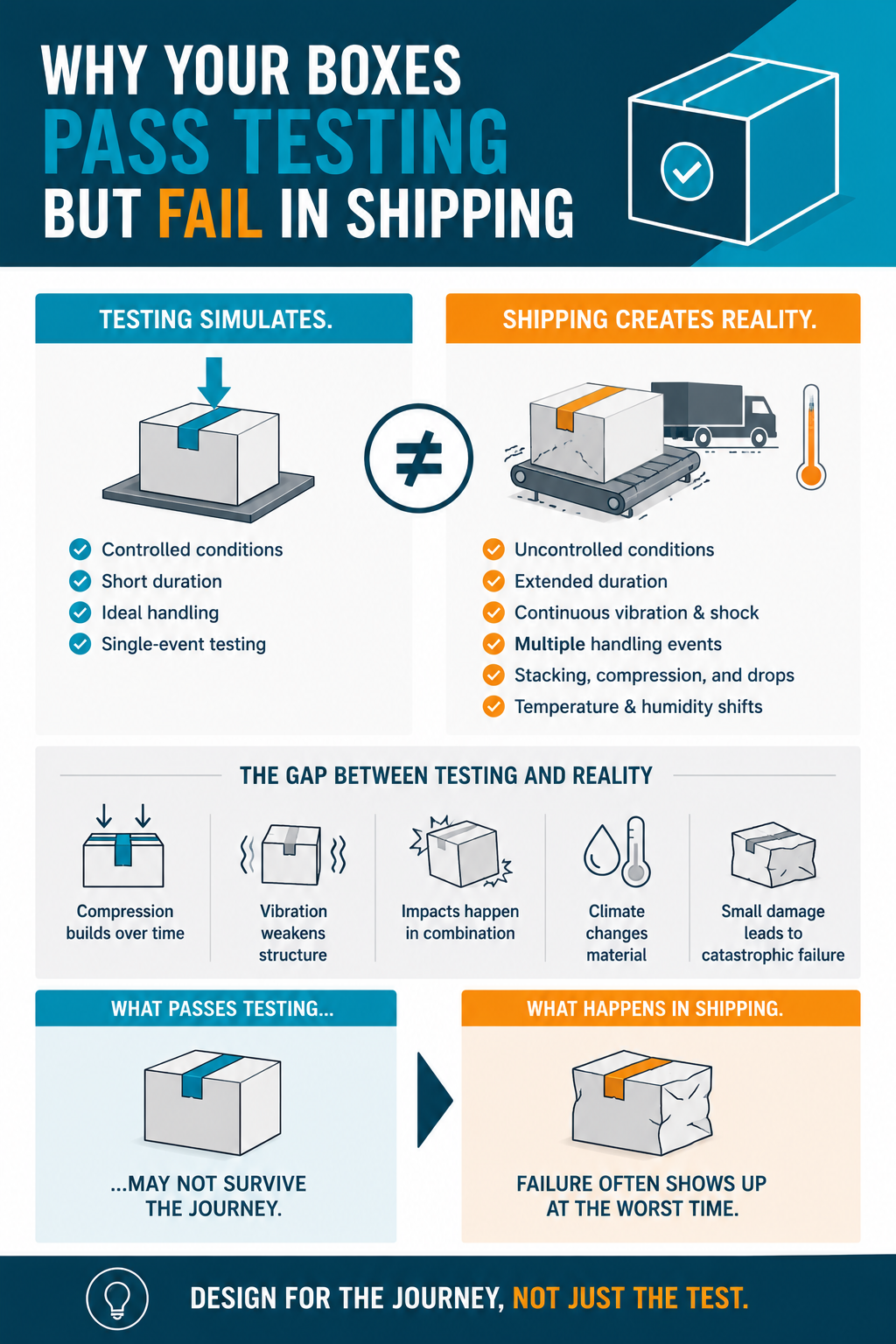
Many packaging systems pass lab testing—and still fail in real-world shipping.

This disconnect happens because testing measures controlled conditions, while shipping introduces variables that are rarely accounted for.

If your boxes are failing despite meeting specs, the issue is not the material—it’s the gap between testing and actual use.

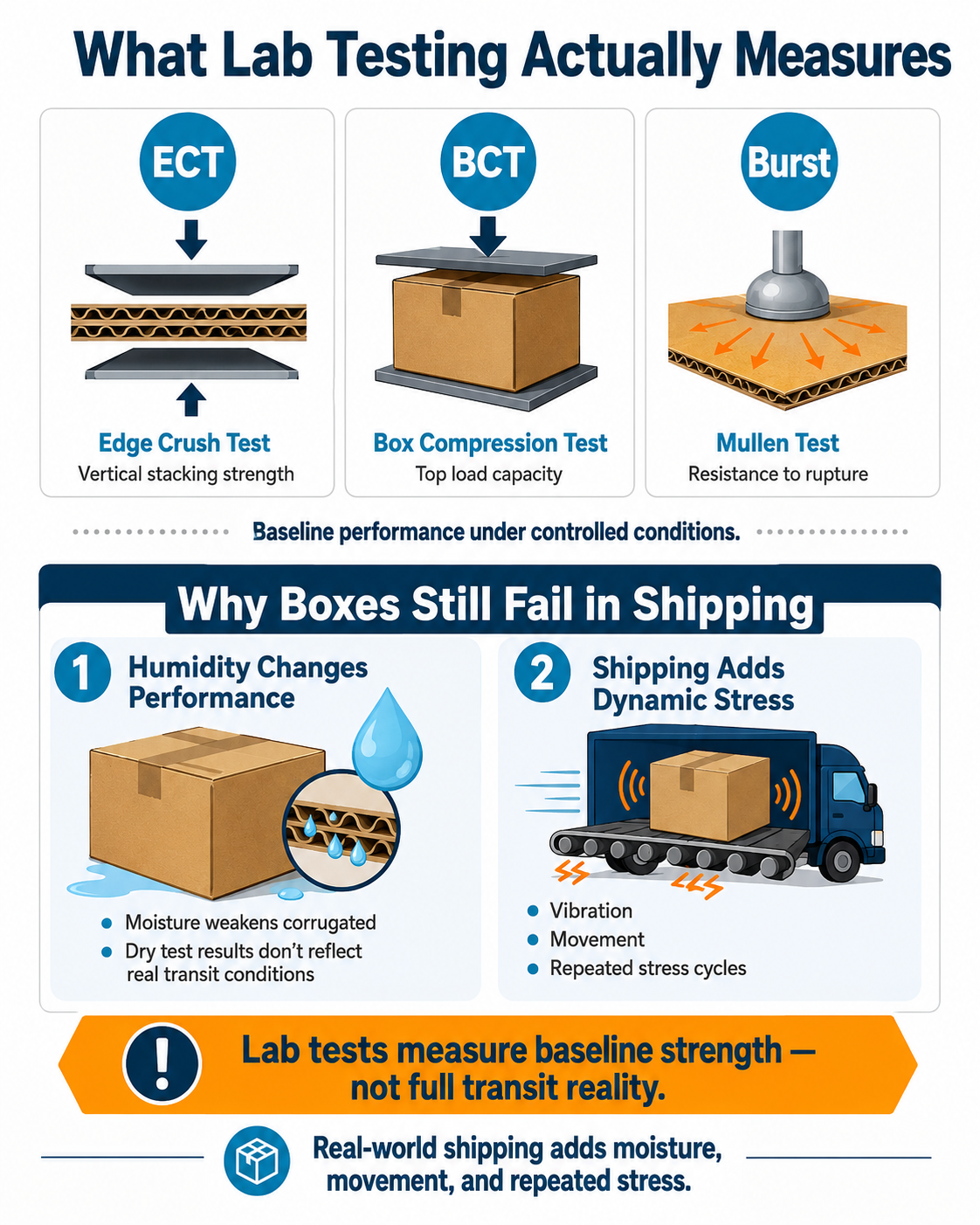
What Lab Testing Actually Measures

Most corrugated packaging is evaluated using standardized tests such as:

  • ECT (Edge Crush Test) – measures vertical stacking strength of board
  • BCT (Box Compression Test) – measures top load capacity
  • Burst Strength (Mullen Test) – measures resistance to rupture

These tests provide baseline performance data under controlled conditions.

👉 But they do not fully represent how packaging behaves in transit

Why Packaging Fails in the Real World

Testing Doesn’t Account for Humidity

Corrugated is highly sensitive to moisture.

  • Strength can drop 30–50% in high humidity environments
  • Warehouses, trailers, and transit conditions vary significantly

👉 A box that passes dry testing may fail under real conditions

Static Load vs Dynamic Conditions

Lab tests measure static strength.

Shipping introduces:

  • Vibration
  • Movement
  • Repeated stress cycles

👉 Over time, these forces weaken the box structure beyond test assumptions

What Lab Testing Actually Measures and Why Packaging Fails in the Real World

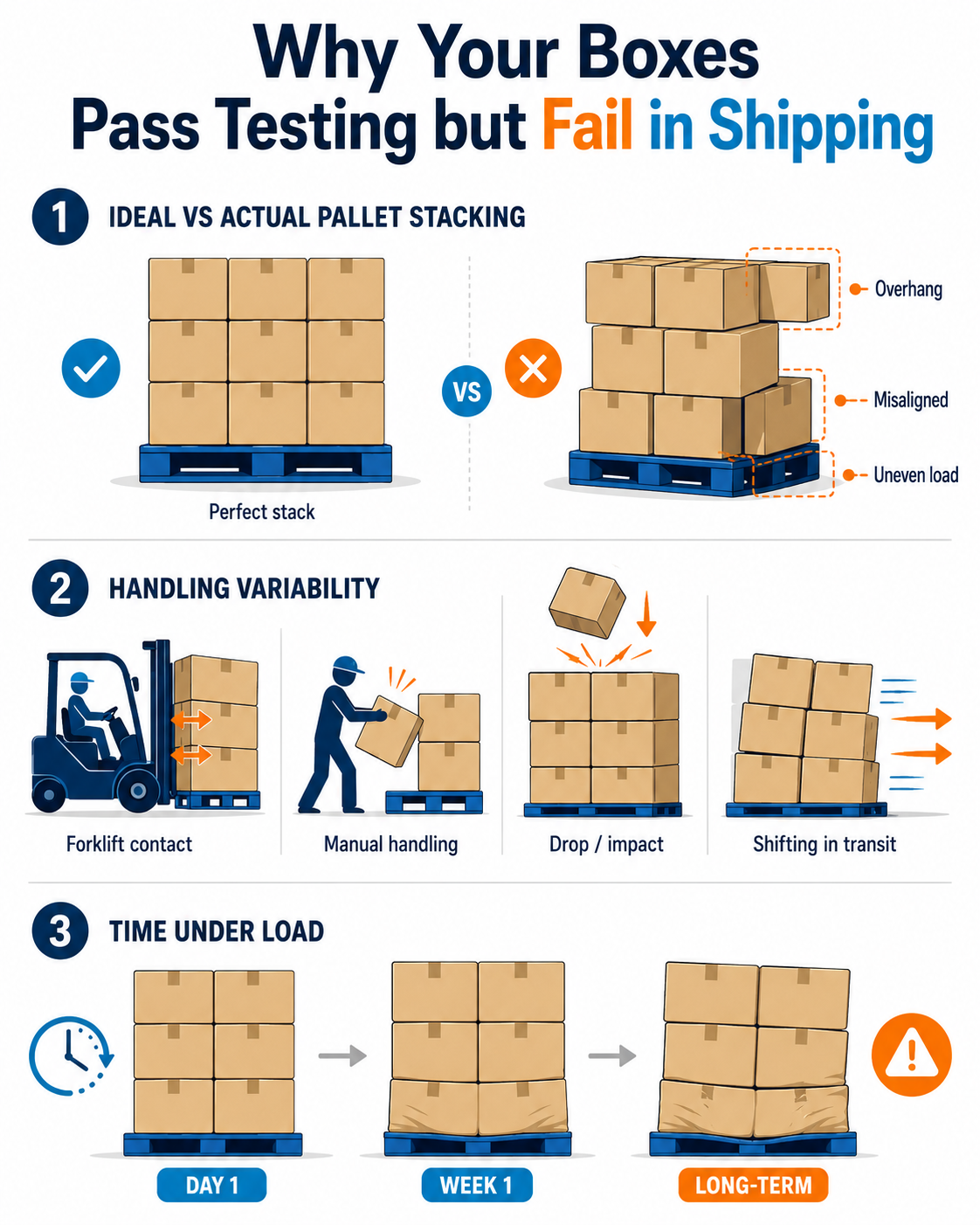
Ideal vs Actual Pallet Stacking

Testing assumes perfect stacking conditions.

Real-world issues include:

  • Misaligned boxes
  • Overhang on pallets
  • Uneven load distribution

👉 Small inconsistencies create localized failure points

Handling Variability

Boxes are not handled consistently.

  • Forklift pressure
  • Manual handling impacts
  • Drops and shifts during transit

👉 These factors are not captured in standard tests

Time Under Load

Boxes weaken the longer they are stacked.

  • Storage duration impacts performance
  • Long-term stacking reduces effective strength

👉 Testing does not always reflect real storage timelines

Why Your boxes pass testing but fail in shipping

The Core Problem

Most companies treat packaging specs as guarantees of performance.

They are not.

They are indicators under controlled conditions, not predictions of real-world outcomes.

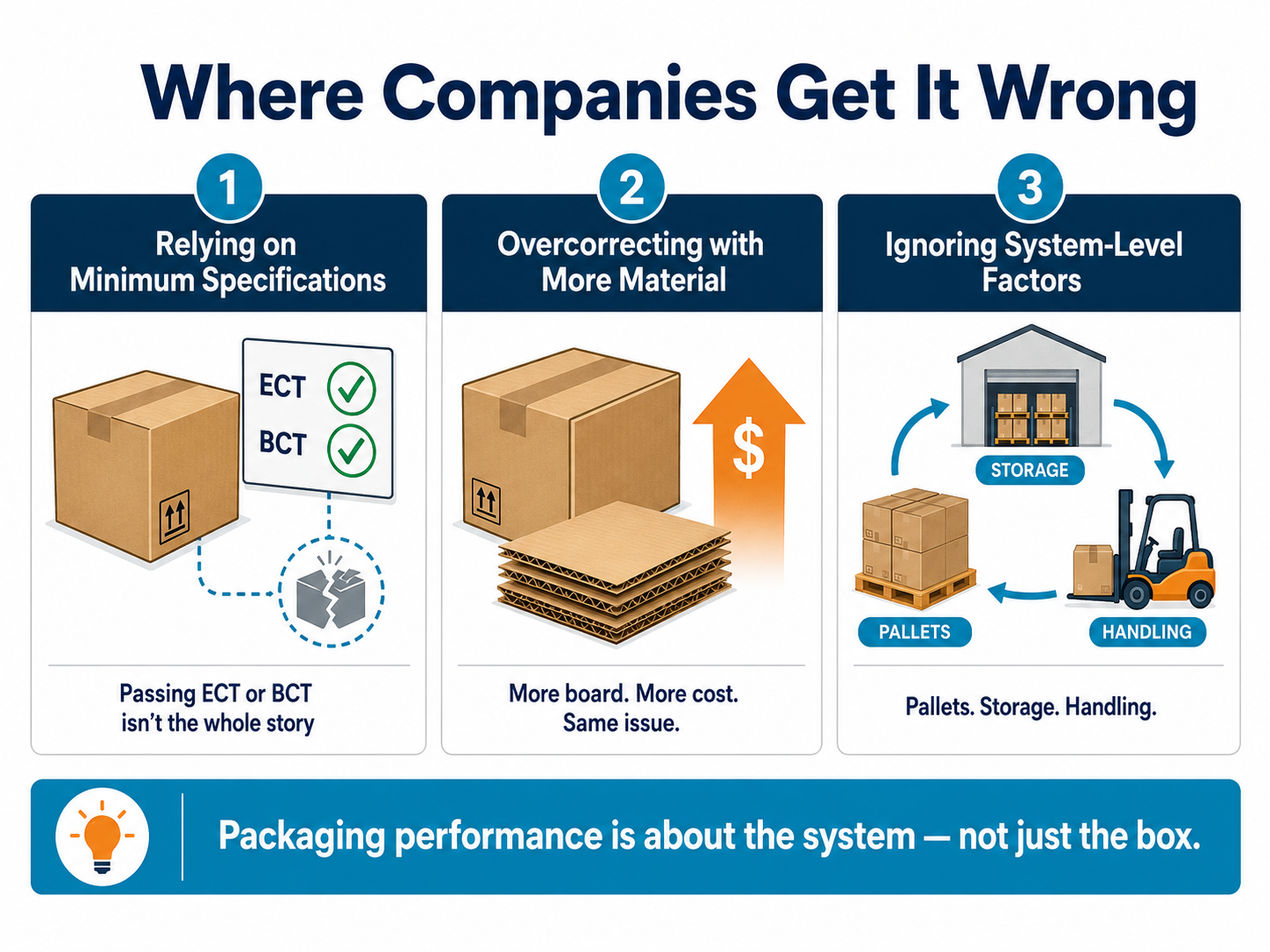
Where Companies Get It Wrong

Relying on Minimum Specifications

  • Assuming passing ECT or BCT is sufficient
  • Ignoring real-world variables

Overcorrecting with More Material

  • Increasing board grade without addressing root causes
  • Adding cost without improving performance

Ignoring System-Level Factors

  • Pallet configuration
  • Storage conditions
  • Handling processes

👉 Packaging performance is not just about the box—it’s about the system it operates in

Why Boxes Pass Testing but Fail in Shipping

How to Fix the Gap

Evaluate Real Shipping Conditions

  • Consider humidity, storage time, and handling
  • Align packaging to actual environment

Adjust Safety Factors

  • Apply appropriate load safety margins
  • Account for variability beyond lab conditions

Improve Palletization

  • Optimize stacking patterns
  • Reduce overhang and load imbalance

Test Beyond the Lab

  • Use real-world simulations when possible
  • Validate packaging under actual conditions

What This Means for Cost

This problem often leads to two costly outcomes:

  • Underperformance → damage, returns, product loss
  • Overcorrection → unnecessary material cost

👉 Both result from misunderstanding how packaging actually performs

Final Takeaway

Passing a test does not mean your packaging will perform in shipping.

If your boxes are failing, the issue is not just strength—it’s how that strength is applied in real conditions.

Most Recent Posts:
Subscribe To Our Newsletter

By submitting your information, you agree to our terms and conditions and privacy policy.

custom printed full overlap (FOL) corrugated box
Custom Corrugated Boxes
Facebook
Twitter
LinkedIn
Pinterest
Relevant Posts