

Home » Why Shelf Span Causes POP Display Failure
Why Shelf Span Causes POP Display Failure
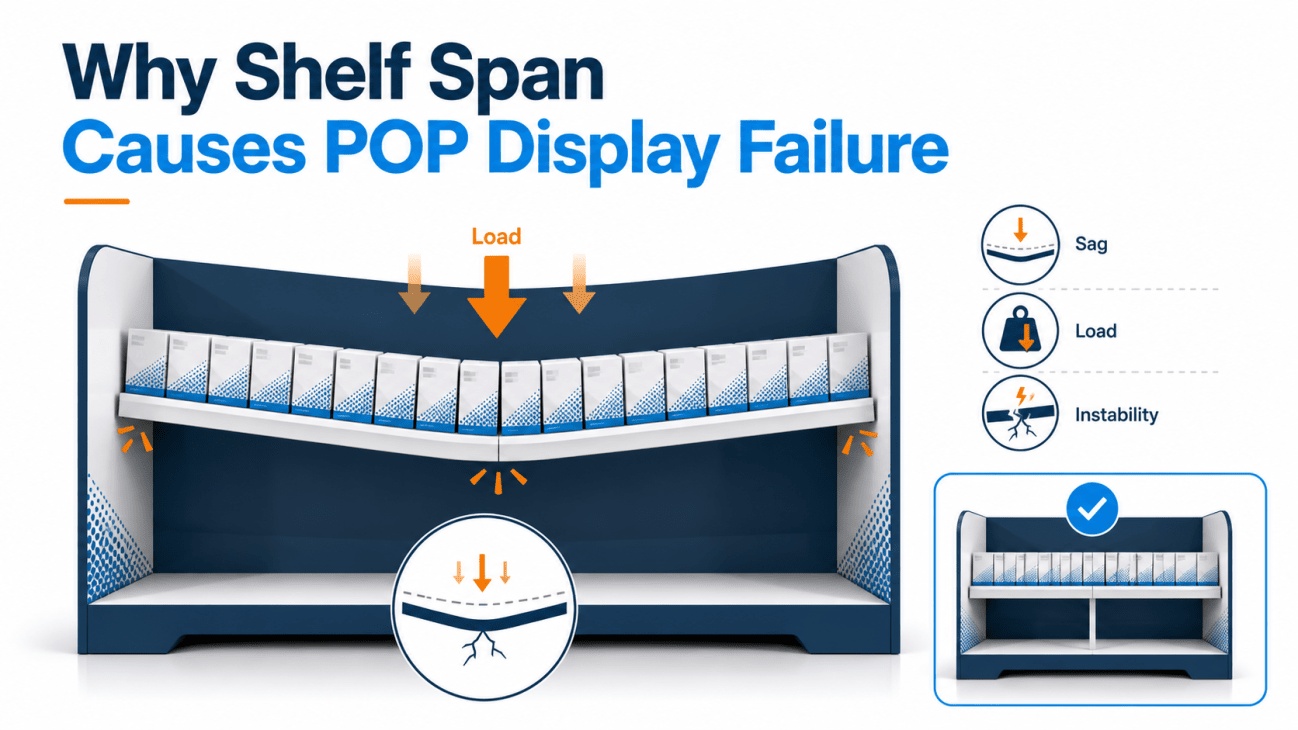
Most POP display failures don’t start with materials—they start with geometry.
Specifically:
👉 Shelf span
Designs often look structurally sound on paper, but once loaded, shelves begin to:
- Sag
- Bend unevenly
- Lose alignment
And it happens faster than expected.
Because shelf span is one of the most underestimated structural variables in POP display design.
What Shelf Span Actually Means
Shelf span is the distance between support points.
The longer the span:
- The more the material must resist bending
- The more sensitive it becomes to load concentration
Even with the right board grade, excessive span creates:
- Flex under weight
- Progressive deformation over time
It’s not just about strength—it’s about how that strength is distributed.
Why Longer Shelves Fail Faster
Wide shelves create leverage.
As span increases:
- Load applies more force at the center
- Deflection increases exponentially—not linearly
This leads to:
- Center sagging under normal load
- Permanent deformation after repeated use
- Increased stress at connection points
What looks stable at setup becomes unstable within days.

Load Is Never Evenly Distributed
Design assumptions:
- Even product placement
- Uniform weight across the shelf
Reality:
- Customers pull from the same area
- Heavier items get grouped together
- One section carries more weight than others
This creates:
- Localized stress across the span
- Uneven bending and twisting
Long spans amplify these problems.
Board Grade Alone Won’t Fix Span Issues
A common mistake:
👉 Upgrading board strength instead of fixing span design
Higher board grade helps—but:
- It doesn’t eliminate deflection
- It increases cost without solving root issues
If the span is too wide:
👉 Even strong material will eventually fail
Design—not just material—is the solution.

Where Shelf Span Causes the Most Problems
- Middle shelves with high product density
- Displays with wide front-facing layouts
- Multi-SKU displays with uneven weight distribution
- Long, uninterrupted tray designs
These configurations create the highest risk of:
- Visible sag
- Structural fatigue
- Reduced product presentation quality
How to Reduce Span-Related Failures
Effective strategies include:
- Adding vertical supports or dividers
- Breaking long shelves into shorter sections
- Reinforcing underside panels where load concentrates
- Designing load paths that reduce mid-span stress
Small structural changes can dramatically improve performance.

The Hidden Impact: Visual Degradation
Shelf sag doesn’t just affect structure—it affects perception.
- Products tilt forward or inward
- Rows become uneven
- Display looks worn or low quality
Customers interpret this as:
👉 Lower product value
Even if the product itself hasn’t changed.
Span + Time = Progressive Failure
Shelf failure isn’t immediate—it compounds:
- Day 1: Slight flex
- Week 1: Noticeable sag
- Week 2+: Structural instability
Once deformation starts:
👉 It accelerates under continued load
Displays are rarely designed for this progression.

What High-Performing Displays Do Differently
They:
- Control shelf span relative to load weight
- Integrate support structures into design—not as an afterthought
- Distribute load across multiple support points
- Maintain structural integrity under partial and uneven loads
They’re engineered for time—not just initial load.
Where Brands Get It Wrong
- Designing wide shelves for visual appeal
- Ignoring mid-span stress points
- Relying on stronger board instead of better structure
- Not testing under real product weight conditions
- Overlooking how products are actually placed and removed
These mistakes lead to early failure—even in well-built displays.
How Brown Packaging Designs for Shelf Performance
At Brown Packaging, shelf span is treated as a core structural variable—not a secondary detail.
We focus on:
- Optimizing span relative to product weight
- Reinforcing critical load areas
- Designing support systems that maintain alignment over time
- Preventing sag before it starts
Because once a shelf begins to fail, the entire display follows.
References
Soroka, W. (2009). Fundamentals of Packaging Technology (4th ed.). IoPP.
TAPPI. (2021). Corrugated Board Testing Methods.
ASTM International. (2022). Corrugated Structural Standards.
ISTA. (2023). Transit and Load Testing Protocols.
Shop! Association. (2023). Retail Display Structural Guidelines.
A folding carton may look simple once it reaches the shelf, but it goes through a controlled production process before it becomes a finished package. Every step — from paperboard
Folding carton production is becoming more automated because buyers are asking for faster timelines, tighter consistency, and more flexibility across more SKUs. Shorter product lifecycles, retail launch windows, labor pressure,
Folding carton style matters because structure affects more than appearance. The right carton can improve shelf presentation, packing speed, product access, closure security, storage efficiency, and overall cost. For retail
Pouch packaging trends in 2027 will be shaped by convenience, shelf impact, sustainability pressure, sealing performance, automation, ecommerce growth, and total packaging cost. Buyers will still want pouches that look
By submitting your information, you agree to our terms and conditions and privacy policy.

Home » Why Shelf Span Causes POP Display Failure


In the competitive retail landscape, creating a sense of urgency through Point of Purchase (POP) displays can significantly boost impulse buying and drive quick sales

When it comes to maximizing shelf space and capturing buyer attention, few pairings are more effective than folding cartons and POP displays. Whether it’s a

Creating impactful promotional messaging for Point of Purchase (POP) displays is vital for capturing customer interest and driving sales. This guide explores essential strategies for