

Home » Best Folding Carton Styles for Retail Packaging
Best Folding Carton Styles for Retail Packaging
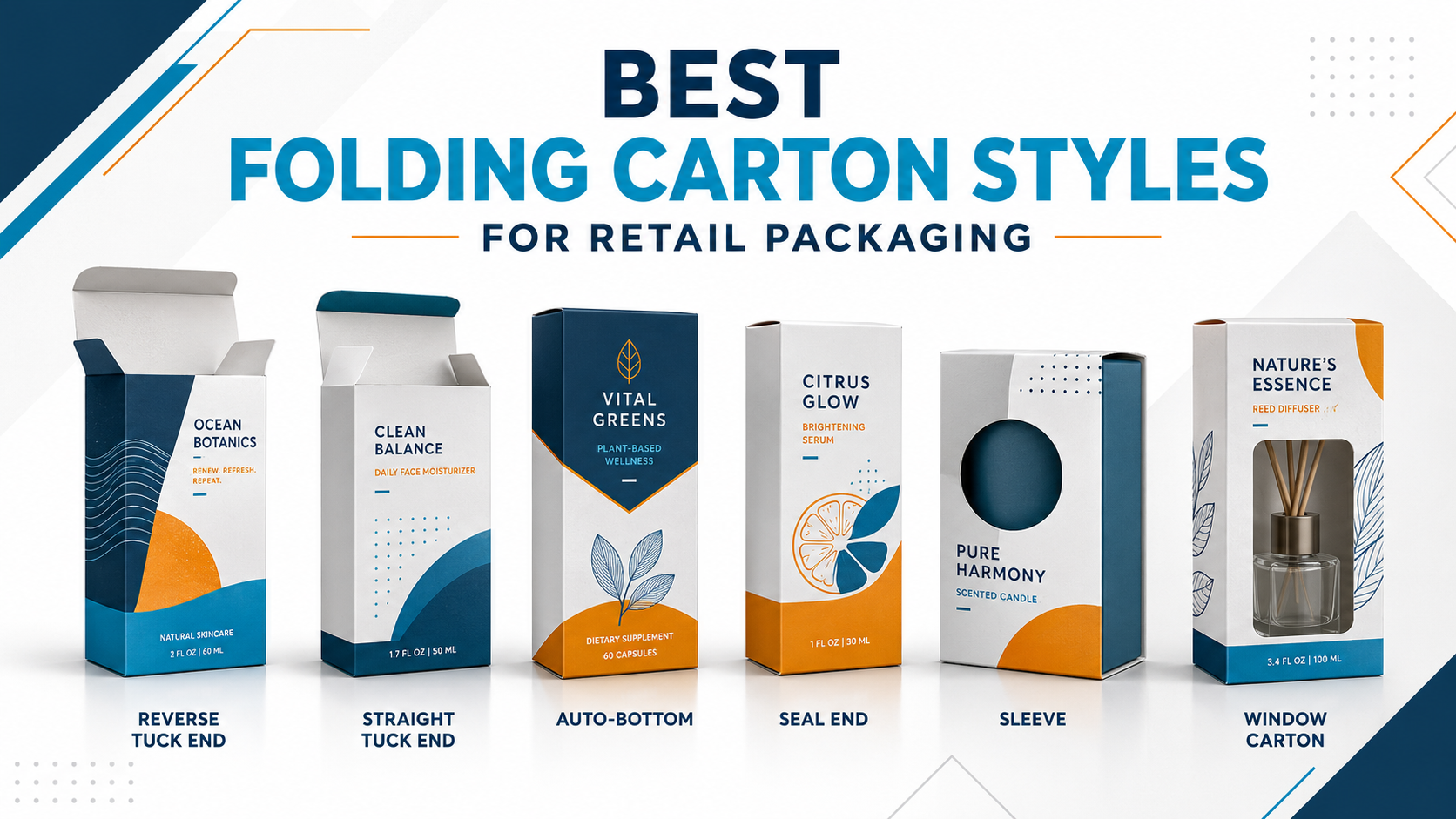
Folding carton style matters because structure affects more than appearance. The right carton can improve shelf presentation, packing speed, product access, closure security, storage efficiency, and overall cost.
For retail packaging buyers, the question is not simply “Which carton looks best?” The better question is: “Which carton style supports the product, packing process, shelf environment, and cost target?”
A reverse tuck end carton, straight tuck end carton, auto-bottom carton, seal end carton, sleeve, or window carton can all work well in retail. The right choice depends on how the product is displayed, how it is packed, how much structure it needs, and how much visual impact the brand requires.
The Paperboard Packaging Council identifies reverse tuck cartons as a common style for lightweight, smaller products, noting that standard reverse tuck cartons can be assembled manually or through automation and are typically shipped flat for easier storage and transportation. The ECMA code system also shows how folding carton styles are classified by structure, including reverse tuck, same-panel tuck, open top, and other carton design formats.
This guide explains the most common retail folding carton styles and how buyers should evaluate them before choosing a structure.
Why Folding Carton Style Matters in Retail Packaging
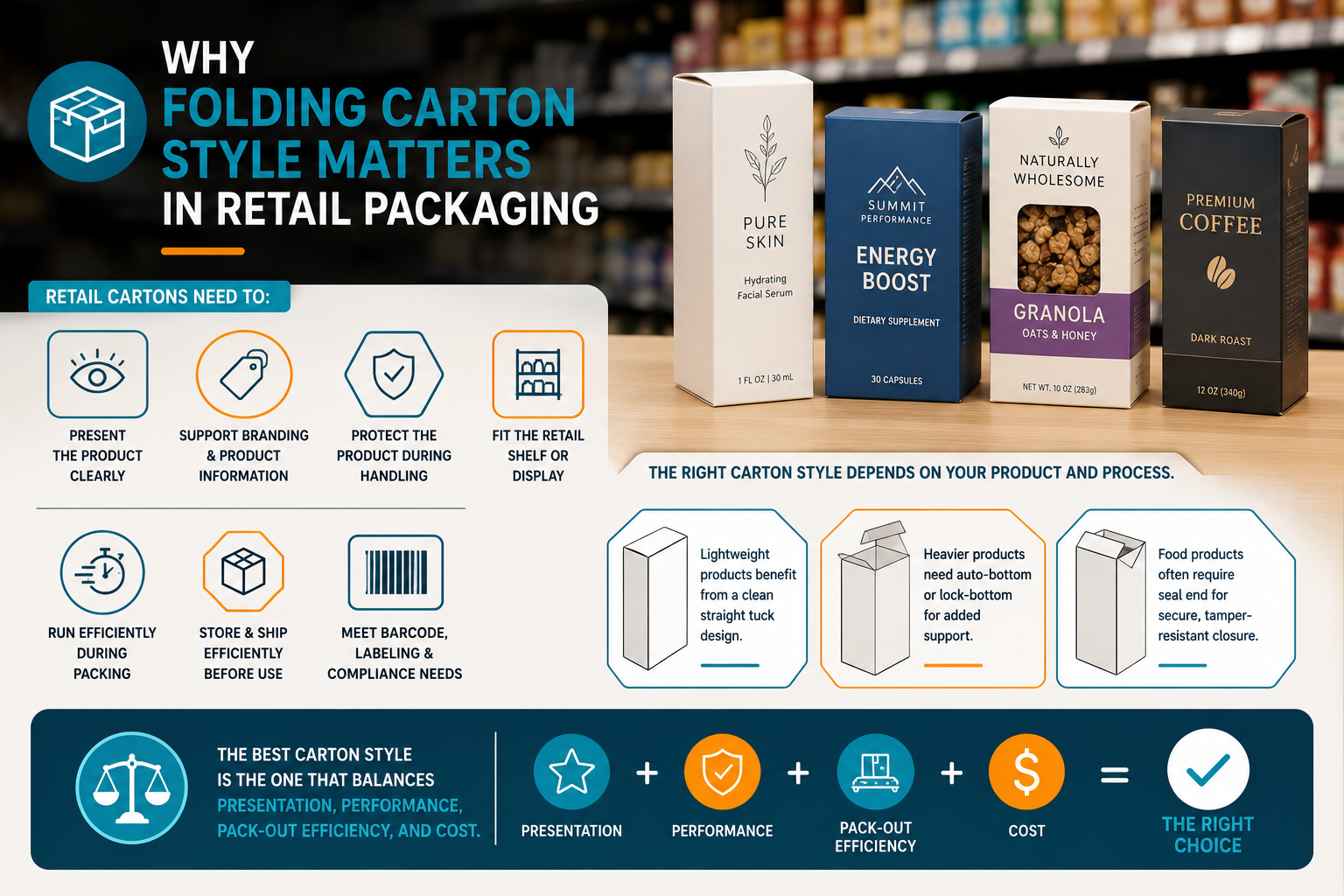
Retail cartons need to do several jobs at once.
They must:
- Present the product clearly
- Support branding and product information
- Protect the product during handling
- Fit the retail shelf or display
- Run efficiently during packing
- Store and ship efficiently before use
- Meet barcode, labeling, and compliance needs
A carton style that works well for one product may be wrong for another.
For example, a lightweight cosmetic carton may benefit from a clean straight tuck design because the front panel stays uninterrupted. A heavier product may need an auto-bottom or lock-bottom style to support the weight during hand packing. A food carton may require a secure seal end structure for high-volume production and tamper-resistant closure.
The best carton style is not always the most premium-looking option. It is the one that balances presentation, performance, pack-out efficiency, and cost.
Reverse Tuck End Cartons
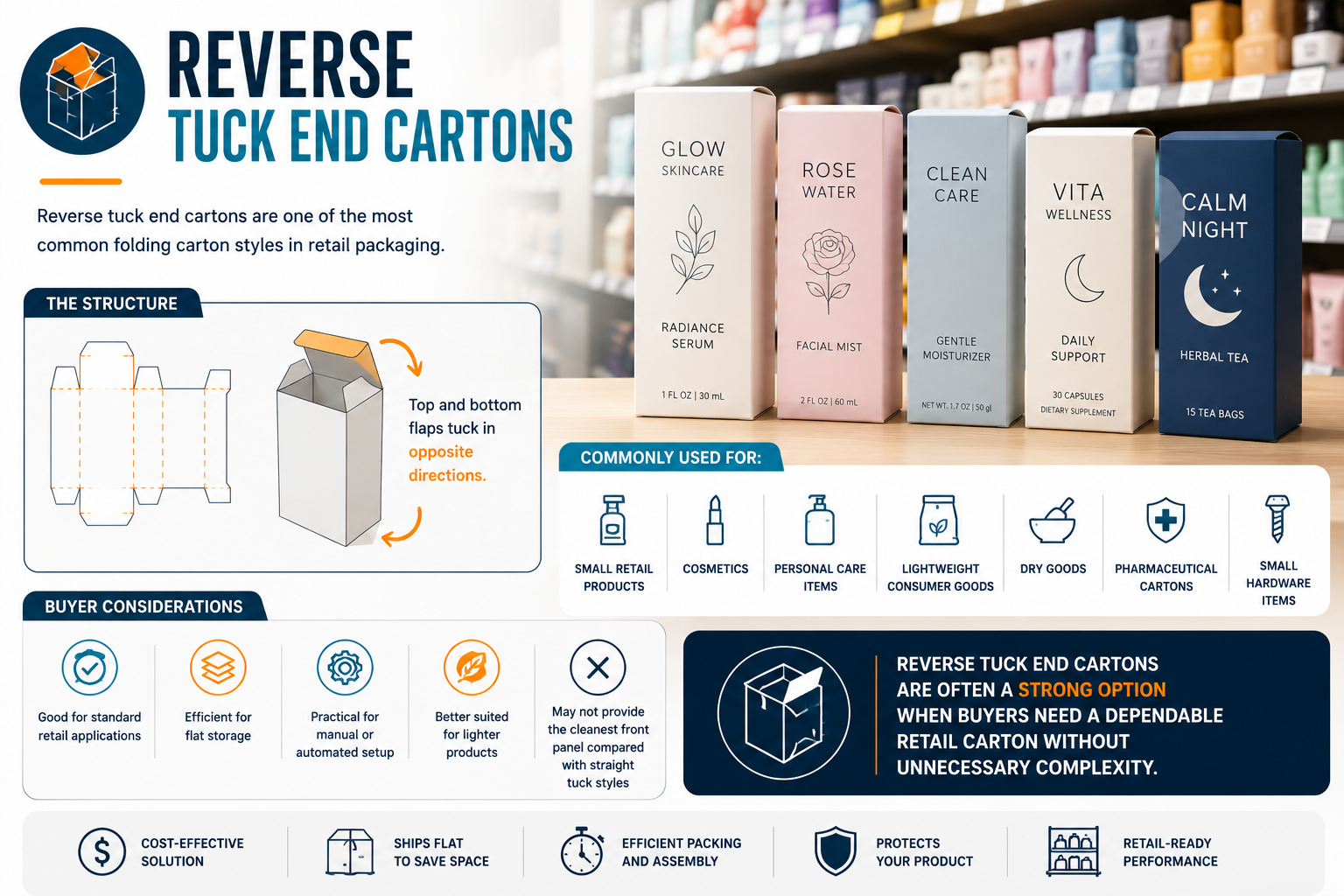
Reverse tuck end cartons are one of the most common folding carton styles in retail packaging.
In this structure, the top and bottom flaps tuck in opposite directions. The Paperboard Packaging Council describes standard reverse tuck cartons as having top and bottom closures that tuck in opposite directions, with the ability to be assembled manually or through automation.
Reverse tuck end cartons are commonly used for:
- Small retail products
- Cosmetics
- Personal care items
- Lightweight consumer goods
- Dry goods
- Pharmaceutical cartons
- Small hardware items
The main advantage is efficiency. Reverse tuck cartons are simple, familiar, and cost-effective for many standard retail products.
They typically work best when the product is lightweight and does not require a reinforced bottom.
Buyer considerations:
- Good for standard retail applications
- Efficient for flat storage
- Practical for manual or automated setup
- Better suited for lighter products
- May not provide the cleanest front panel compared with straight tuck styles
Reverse tuck end cartons are often a strong option when buyers need a dependable retail carton without unnecessary complexity.
Straight Tuck End Cartons
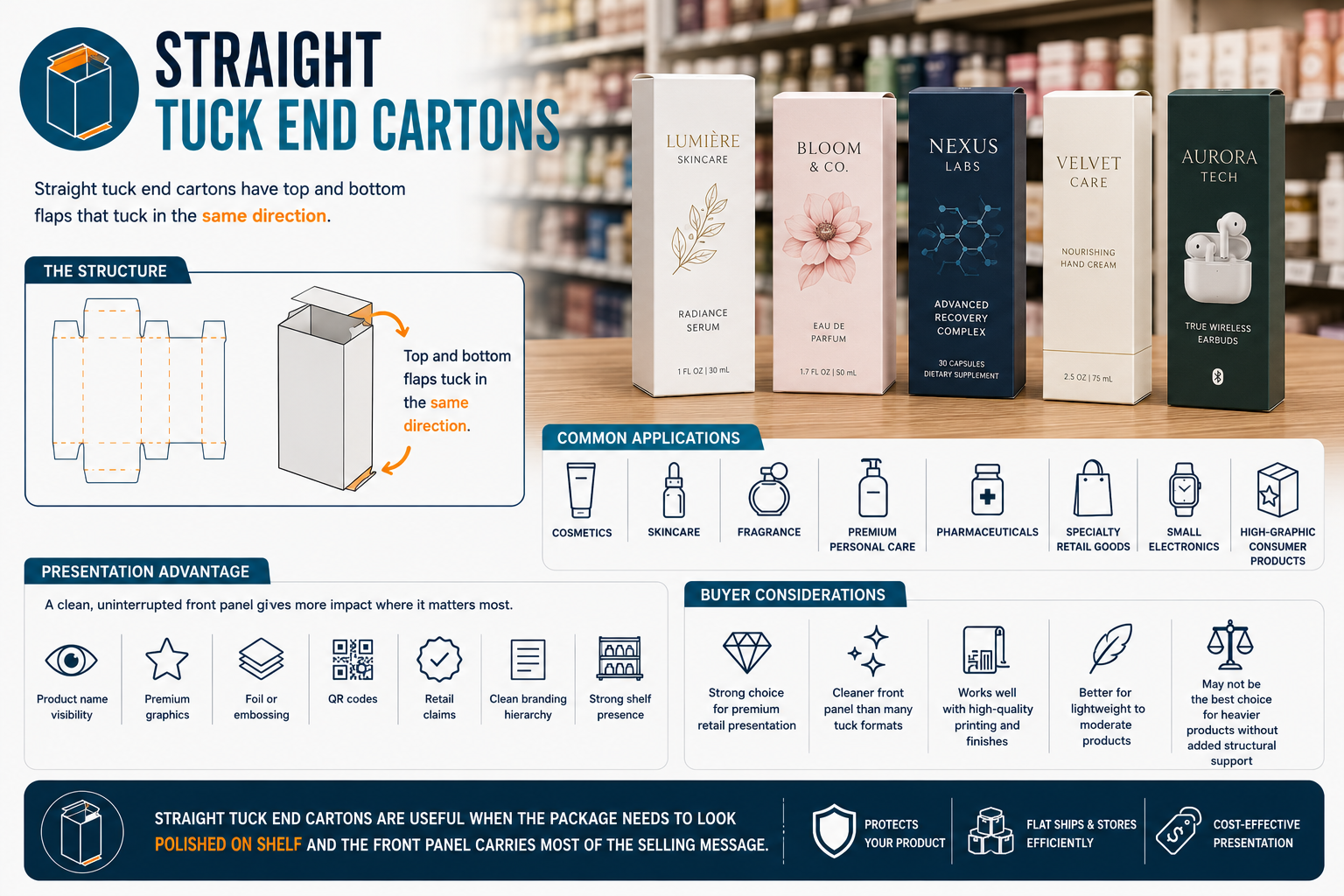
Straight tuck end cartons are another common retail folding carton style.
In this structure, the top and bottom flaps tuck in the same direction. This design helps keep the front panel cleaner because the closure edges are typically positioned away from the primary display face.
Straight tuck end cartons are often used when front-panel branding matters.
Common applications include:
- Cosmetics
- Skincare
- Fragrance
- Premium personal care
- Pharmaceuticals
- Specialty retail goods
- Small electronics
- High-graphic consumer products
The biggest advantage is presentation. A clean, uninterrupted front panel gives buyers more control over the main retail-facing area.
This matters when the carton needs to support:
- Product name visibility
- Premium graphics
- Foil or embossing
- QR codes
- Retail claims
- Clean branding hierarchy
- Strong shelf presence
Buyer considerations:
- Strong choice for premium retail presentation
- Cleaner front panel than many tuck formats
- Works well with high-quality printing and finishes
- Better for lightweight to moderate products
- May not be the best choice for heavier products without added structural support
Straight tuck end cartons are useful when the package needs to look polished on shelf and the front panel carries most of the selling message.
Auto-Bottom Cartons
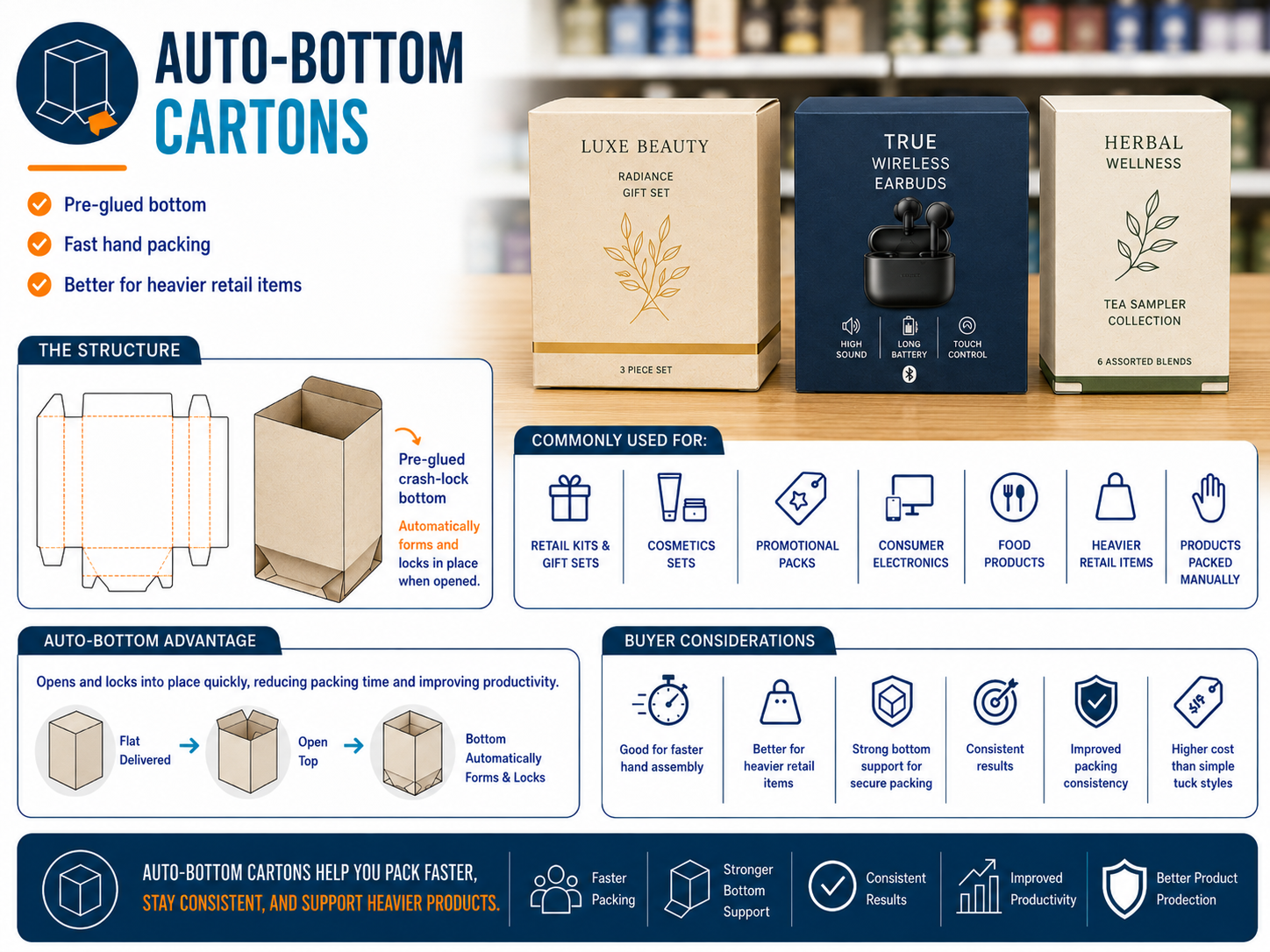
Auto-bottom cartons are designed for faster setup.
The bottom is pre-glued so it automatically forms when the carton is opened. This makes the structure useful when hand-packing speed matters.
Auto-bottom cartons are commonly used for:
- Retail kits
- Gift sets
- Cosmetics
- Promotional packs
- Consumer electronics
- Food products
- Heavier retail items
- Products packed manually
The major advantage is labor efficiency. Instead of manually folding and locking the bottom, the carton opens into position more quickly.
This can reduce packing time, especially when workers are assembling cartons by hand.
Buyer considerations:
- Good for faster hand assembly
- Useful for heavier products than standard tuck cartons
- Reduces manual bottom-folding steps
- Can improve packing consistency
- Usually costs more than simpler tuck-end structures
Auto-bottom cartons are not always necessary. But when labor speed, pack-out consistency, or heavier product support matters, they can be worth the added structure.
Seal End Cartons
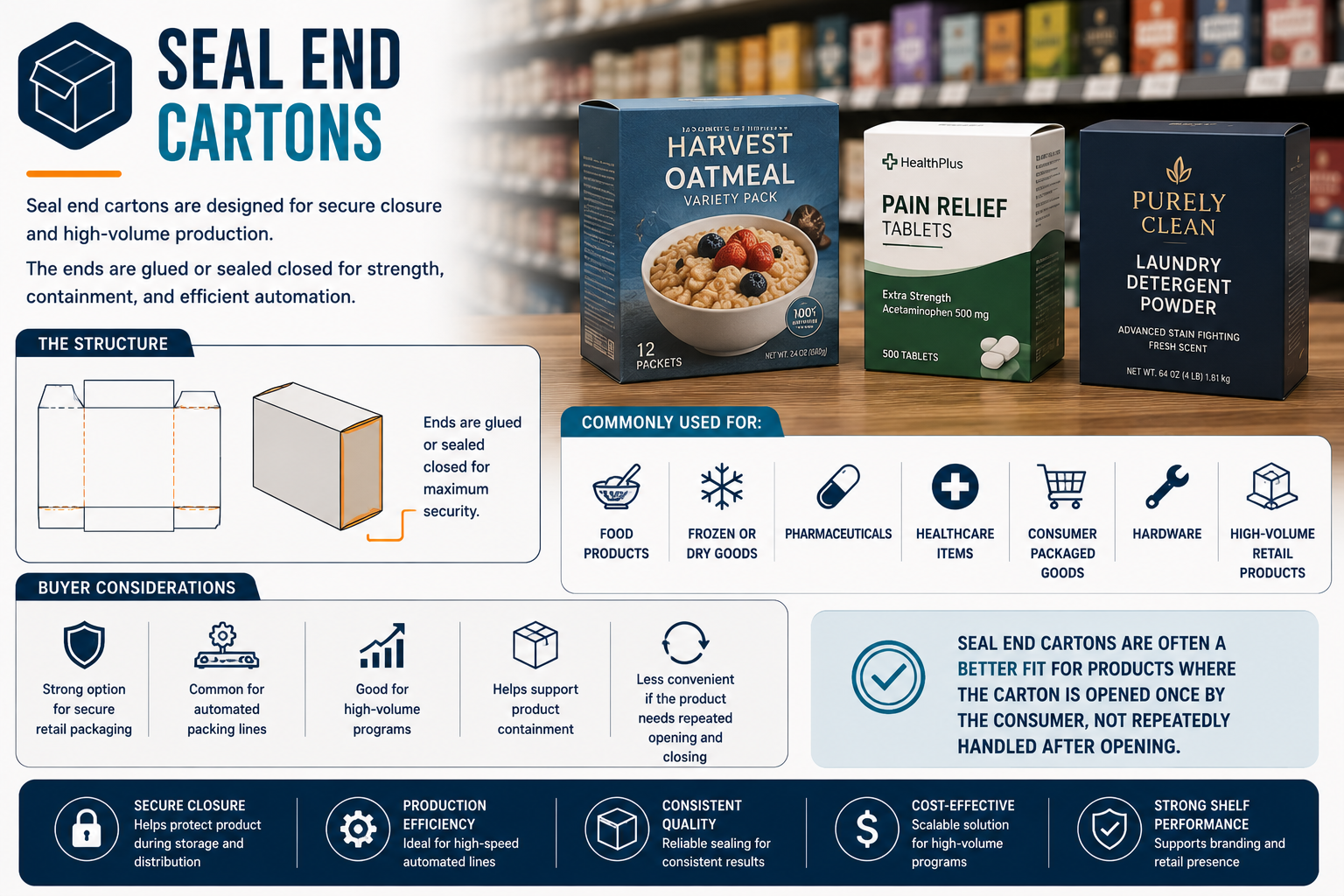
Seal end cartons are designed for secure closure and high-volume production.
Instead of tuck flaps, the ends are glued or sealed closed. This structure is common in food, healthcare, pharmaceuticals, and other consumer packaged goods where secure closure and efficient production are important.
Seal end cartons are often used for:
- Food products
- Frozen or dry goods
- Pharmaceuticals
- Healthcare items
- Consumer packaged goods
- Hardware
- High-volume retail products
The main advantage is security and production efficiency. Seal end cartons can be a strong fit when cartons are filled and sealed on automated equipment.
Buyer considerations:
- Strong option for secure retail packaging
- Common for automated packing lines
- Good for high-volume programs
- Helps support product containment
- Less convenient if the product needs repeated opening and closing
Seal end cartons are often a better fit for products where the carton is opened once by the consumer, not repeatedly handled after opening.
Sleeve Cartons
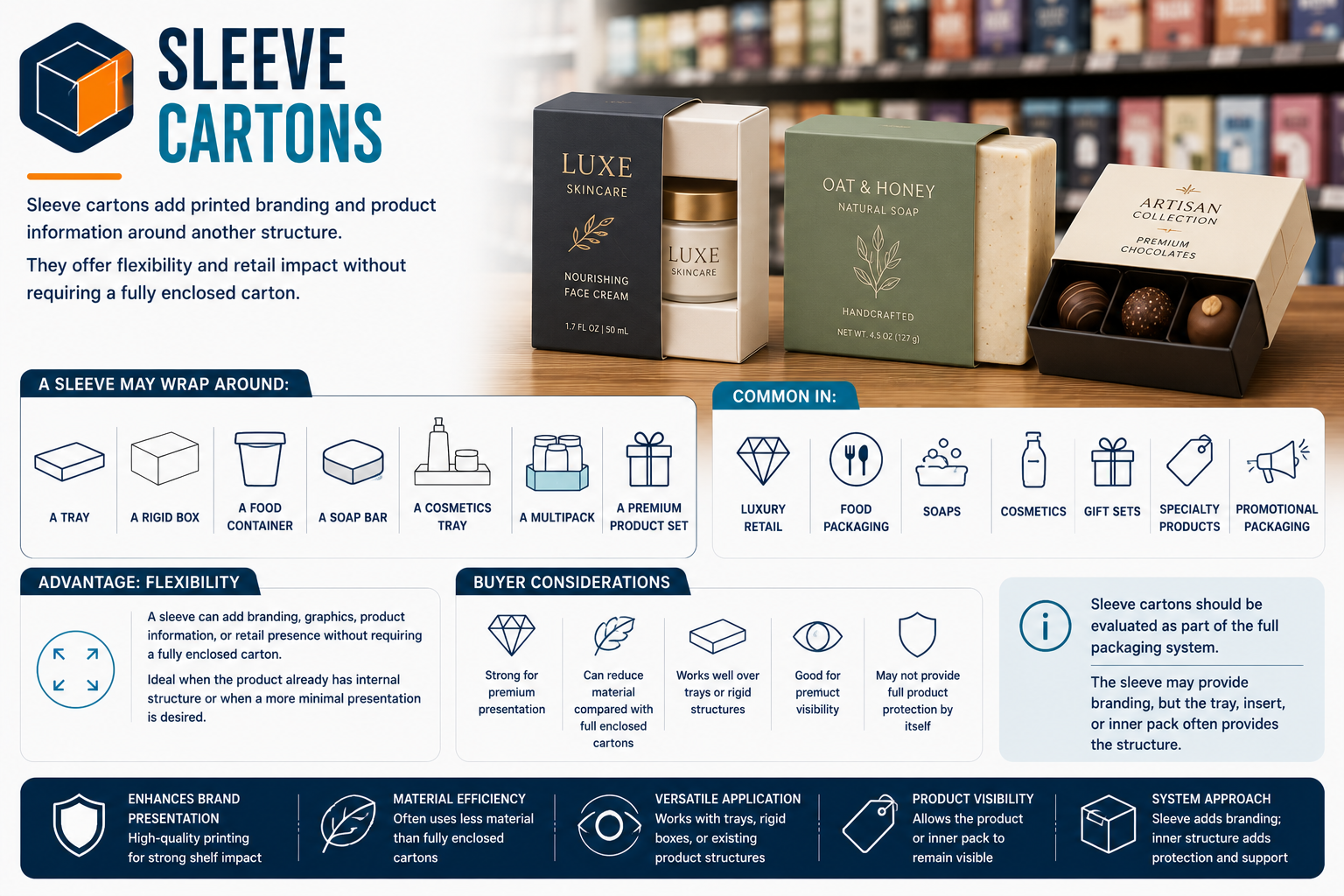
Sleeve cartons are used when a brand wants to add printed branding or product information around another structure.
A sleeve may wrap around:
- A tray
- A rigid box
- A food container
- A soap bar
- A cosmetics tray
- A multipack
- A premium product set
Sleeve cartons are common in:
- Luxury retail
- Food packaging
- Soaps
- Cosmetics
- Gift sets
- Specialty products
- Promotional packaging
The advantage is flexibility. A sleeve can add branding, graphics, product information, or retail presence without requiring a fully enclosed carton.
This can be useful when the product already has internal structure or when the brand wants a more minimal presentation.
Buyer considerations:
- Strong for premium presentation
- Can reduce material compared with full enclosed cartons
- Works well over trays or rigid structures
- Good for product visibility
- May not provide full product protection by itself
Sleeve cartons should be evaluated as part of the full packaging system. The sleeve may provide branding, but the tray, insert, or inner pack often provides the structure.
Window Cartons
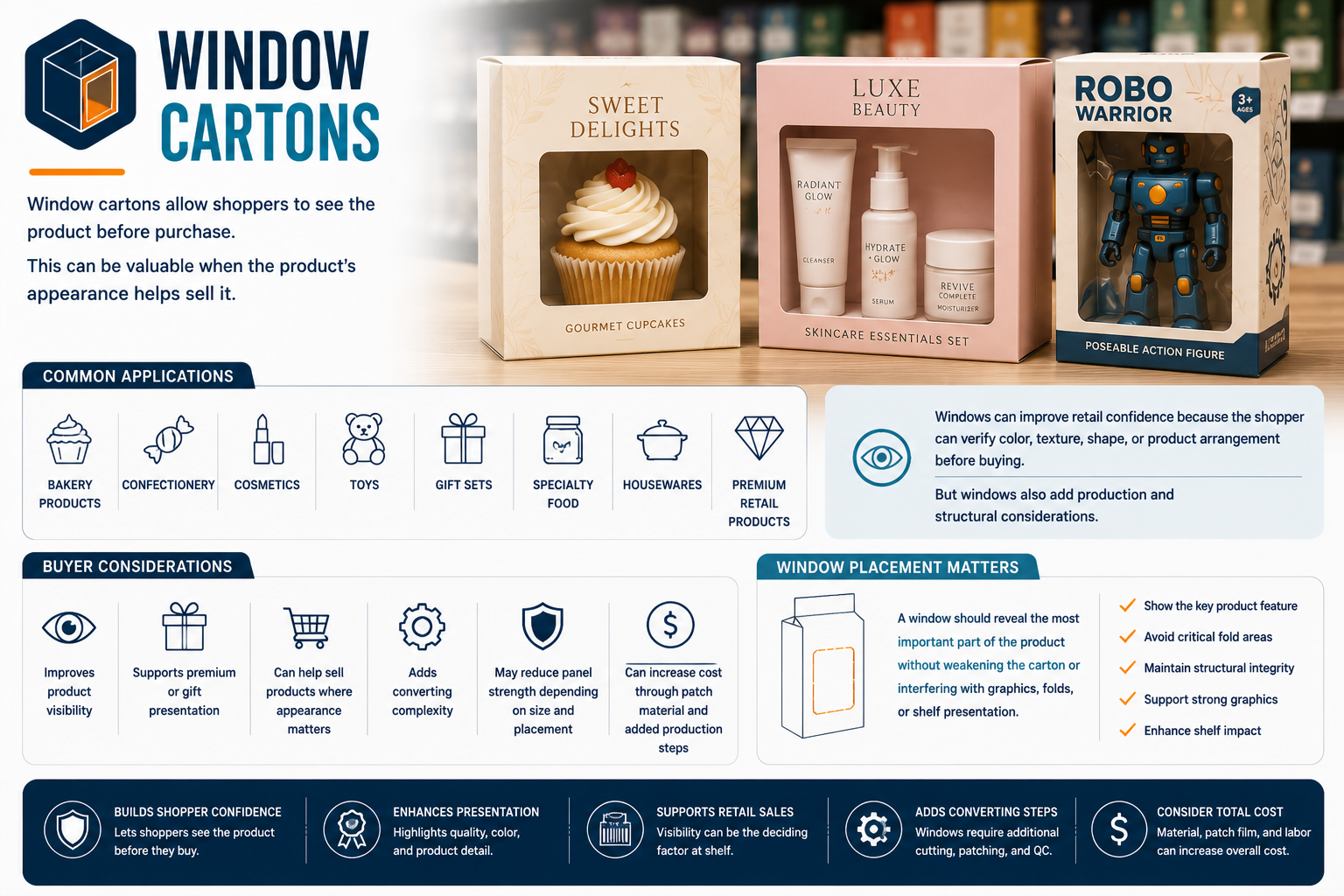
Window cartons allow shoppers to see the product before purchase.
This can be valuable when the product’s appearance helps sell it.
Common applications include:
- Bakery products
- Confectionery
- Cosmetics
- Toys
- Gift sets
- Specialty food
- Housewares
- Premium retail products
Windows can improve retail confidence because the shopper can verify color, texture, shape, or product arrangement before buying.
But windows also add production and structural considerations.
Buyer considerations:
- Improves product visibility
- Supports premium or gift presentation
- Can help sell products where appearance matters
- Adds converting complexity
- May reduce panel strength depending on size and placement
- Can increase cost through patch material and added production steps
Window placement should be intentional. A window should reveal the most important part of the product without weakening the carton or interfering with graphics, folds, or shelf presentation.
How to Choose the Right Folding Carton Style
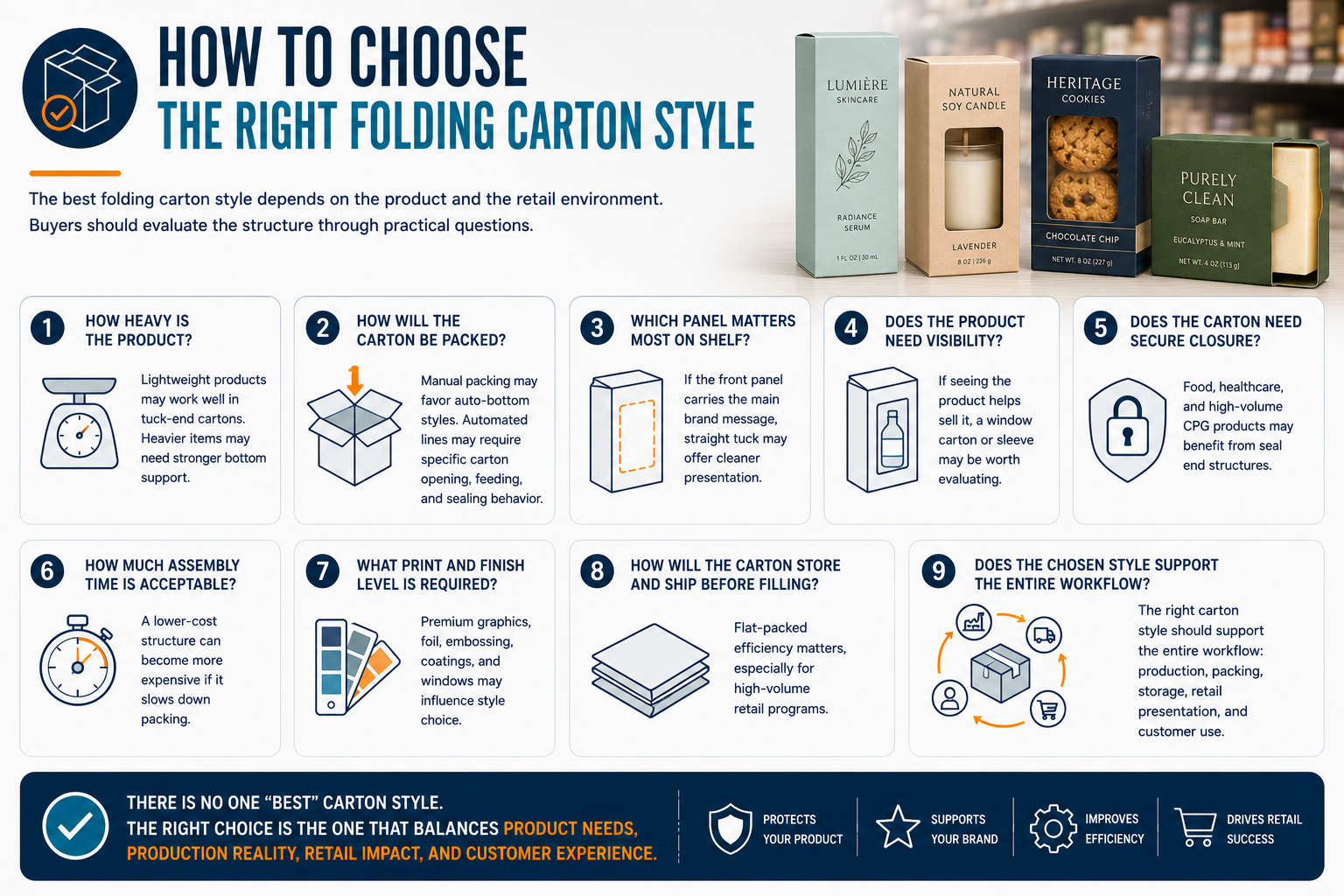
The best folding carton style depends on the product and the retail environment.
Buyers should evaluate the structure through practical questions:
How heavy is the product?
Lightweight products may work well in tuck-end cartons. Heavier items may need stronger bottom support.
How will the carton be packed?
Manual packing may favor auto-bottom styles. Automated lines may require specific carton opening, feeding, and sealing behavior.
Which panel matters most on shelf?
If the front panel carries the main brand message, straight tuck may offer cleaner presentation.
Does the product need visibility?
If seeing the product helps sell it, a window carton or sleeve may be worth evaluating.
Does the carton need secure closure?
Food, healthcare, and high-volume CPG products may benefit from seal end structures.
How much assembly time is acceptable?
A lower-cost structure can become more expensive if it slows down packing.
What print and finish level is required?
Premium graphics, foil, embossing, coatings, and windows may influence style choice.
How will the carton store and ship before filling?
Flat-packed efficiency matters, especially for high-volume retail programs.
The right carton style should support the entire workflow: production, packing, storage, retail presentation, and customer use.
Where Buyers Get Folding Carton Styles Wrong
Retail carton issues often happen when buyers choose the structure too late or choose it based only on appearance.
Common mistakes include:
Choosing a Style Before Understanding Product Weight
A carton that looks good may not support the product properly.
Ignoring the Packing Process
A structure that is slow to assemble can increase labor cost.
Overusing Premium Features
Foil, embossing, windows, and specialty finishes should support the product’s retail strategy, not just add decoration.
Using a Window Without Reviewing Structure
Large windows may improve visibility but reduce panel strength.
Choosing a Tuck Style When Secure Closure Is Needed
Some products need a more secure seal than a basic tuck closure.
Not Considering Shelf Orientation
The most important panel should face the shopper clearly and consistently.
Treating Every SKU the Same
Different products may need different carton structures based on weight, fill process, and retail use.
A folding carton style should never be selected in isolation. It should be matched to the product, shelf, packing method, and cost target.
Retail Folding Carton Style Comparison
Carton Style | Best For | Key Advantage | Buyer Watchout |
Reverse Tuck End | Standard lightweight retail products | Cost-efficient and common | Not always the cleanest front panel |
Straight Tuck End | Premium branding and shelf presentation | Clean front panel | Better for lighter to moderate products |
Auto-Bottom | Hand-packed products and heavier items | Faster setup | Higher structure cost |
Seal End | Food, healthcare, and high-volume CPG | Secure closure | Less reusable after opening |
Sleeve Carton | Trays, soaps, gift sets, premium goods | Adds branding with less structure | Needs inner support |
Window Carton | Products where visibility drives purchase | Shows product inside | Adds cost and structural considerations |
Final Takeaway
Folding carton styles are not interchangeable.
Each structure affects shelf impact, packing speed, closure security, cost, storage efficiency, and product presentation.
Reverse tuck end cartons are practical for standard retail use. Straight tuck end cartons support cleaner branding. Auto-bottom cartons improve hand-packing speed. Seal end cartons provide secure closure for high-volume products. Sleeves create flexible branding opportunities. Window cartons improve product visibility when seeing the item helps sell it.
The best retail folding carton is not just the one that looks good. It is the one that fits the product, runs efficiently, presents well on shelf, and supports the full packaging process.
The right carton style turns retail packaging into a better-performing system.
Partner With Brown Packaging
Brown Packaging helps buyers choose folding carton styles that align with product requirements, retail presentation, packing method, print needs, and cost targets.
We can support straight tuck, reverse tuck, auto-bottom, seal end, sleeve, window, and custom folding carton structures for retail, food, beverage, cosmetics, healthcare, household goods, promotional packaging, and specialty consumer products.
Whether your priority is shelf impact, faster pack-out, product visibility, secure closure, or production efficiency, we can help develop folding carton packaging that fits the way your product is sold, packed, and shipped.
Partner with Brown Packaging to build retail folding cartons designed for presentation, performance, and real-world production.
References
ECMA. (2022). The ECMA code of folding carton design styles. European Carton Makers Association. https://ecma.org/uploads/Bestanden/ECMA%20Sales%20Toolkit/ECMA%20Support%20Tools/New%202022/ECMA%20Codes%20EN%202022.pdf
Paperboard Packaging Council. (2023, May 15). 5 must-know folding carton designs. https://paperbox.org/5-must-know-folding-carton-designs/
Sustainable packaging in 2027 will be less about broad claims and more about proof, performance, compliance, and cost control. Buyers will still care about recyclable materials, recycled content, and lower
Sustainable packaging in 2027 will be less about broad claims and more about proof, performance, compliance, and cost control. Buyers will still care about recyclable materials, recycled content, and lower
A folding carton may look simple once it reaches the shelf, but it goes through a controlled production process before it becomes a finished package. Every step — from paperboard
Folding carton production is becoming more automated because buyers are asking for faster timelines, tighter consistency, and more flexibility across more SKUs. Shorter product lifecycles, retail launch windows, labor pressure,
By submitting your information, you agree to our terms and conditions and privacy policy.
Home » Best Folding Carton Styles for Retail Packaging

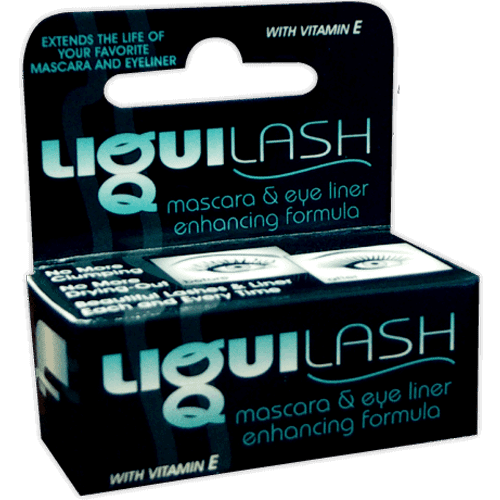

Choosing a folding carton isn’t just about the graphics or the style—it’s about how the structural design and substrate work in tandem. The right combination
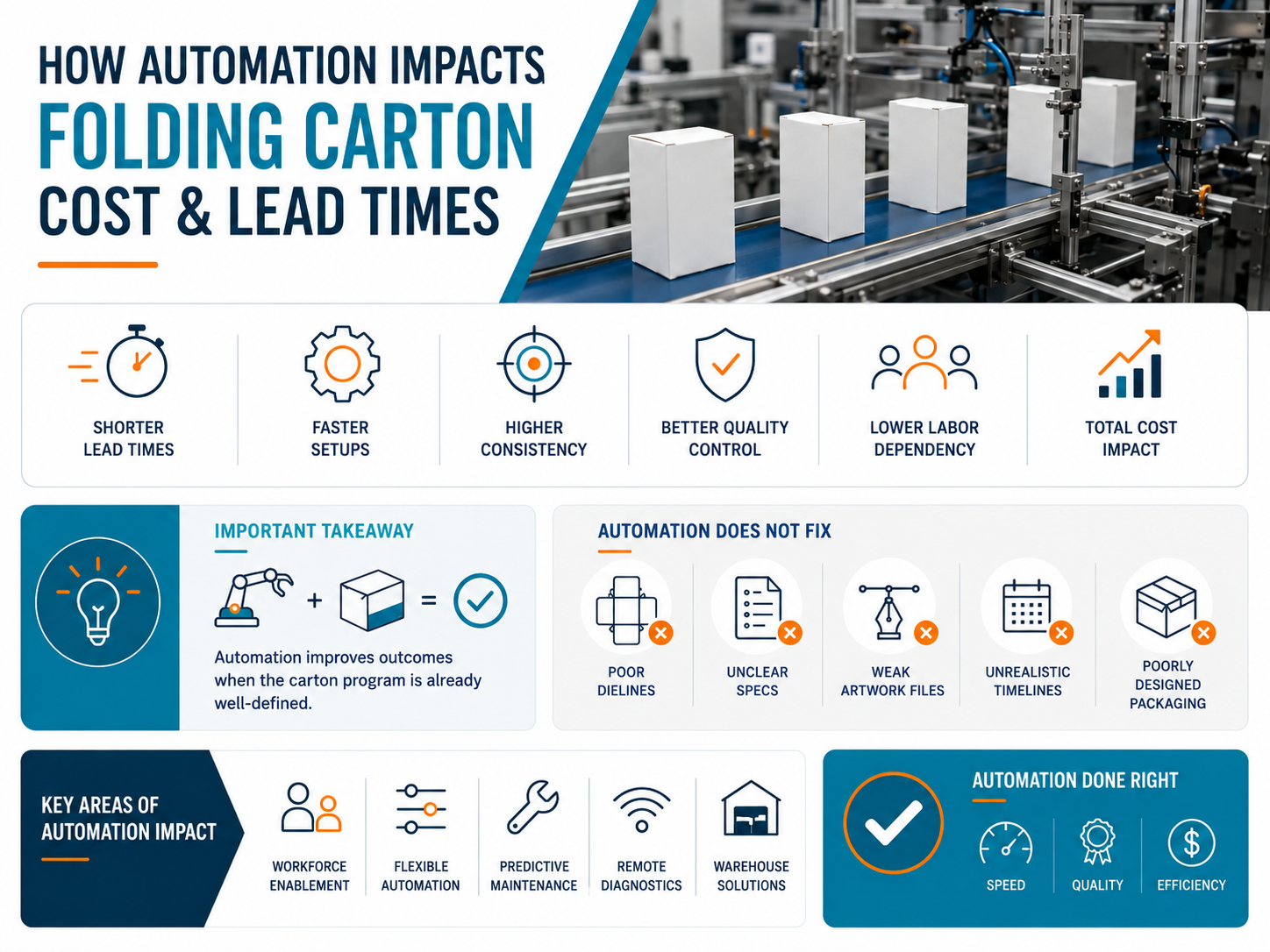
Folding carton production is becoming more automated because buyers are asking for faster timelines, tighter consistency, and more flexibility across more SKUs. Shorter product lifecycles,
E-commerce exposes folding cartons to more handling points, longer transit times, and harsher mechanical stresses than traditional retail distribution. Designing for these conditions requires careful