Home » What Is Box Compression Strength (BCT)?
What Is Box Compression Strength (BCT)?
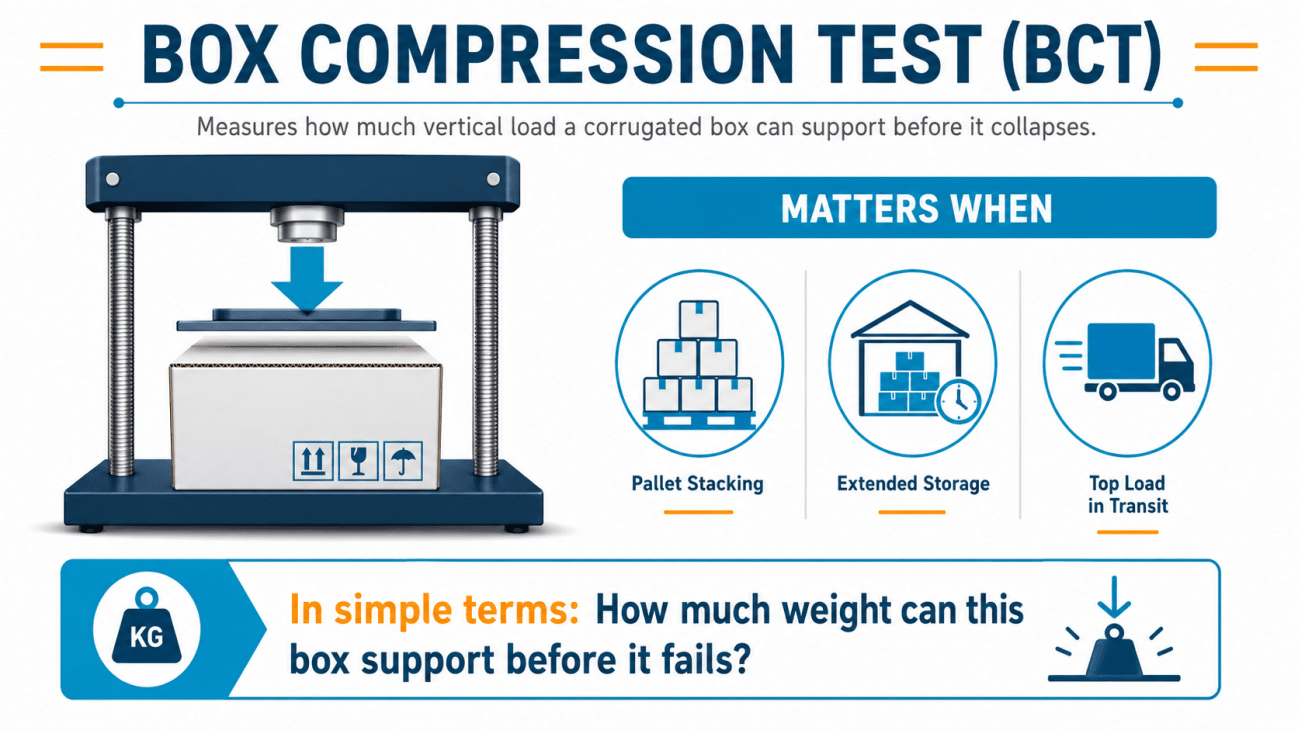
Box Compression Test (BCT) measures how much vertical load a corrugated box can last before it collapses.
This matters when:
- Boxes are stacked on pallets
- Loads are stored for extended periods
- Shipments experience top load during transit
👉 In simple terms, BCT tells you:
“How much weight can this box support before it fails?”
Why Stacking Strength Is Critical
Most failures happen in storage or transit—not during handling.
Common scenarios:
- Bottom boxes crushed under pallet weight
- Long-term warehouse stacking causing gradual failure
- Freight stacking adding unexpected top load
👉 If stacking strength is wrong, everything downstream fails—damage, returns, and lost product
How BCT Is Calculated (Simplified)
The most commonly used estimation is based on ECT (Edge Crush Test):
This gives a baseline estimate, not real-world performance
Why This Formula Alone Is Not Enough
Many companies rely on this calculation—but miss real-world factors that reduce strength.
Humidity
Corrugated loses strength in moisture.
- Can reduce strength by 30–50%
- Common in warehouses and transit
Stacking Time
Boxes weaken over time under load.
- Long-term storage reduces effective strength
- Static load ≠ dynamic performance
Pallet Configuration
How boxes are stacked changes everything.
- Column stacking = maximum strength
- Interlocking = reduced strength (up to ~30%)
Load Distribution
Uneven loads create failure points.
- Overhang weakens edges
- Misaligned stacks concentrate pressure
Handling & Transit Conditions
Vibration and movement reduce real strength.
- Especially relevant in LTL and parcel
- Repeated stress weakens structure
How to Estimate Required Box Strength
Instead of asking “How strong is this box?”
Ask: “How much load will this box actually carry?”
Step 1: Calculate Total Stack Weight
- Weight of all boxes above the bottom box
Step 2: Apply Safety Factor
Typical range:
- 3x to 5x safety factor
👉 Accounts for humidity, handling, and variability
Step 3: Compare Against BCT
Your box must exceed:
Total load × safety factor
Where Companies Get This Wrong
Overestimating Strength
- Assuming ECT = real-world performance
- Ignoring environmental factors
Underestimating Load
- Not accounting for stack height
- Ignoring freight stacking
Over-Engineering as a Default
- Jumping to double wall unnecessarily
Increasing cost without solving root issue
When You Actually Need More Strength
You may need higher board grade or double wall when:
- Products are heavy
- Pallets are stacked multiple levels high
- Storage duration is long-term
- Environment includes humidity exposure
When You Don’t
Single wall is often sufficient when:
- Loads are controlled
- Stack heights are limited
- Shipping is short-cycle (e.g., parcel)
👉 Many companies overpay for strength they don’t use
What This Means for Cost
Stacking strength is directly tied to cost—but not in the way most people think.
- Too weak → damage, returns, loss
- Too strong → unnecessary material cost
👉 The goal is not maximum strength—it’s correct strength
Final Takeaway
Box compression strength is not just a spec — it is a system decision tied to how your product is stored, shipped, stacked, and handled. If stacking requirements are not calculated correctly, companies are either risking failure or overpaying for protection they do not need.
Brown Packaging helps companies evaluate box strength, pallet loads, storage conditions, transit risks, and real-world handling factors to determine the right packaging structure for the application — not just the strongest or cheapest option.
Box Compression Test (BCT) measures how much vertical load a corrugated box can last before it collapses. This matters when: Boxes are stacked on pallets Loads are stored for extended
Most companies don’t realize how much they’re paying to ship empty space. Packaging is often designed around convenience or standard sizes, not efficiency. The result is wasted cube, higher freight
Excess moisture in pet food packaging can cause mold growth, nutrient degradation, clumping, and product spoilage. Effective moisture control combines barrier material selection, packaging design, and controlled production environments to
Exporting products requires packaging that can endure extended transit times, multiple handling points, and strict international regulations. Full Overlap (FOL) boxes are a proven solution for export shipments because their
Home » What Is Box Compression Strength (BCT)?