


window.uetq = window.uetq || []; window.uetq.push(‘event’, ‘submit_lead_form’,{ event_label:‘SUBMIT MESSAGE’ }); window.lintrk('track', { conversion_id: 10271009 }); window.lintrk('track', { conversion_id: 10271017 });

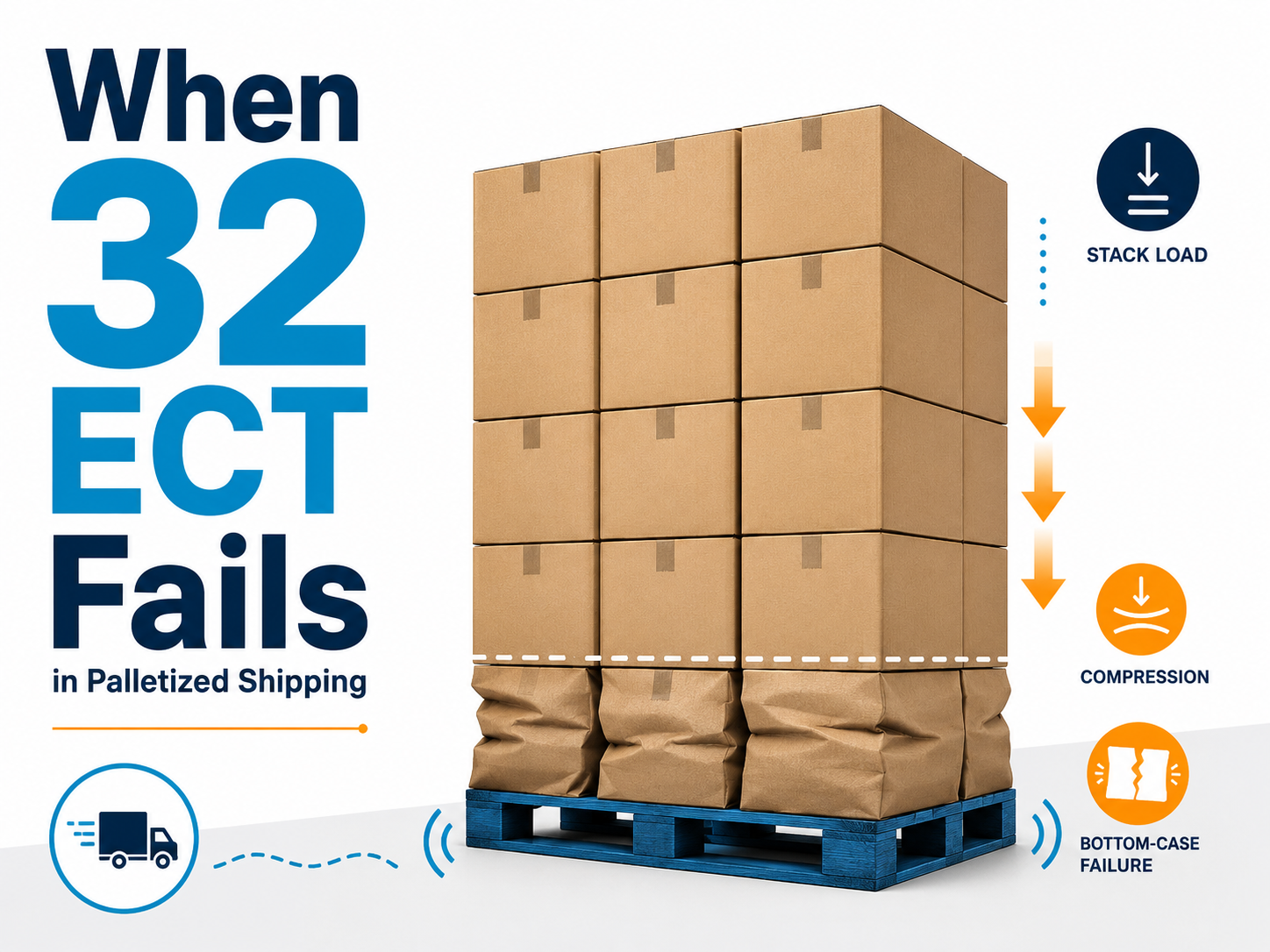
When 32 ECT Fails in Palletized Shipping

When 32 ECT corrugated shipping boxes fail

32 ECT is one of the most commonly used corrugated board grades.

It’s also one of the most misunderstood.

Many companies assume 32 ECT is “standard” and sufficient for most applications—but in palletized shipping, that assumption often leads to box failure, product damage, and hidden cost.

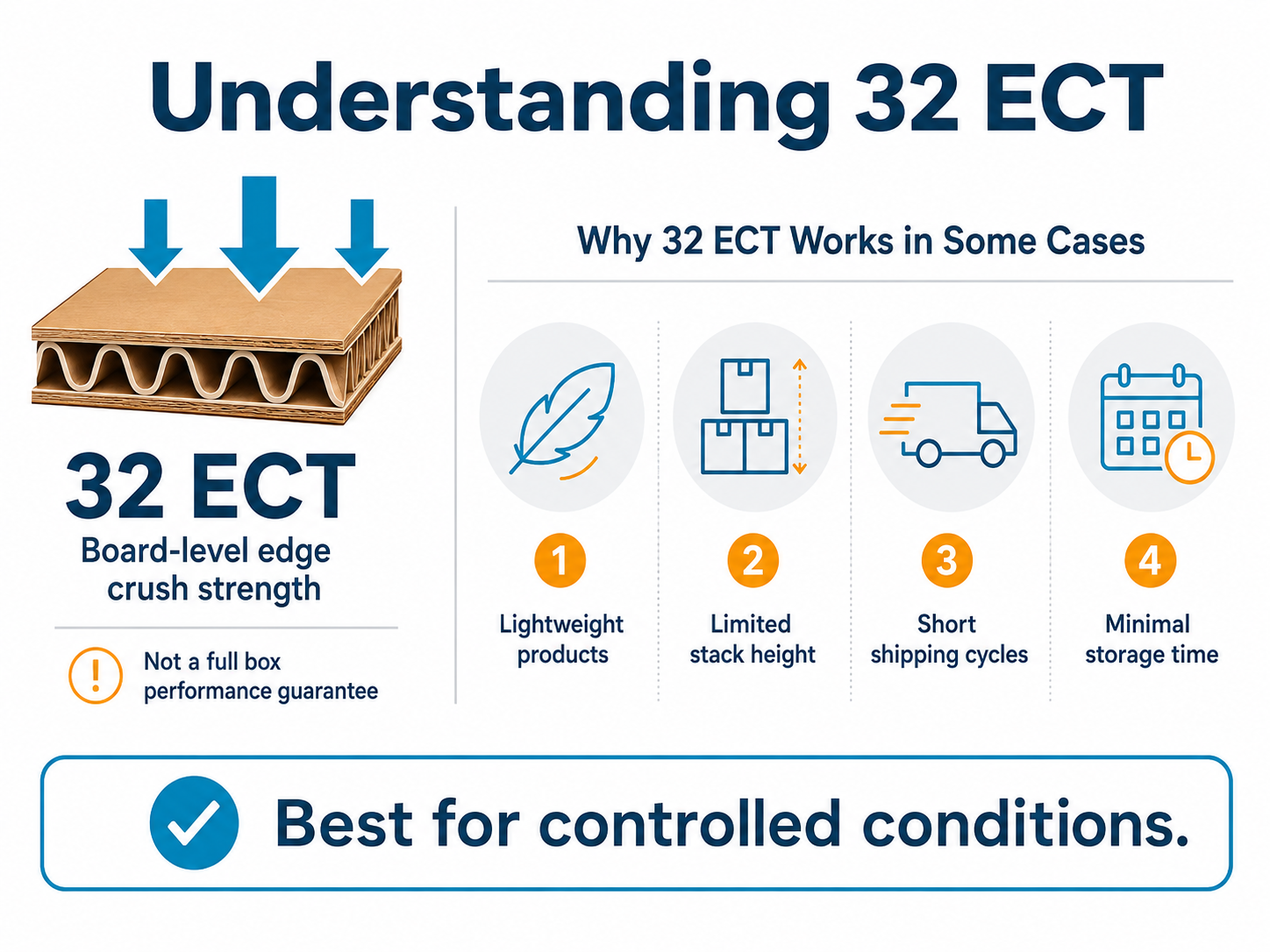
What 32 ECT Actually Means

ECT (Edge Crush Test) measures the stacking strength of corrugated board.

32 ECT indicates the board can withstand 32 pounds of force per inch of edge before crushing.

👉 It is a board-level measurement—not a full box performance guarantee

Why 32 ECT Works in Some Cases

32 ECT performs well when conditions are controlled:

  • Lightweight products
  • Limited stack height
  • Short shipping cycles (e.g., parcel)
  • Minimal storage time

👉 In these environments, 32 ECT is often cost-effective and sufficient

Understanding 32 ECT packaging strength

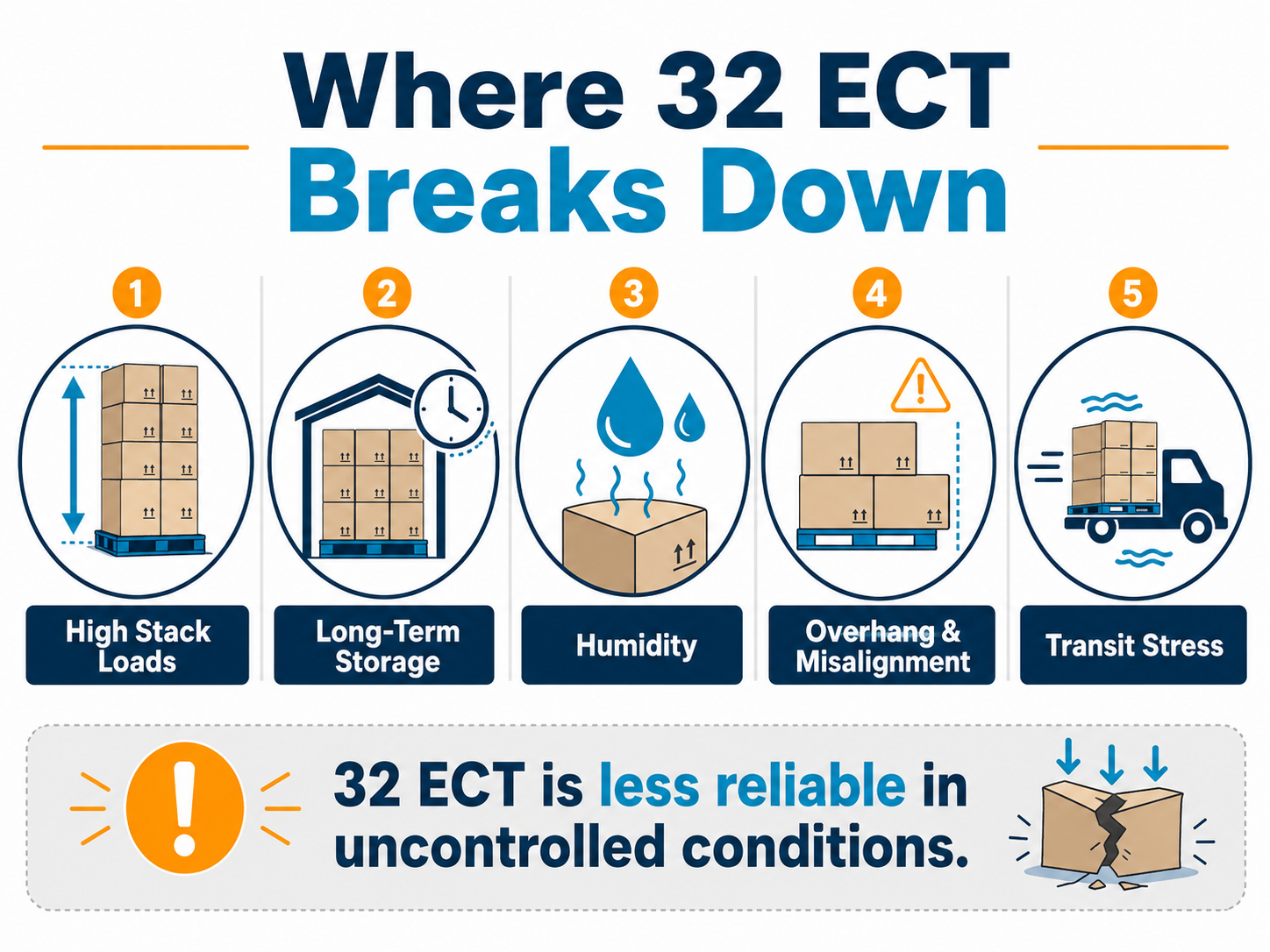
Where 32 ECT Starts to Fail

High Stack Loads

As pallet height increases, bottom boxes تحمل the full load.

  • Increased compression leads to panel deformation and collapse
  • Failure often starts at corners and edges

👉 32 ECT quickly reaches its limit under heavy stacking

Long-Term Storage

Time weakens corrugated under load.

  • Boxes lose strength the longer they remain stacked
  • Static load turns into gradual structural failure

👉 What holds for 1 day may fail over 2–3 weeks

Humidity Exposure

Moisture significantly reduces corrugated strength.

  • Strength loss of 30–50% is common
  • Warehouses and transit environments vary

👉 32 ECT becomes unreliable in uncontrolled conditions

Pallet Overhang & Misalignment

Real-world stacking is rarely perfect.

  • Overhang weakens edge support
  • Misalignment creates point loading

👉 These factors accelerate failure even at moderate loads

Dynamic Shipping Conditions

Movement introduces stress beyond static calculations.

  • Vibration during transit
  • Load shifting in LTL shipments

👉 Repeated stress reduces effective strength over time

32 ECT reliability breakdown infographic

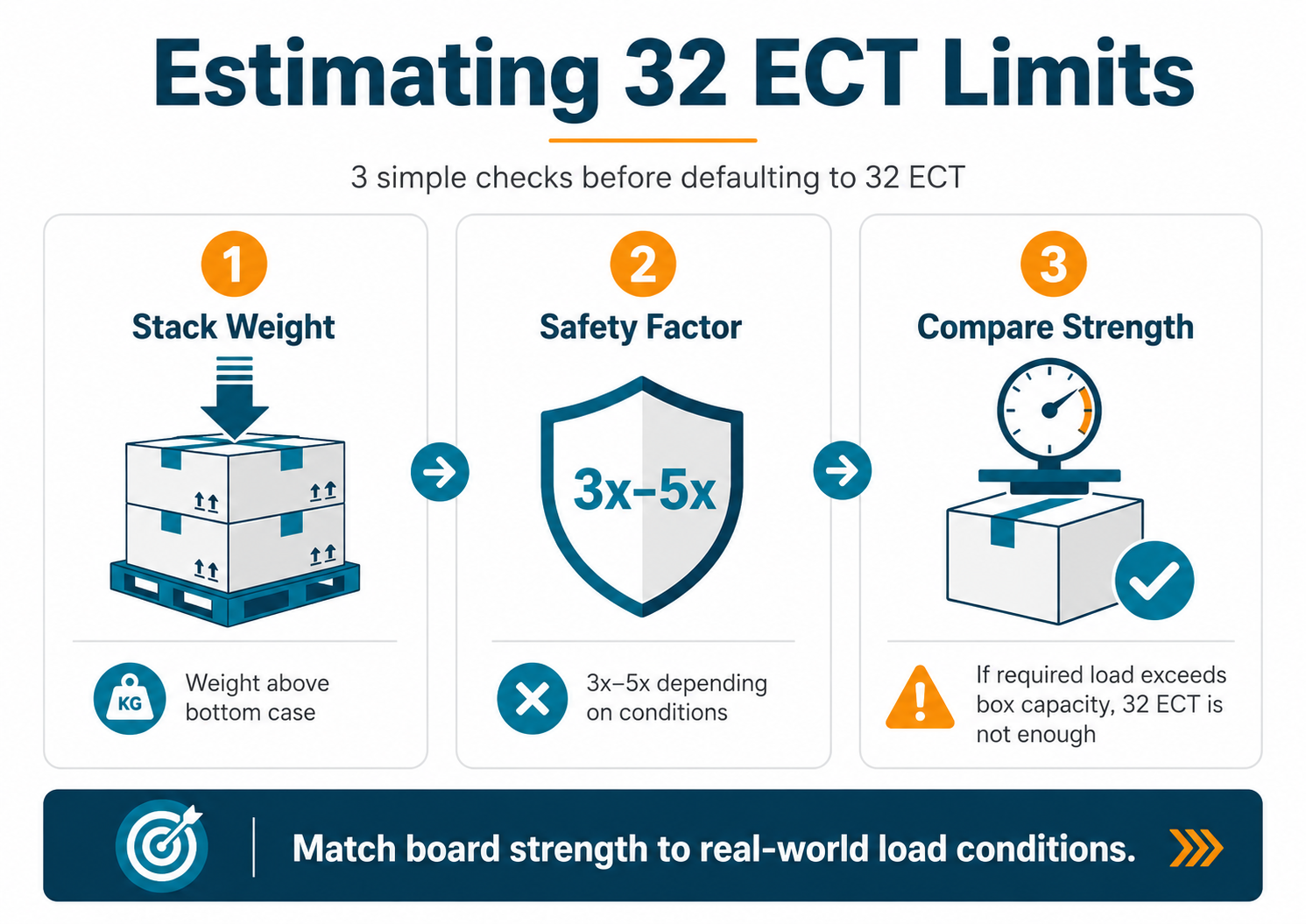
How to Estimate When 32 ECT Is Not Enough

Instead of defaulting to 32 ECT, evaluate actual load conditions:

Step 1: Calculate Total Stack Weight

  • Weight of all boxes above the bottom case

Step 2: Apply a Safety Factor

Typical range:

  • 3x to 5x depending on conditions

Step 3: Compare to Box Compression Strength

If required strength exceeds estimated capacity:

👉 32 ECT is not sufficient for the application

Estimating ECT limits: 3 checks

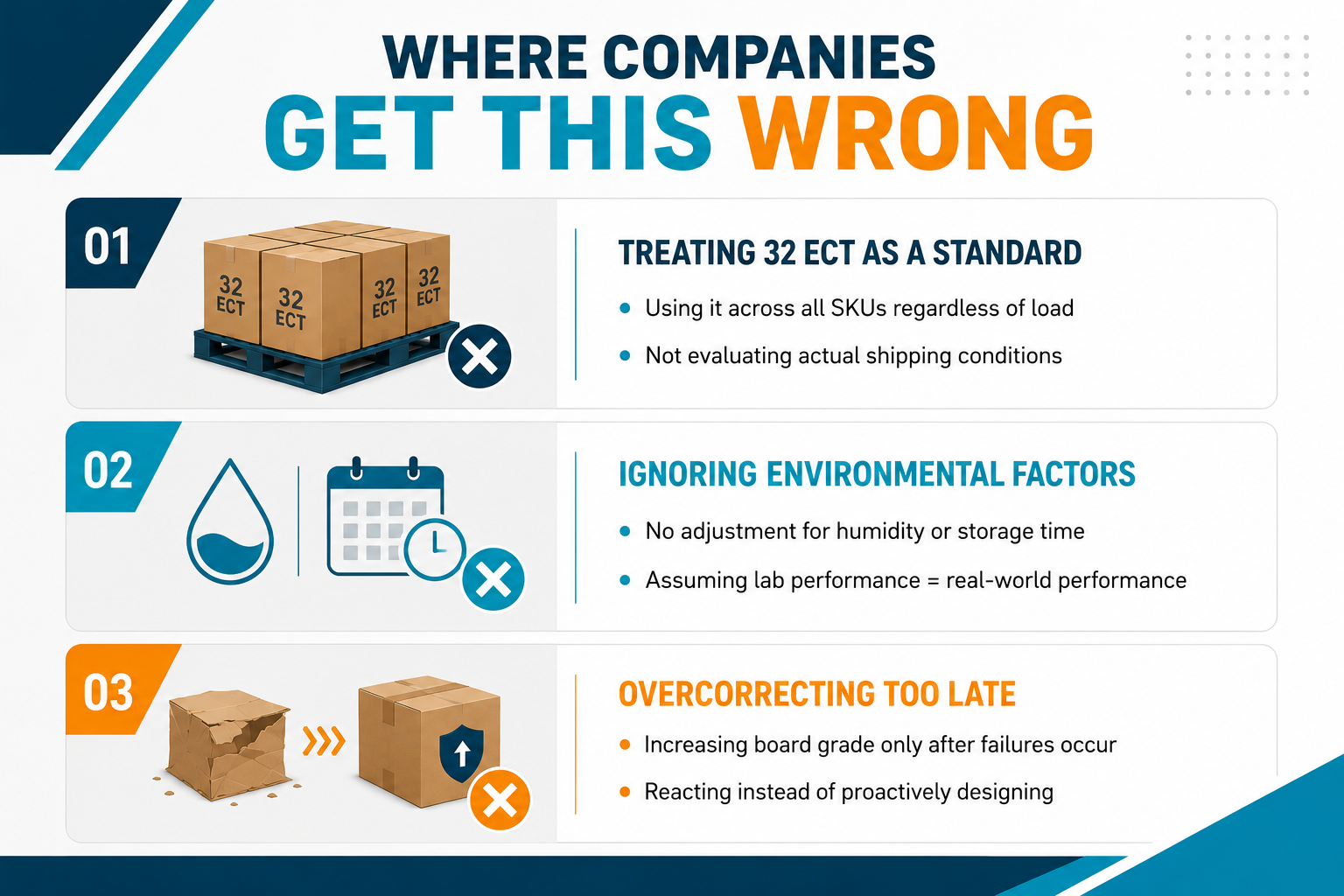
Where Companies Get This Wrong

Treating 32 ECT as a Standard

  • Using it across all SKUs regardless of load
  • Not evaluating actual shipping conditions

Ignoring Environmental Factors

  • No adjustment for humidity or storage time
  • Assuming lab performance = real-world performance

Overcorrecting Too Late

  • Increasing board grade only after failures occur
  • Reacting instead of proactively designing
When 32 ECT corrugated shipping boxes fail

When to Upgrade Beyond 32 ECT

You should consider higher strength (e.g., 44 ECT or double wall) when:

  • Products are heavy
  • Pallets are stacked high or double-stacked
  • Storage duration is extended
  • Environment includes humidity exposure
  • Shipping involves LTL or long transit cycles

When 32 ECT Is Still the Right Choice

32 ECT remains effective when:

  • Loads are controlled
  • Stack heights are limited
  • Shipping cycles are short
  • Products are relatively lightweight

👉 In these cases, higher board grade can be unnecessary cost

What This Means for Cost

32 ECT sits at the center of a common mistake:

  • Too weak → damage, claims, product loss
  • Too strong (overcorrected) → unnecessary material cost

👉 The goal is not to default to 32 ECT—it’s to match strength to actual conditions

Final Takeaway

32 ECT is not a universal standard—it is a specific solution for specific conditions. If you are not evaluating real load, storage, humidity, and shipping factors, you are either risking failure or overpaying to prevent it. Brown Packaging helps companies evaluate actual pallet loads, storage conditions, and transit demands to determine whether 32 ECT is sufficient or if a stronger corrugated solution is needed. The goal is not to default to 32 ECT or automatically upgrade beyond it—it is to match box strength to real-world conditions and total packaging cost.

Most Recent Posts:
Moisture Control in Pet Food Packaging

Excess moisture in pet food packaging can cause mold growth, nutrient degradation, clumping, and product spoilage. Effective moisture control combines barrier material selection, packaging design, and controlled production environments to

Read More »
Subscribe To Our Newsletter

By submitting your information, you agree to our terms and conditions and privacy policy.

custom corrugated box with print, roll end tuck top with cherry locks and dust flaps
Custom Corrugated Boxes
Facebook
Twitter
LinkedIn
Pinterest
Relevant Posts